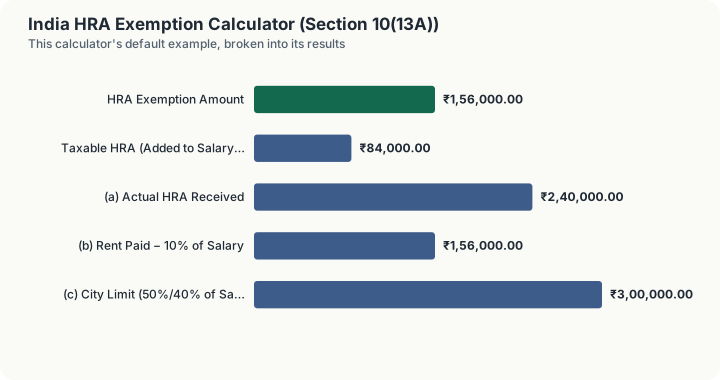
Quick Answer: An Indian taxpayer with ₹6,00,000 annual Basic+DA salary, ₹2,40,000 House Rent Allowance received, and ₹2,16,000 rent actually paid while living in a metro city (Mumbai, Kolkata, Delhi, or Chennai) can claim an HRA exemption of ₹1,56,000 under Section 10(13A) -- leaving ₹84,000 of the HRA received as taxable salary income.
Overview
House Rent Allowance is one of the largest and most commonly misunderstood salary components for Indian taxpayers who opt for the old tax regime. Employers pay HRA as a fixed allowance, but the Income Tax Act does not automatically treat all of it as tax-free -- Section 10(13A), read with Rule 2A of the Income Tax Rules, exempts only the least of three separately computed amounts, and the remainder is added straight back into your taxable salary. Because the formula depends on your actual rent, your salary structure, and even which city you live in, most people either underclaim (assuming the whole HRA is exempt) or overclaim (forgetting the 10%-of-salary floor on rent, or the city-based cap).
This calculator runs all three limbs of the Rule 2A formula side by side for FY2025-26 (AY2026-27), shows you exactly which one is binding, and tells you precisely how much of your HRA is exempt versus taxable -- a genuinely important distinction since claiming more than the actual exemption is a common trigger for tax notices during return processing.
How This Is Calculated
The HRA exemption under Section 10(13A) is the least of the following three amounts, computed annually (or pro-rated for the relevant period if your salary/rent/city changed mid-year):
Here, "Salary" (per Rule 2A's Explanation) means Basic Pay + Dearness Allowance (only the portion that forms part of retirement-benefit computation) + commission received as a fixed percentage of turnover -- it explicitly excludes HRA itself and every other allowance or perquisite. "Metro" for this purpose means exactly four cities named in the rule: Mumbai, Kolkata, Delhi, and Chennai; every other city in India -- including Bengaluru, Hyderabad, Pune, and Ahmedabad -- falls under the 40% non-metro limit, despite what some online sources list as an 8-city "metro" group.
Whatever portion of the actual HRA received exceeds this exempt amount is added to your taxable salary income and taxed at your slab rate:
Critically, this exemption is available only under the old tax regime. Section 115BAC(2) excludes Section 10(13A) for taxpayers who opt into the new regime -- under the new regime, 100% of HRA received is taxable salary, with no exemption computation at all.
Worked Example
Using the calculator's default inputs:
- Basic Salary + DA (Annual): ₹6,00,000
- HRA Received (Annual): ₹2,40,000
- Rent Paid (Annual): ₹2,16,000
- City: Metro (Delhi, in this example)
Step by step:
- (a) Actual HRA received: ₹2,40,000
- (b) Rent paid minus 10% of salary: ₹2,16,000 − (10% × ₹6,00,000 = ₹60,000) = ₹1,56,000
- (c) City limit (50% of salary, metro): 50% × ₹6,00,000 = ₹3,00,000
- Least of the three: ₹1,56,000 (option b is binding)
- Exempt amount: ₹1,56,000. Taxable HRA: ₹2,40,000 − ₹1,56,000 = ₹84,000, added to taxable salary income.
If the same person lived in a non-metro city instead, the city limit in step 3 would drop to 40% × ₹6,00,000 = ₹2,40,000 -- still above ₹1,56,000, so the exemption result would not actually change in this particular example, since option (b) remains the binding constraint either way. The city classification matters most when rent paid is high relative to salary (pushing option (b) up) while salary itself is comparatively low (pulling the city-limit option (c) down) -- see the Frequently Asked Questions below for when that flips.
What This Does Not Account For
- Mid-year changes. If your salary, rent, or city of residence changed partway through the year, the exemption should technically be computed separately for each period and then summed -- this calculator computes a single full-year figure using the annual inputs you provide.
- Multiple rented properties or shared accommodation with split rent receipts across co-tenants, which requires apportioning the rent-paid figure before applying this formula.
- Rent paid to a family member (e.g., a parent). This is legally permissible if the rent is genuinely paid and the recipient declares it as rental income, but it invites closer scrutiny; this calculator does not flag or adjust for that scenario.
- The new tax regime, under which HRA exemption is entirely unavailable -- this calculator assumes you are filing (or comparing against) the old regime. Use the Old vs New Tax Regime Calculator to see whether the old regime is even worth it for your overall numbers.
- Employer-provided rent-free accommodation (a perquisite valued differently under Rule 3, not an HRA cash allowance) is a separate computation entirely, not covered here.
Common Pitfalls
- Assuming the entire HRA received is automatically exempt. It almost never is; the least-of-three rule routinely leaves a meaningful taxable portion, especially for high earners with modest rent.
- Forgetting the 10%-of-salary floor in option (b). Only rent paid above 10% of salary counts toward the exemption -- the first 10% of salary's worth of rent effectively earns no exemption benefit at all.
- Using the wrong 8-city "metro" list. Only Mumbai, Kolkata, Delhi, and Chennai get the 50% limit under the actual rule text; treating Bengaluru or Hyderabad as a "metro" for this specific calculation overstates the exemption.
- Claiming HRA exemption with no rent receipts or rental agreement, or while living in a self-owned house -- without actual rent paid, option (b) collapses toward zero (or below), driving the exemption to nil regardless of how much HRA was received.
- Not recomputing after a mid-year salary hike or rent increase, which shifts all three limbs of the formula and can change which one binds.
Frequently Asked Questions
How much HRA exemption can I claim if I live in Mumbai?
Is HRA exemption available under the new tax regime?
Can I claim HRA exemption if I don't pay any rent?
Is Bengaluru considered a metro city for HRA purposes?
Does DA count toward the "salary" used in this formula?
Can I claim HRA exemption and a home loan deduction in the same year?
Sources
- Section 10(13A), Income-tax Act, 1961. incometax.gov.in/iec/foportal
Also consulted: Rule 2A, Income-tax Rules, 1962 (least-of-three formula, city classification, and the definition of "salary" for this purpose); Section 115BAC(2), Income-tax Act, 1961 (new-regime exclusion of Section 10(13A)); Income Tax Department official portal (incometaxindia.gov.in) -- HRA exemption schedule reference.