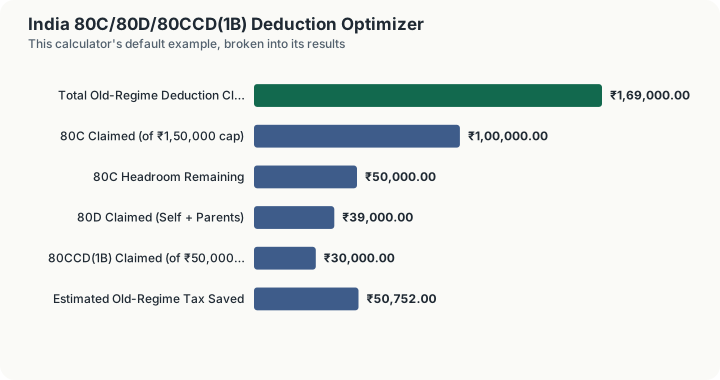
Quick Answer: An old-regime taxpayer earning ₹12,00,000 who claims ₹1,00,000 in Section 80C investments, ₹19,000 in Section 80D health premiums, and ₹30,000 in additional Section 80CCD(1B) NPS contributions gets a total deduction of ₹1,69,000, saving an estimated ₹50,752 in tax versus claiming none of it -- and still has ₹50,000 of unused 80C headroom available before hitting the cap.
Overview
Sections 80C, 80D, and 80CCD(1B) are the three deduction buckets that do the heaviest lifting for old-regime taxpayers, but each has its own separate statutory ceiling, its own age-tiered rules, and its own easy-to-miss traps -- and none of them are available at all if you file under the new tax regime. Section 80C caps out at ₹1,50,000 combined across a long list of instruments (ELSS, PPF, EPF, life insurance, home loan principal, and more); Section 80D's health insurance cap depends on whether you or your parents have crossed 60; and Section 80CCD(1B) offers a genuinely separate ₹50,000 NPS allowance that most people either forget entirely or mistakenly lump into the 80C bucket.
This calculator takes what you've actually contributed or plan to contribute across all three buckets, applies every cap correctly (including the subtle rule that the ₹5,000 preventive-health-checkup allowance sits inside, not on top of, your 80D health-premium cap), and shows you both the total deduction achieved and how much headroom remains -- plus an estimate of the real old-regime tax rupees that deduction actually saves you at your income.
How This Is Calculated
- Section 80C / 80CCE aggregate cap. Your 80C-eligible investments plus any own-contribution NPS amount claimed under Section 80CCD(1) are summed and capped at ₹1,50,000 combined (Section 80CCE) -- you cannot claim more than this across the two put together, regardless of how much you actually invest.
- Section 80D, split into two independent buckets. Self+family premium is capped at ₹25,000 (below 60) or ₹50,000 (60+); parents' premium has its own separate cap using the parents' age, not yours. The ₹5,000 preventive-health-checkup allowance is added into the self+family premium total before applying that same cap -- it is not an additional ₹5,000 on top.
- Section 80CCD(1B), a genuinely separate ₹50,000 bucket. Only NPS contributions not already claimed under 80CCD(1) count here -- you cannot claim the same rupee of NPS contribution in both places.
- Total deduction and estimated tax savings. The three totals are summed, then the calculator computes old-regime tax on your entered income both with and without this total deduction (holding the standard deduction fixed) to show the actual rupee tax impact.
Worked Example
Using the calculator's default inputs:
- Annual Gross Income: ₹12,00,000, filing old regime, below 60
- 80C Investments: ₹1,00,000
- 80D Self+Family Premium: ₹15,000 (not senior) + Preventive Checkup: ₹4,000
- 80D Parents' Premium: ₹20,000 (parents are senior citizens)
- 80CCD(1B) NPS: ₹30,000
Step by step:
- 80C: ₹1,00,000 claimed (well under the ₹1,50,000 cap) → ₹50,000 of headroom remains.
- 80D self+family: ₹15,000 + ₹4,000 = ₹19,000, under the ₹25,000 cap (not senior) → ₹19,000 claimed.
- 80D parents: ₹20,000, under the ₹50,000 senior-citizen cap → ₹20,000 claimed. Total 80D: ₹39,000.
- 80CCD(1B): ₹30,000, under the ₹50,000 cap → ₹30,000 claimed.
- Total deduction: ₹1,00,000 + ₹39,000 + ₹30,000 = ₹1,69,000
- Tax impact: Old-regime tax on ₹11,50,000 taxable (after the ₹50,000 standard deduction) without these deductions is ₹1,63,800; with ₹1,69,000 more deducted, taxable income falls to ₹9,81,000 and tax falls to ₹1,13,048 -- a saving of ₹50,752.
Maxing out all three buckets entirely (₹1,50,000 + ₹25,000 self + ₹50,000 senior parents + ₹50,000 NPS = ₹2,75,000 total) at the same income pushes the estimated savings up to ₹72,800.
What This Does Not Account For
- Section 80CCD(2) (employer NPS contribution), which is a completely separate, uncapped-by-this-tool deduction available under both old and new regimes -- not part of this calculator's three buckets.
- Other Chapter VI-A deductions outside these three sections -- Section 80E (education loan interest), 80EEA/80EE (specific home loan interest), 80G (donations), 80TTA/80TTB (savings/senior-citizen interest), and others are not modeled here.
- Section 24(b) home loan interest, a separate (non-Chapter-VI-A) deduction against house property income, not part of the 80C/80D/80CCD(1B) framework this calculator focuses on.
- The new tax regime, under which none of these three deductions are available at all (aside from 80CCD(2)); this calculator assumes an old-regime filer. Compare regimes overall with the Old vs New Tax Regime Calculator.
- Documentation and proof-of-payment requirements for each instrument (e.g., premium receipts, PPF passbook, ELSS statement) -- this tool computes the deduction math only, not compliance.
Common Pitfalls
- Double-counting NPS contributions across 80CCD(1) and 80CCD(1B). Only contributions not already claimed under 80CCD(1) -- which itself sits inside the shared 80C/80CCE ₹1,50,000 cap -- can go into the separate ₹50,000 80CCD(1B) bucket.
- Treating the preventive-health-checkup allowance as an extra ₹5,000 on top of the 80D premium cap. It is not additional; it consumes part of the same self+family cap.
- Using the wrong age for the parents' 80D cap. The parents' bucket uses the parents' age (60+ or not), completely independent of whether you or your spouse have crossed 60.
- Assuming unused 80C headroom carries forward. It does not -- any 80C cap headroom not used within the financial year is simply lost; there is no carryforward to a future year.
- Forgetting these deductions vanish entirely under the new regime. If you're comparing tax regimes, factor in that switching to the new regime for a marginal rate-slab benefit also forfeits all of this deduction value at once.
Frequently Asked Questions
What is the maximum I can claim between 80C, 80D, and 80CCD(1B) combined?
Is the ₹50,000 NPS deduction under 80CCD(1B) different from my regular NPS contribution?
Can I claim 80D for my in-laws' health insurance?
Does the preventive health checkup limit apply per person or per family?
Are these deductions available under the new tax regime?
Do I lose unused 80C or 80D headroom if I don't use it by March 31?
Can I split my 80C investment across multiple instruments (ELSS, PPF, insurance) rather than putting it all in one?
If I'm self-employed with no employer, can I still claim 80CCD(1B) for my own NPS contribution?
Sources
- Section 80CCE, Income-tax Act, 1961 (aggregate ₹1,50,000 cap across 80C+80CCC+80CCD(1)). incometax.gov.in/iec/foportal
Also consulted: Section 80D, Income-tax Act, 1961, as amended by Finance Act 2018 (age-tiered caps); Section 80CCD(1B), Income-tax Act, 1961 (additional ₹50,000 NPS deduction); Section 115BAC(2), Income-tax Act, 1961 (new-regime exclusion of these deductions, except 80CCD(2)).