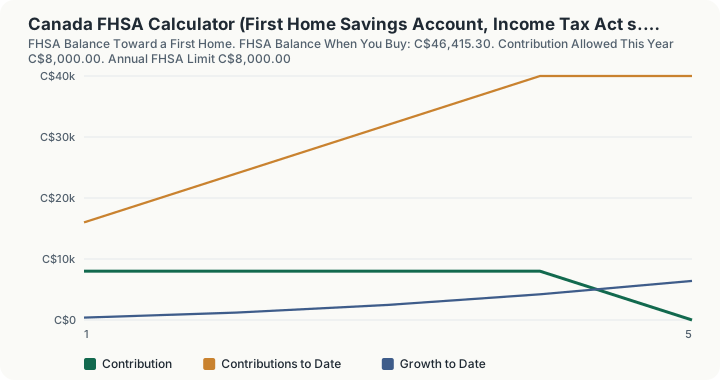
Quick Answer: An FHSA opened with C$8,000 now and topped up for four more years reaches C$46,415.30 by a purchase five years out, at a 5% return. That is C$40,000 of contributions, which exhausts the entire lifetime limit, plus C$6,415.30 of growth. The deduction generates C$12,200.00 of tax refunds at a 30.5% combined marginal rate along the way, so the account produces C$18,615.30 more than the same money saved in a taxable account with no relief. All figures are in Canadian dollars.
What does this calculator do?
The First Home Savings Account is the only registered account in Canada that is deductible going in and tax-free coming out. An RRSP gives you the deduction but taxes the withdrawal. A TFSA gives you the tax-free withdrawal but no deduction. The FHSA, under Income Tax Act s. 146.6, gives you both, which makes it strictly better than either for money genuinely destined for a first home.
The limits are stated in the Act and are not indexed. The annual limit is C$8,000. Unused room carries forward, but the carryforward is itself capped at C$8,000, so the most anyone can ever contribute in a single year is C$16,000, no matter how long the account sat empty. The lifetime limit is C$40,000, measured across every FHSA you hold.
One rule catches almost everyone: room does not begin accruing until you OPEN an account. This is the opposite of the TFSA, where room accumulates from age 18 whether or not you have ever held one. That makes opening an FHSA early, even with a nominal contribution, the single most valuable thing an eventual first-time buyer can do, because it starts the carryforward clock.
The account is also time-limited. The maximum participation period runs to the end of the year following the earliest of the 14th anniversary of first opening an FHSA, the year you turn 70, and your first qualifying withdrawal. If you never buy, the balance can be transferred to an RRSP or RRIF without using RRSP room, which makes the downside of opening one very small.
How is this calculated?
Step 1: determine the carryforward, capped at C$8,000.
c = min(8,000, Unused Room)
Step 2: form this year's annual FHSA limit.
L_annual = 8,000 + c
Step 3: find the lifetime room remaining.
L_life = 40,000 − Prior Contributions
Step 4: take the least of the plan and both limits.
A = min(Planned, L_annual, L_life)
Step 5: value the deduction at your combined marginal rate.
Refund = A × (r_fed + r_prov)
Step 6: project forward. The allowed contribution goes in first, then each projected year adds C$8,000 if lifetime room remains, and the balance compounds through the shared time-value-of-money solver, one ordinary-annuity year per iteration.
Worked Example
Using the page defaults: no carryforward, no prior contributions, C$8,000 planned this year, four further contribution years, five years until purchase, a 5% return, and combined marginal rates of 20.5% federal and 10% provincial.
Step 1: this year's annual limit. No carryforward, so the base amount alone. C$8,000
Step 2: the contribution allowed. C$8,000 planned fits under both the annual and the C$40,000 lifetime limit. C$8,000
Step 3: this year's tax refund. C$8,000 at the 30.5% combined marginal rate. C$2,440.00
Step 4: the net cost of contributing. C$8,000 less the refund. C$5,560.00
Step 5: year one. C$8,000 grows at 5% to C$8,400, then another C$8,000 goes in. C$16,400.00
Step 6: year two. C$16,400 grows to C$17,220, plus C$8,000. C$25,220.00
Step 7: year three. C$25,220 grows to C$26,481, plus C$8,000. C$34,481.00
Step 8: year four. C$34,481 grows to C$36,205.05, plus the final C$8,000, which exhausts the C$40,000 lifetime limit. C$44,205.05
Step 9: year five. No lifetime room remains, so the balance simply grows at 5%. C$46,415.30
Step 10: total investment growth. C$46,415.30 less the C$40,000 contributed. C$6,415.30
Step 11: total tax refunds. C$40,000 of contributions at 30.5%. C$12,200.00
Every dollar of that C$46,415.30 comes out tax-free on a qualifying withdrawal, and the C$12,200 of refunds is money you never had to earn twice.
What does this calculator not account for?
- Marginal rates are inputs and were not verified. The federal bracket thresholds are indexed annually under s. 117.1 and are not stated in the Act, and provincial rates have no national value.
- The deduction is assumed usable in full, in the year of contribution. In reality the FHSA deduction can be carried forward and claimed in a later, higher-income year, which is often the better move for a student or early-career saver. This page values every contribution at the single rate you enter.
- The projection assumes a flat C$8,000 every future year. Unlike the TFSA limit, the FHSA annual limit is a fixed statutory amount rather than an indexed one, so this assumption is more defensible here than it would be for a TFSA. It still assumes Parliament does not amend s. 146.6.
- The maximum participation period is not enforced. The Act ends the period at the end of the year following the earliest of the 14th anniversary of opening, the year you turn 70, and your first qualifying withdrawal. This page lets you project up to 15 years and does not check your age.
- Qualifying individual status is not tested. Section 146.6 requires you to be resident in Canada, at least 18, and not to have lived in a home you or a spouse owned at any time in the calendar year or the four preceding calendar years. This page assumes you qualify.
- The qualifying withdrawal conditions are not tested either. They include a written request specifying the home, a written agreement to acquire it before 1 October of the following year, and acquisition no more than 30 days before the withdrawal. A withdrawal that fails these is fully taxable.
- No RRSP transfer modelling. Transfers in from an RRSP use FHSA room but generate no deduction, and unused balances can move to an RRSP or RRIF at the end of the period without using RRSP room. Neither path is modelled.
- No return volatility. A single fixed rate over five years is a planning figure, not a forecast, and a short horizon argues for a conservative one.
What mistakes do people make with this?
- Waiting to open the account until you are ready to save. Room starts accruing only when you open an FHSA, unlike the TFSA. Opening one early with a token amount starts the carryforward and costs almost nothing.
- Expecting more than one year of carryforward. The carryforward is capped at C$8,000, so three empty years still leave you at a C$16,000 maximum, not C$32,000.
- Contributing before 31 December and expecting a first-60-days rule. FHSA contributions must be made in the calendar year to be deducted for that year. The RRSP first-60-days rule does not apply.
- Claiming the deduction immediately at a low income. The deduction can be carried forward indefinitely. A student contributing at a 20% rate who will earn at 40% in three years is better off holding the deduction.
- Assuming the FHSA replaces the Home Buyers Plan. It does not. Both can be used on the same purchase, and the FHSA money never has to be repaid while the Home Buyers Plan money does.
Frequently Asked Questions
How much can I put in an FHSA each year?
Is an FHSA better than a TFSA or an RRSP for a first home?
When does FHSA contribution room start accruing?
What happens if I never buy a home?
Can I use the FHSA and the Home Buyers Plan on the same purchase?
Sources
- Income Tax Act, R.S.C. 1985, c. 1 (5th Supp.), s. 146.6, First Home Savings Account: the definitions of "FHSA carryforward" (the least of C$8,000 and unused room), "annual FHSA limit", "lifetime FHSA limit" (C$40,000), "qualifying individual", "maximum participation period" and "qualifying withdrawal". Justice Laws Website, read 2026-08-31; Act current to 2026-06-21, last amended 2026-06-18. laws-lois.justice.gc.ca/eng/acts/I-3.3/section-146.6.html
- Income Tax Act, s. 146.01, the Home Buyers' Plan, referenced above as the separate measure that can fund the same purchase. Justice Laws Website, read 2026-08-31. laws-lois.justice.gc.ca/eng/acts/I-3.3/section-146.01.html
- Income Tax Act, s. 117(2), the federal marginal rates at which the FHSA deduction is valued. Justice Laws Website, read 2026-08-31. laws-lois.justice.gc.ca/eng/acts/I-3.3/section-117.html
Also consulted: Provincial and territorial marginal rates are set in each province's own legislation and have no national value, so they are user inputs.