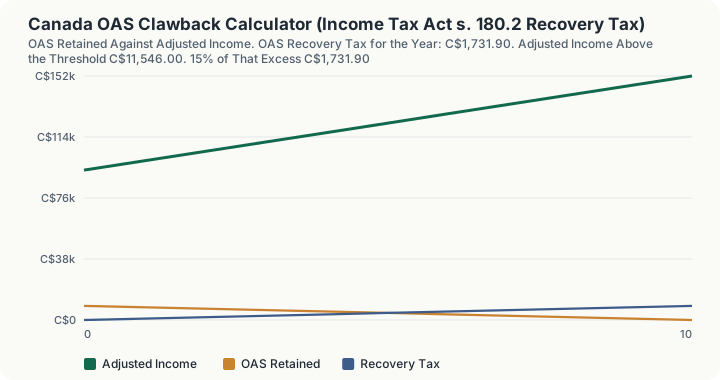
Quick Answer: C$105,000 of adjusted income against the C$93,454 recovery threshold for 2025 income triggers C$1,731.90 of Income Tax Act s. 180.2 recovery tax, 15% of the C$11,546 excess. That is less than the C$8,800 benefit itself, so C$7,068.10 of OAS is retained and next year's payments drop by C$144.33 a month. The entire benefit would be gone at C$152,120.67 of adjusted income. All figures are in Canadian dollars.
What does this calculator do?
Old Age Security is not means-tested at the door. Everyone who qualifies receives it, and then Part I.2 of the Income Tax Act takes some or all of it back through a separate tax on higher-income recipients. Section 180.2 calls it a recovery tax; almost everyone else calls it the clawback.
The mechanism is simple and unusually harsh. Once adjusted income passes a threshold, fifteen cents of OAS is recovered for every dollar above it. That 15% sits on top of your ordinary federal and provincial income tax, so a retiree in the recovery range faces a combined effective marginal rate that can exceed sixty percent. It is, for many Canadians, the highest marginal rate they will ever face, and it arrives at exactly the point in life when people assume their rates are falling.
The recovery is capped: the amount taken is the lesser of the 15% computation and the OAS actually included in income, so it can never exceed the benefit and never turns into a bill for someone receiving no OAS. Once the 15% figure reaches the benefit, the benefit is simply gone and further income costs nothing more under this provision.
One timing detail catches people out. The recovery is not deducted from the year's payments. It is assessed on that year's income and then collected by reducing the FOLLOWING benefit year's monthly payments, running July through June. A single high-income year therefore hits the pension a year later.
How is this calculated?
Step 1: find the excess over the threshold. Adjusted income above the s. 180.2 threshold, floored at nil:
E = max(0, Adjusted Income − T)
Step 2: apply the statutory 15% rate. This is subparagraph (ii) of element A in the s. 180.2 formula:
A_ii = 0.15 × E
Step 3: take the lesser of that and the benefit. Element A is the lesser of the OAS included in income and the 15% computation:
Recovery = min(A_ii, OAS)
Step 4: find what is retained and the monthly effect.
Retained = OAS − Recovery; Monthly = Recovery/12
Step 5: find the income at which the whole benefit disappears.
T_full = T + OAS/0.15
Worked Example
Using the page defaults: C$105,000 of adjusted income, C$8,800 of OAS received, and the C$93,454 threshold.
Step 1: find the income above the threshold. C$105,000 less C$93,454. C$11,546
Step 2: apply the statutory 15% recovery rate. C$11,546 at 15%. C$1,731.90
Step 3: compare to the OAS received. C$1,731.90 against C$8,800.00, and the recovery is the lesser. C$1,731.90
Step 4: OAS retained. C$8,800.00 less C$1,731.90. C$7,068.10
Step 5: monthly reduction to next year's payments. C$1,731.90 divided by 12. C$144.33
Step 6: income at which the benefit would be entirely gone. C$8,800 divided by 0.15 is C$58,666.67, added to the C$93,454 threshold. C$152,120.67
Step 7: the share of the benefit recovered. C$1,731.90 divided by C$8,800. 19.68%
Ten thousand dollars of additional income anywhere inside that range costs exactly C$1,500 of OAS, on top of the ordinary income tax on the same money.
What does this calculator not account for?
- The threshold changes every year. The default is C$93,454, the threshold for 2025 income that sets recovery from July 2026 to June 2027. For 2026 income (recovered July 2027 to June 2028) the Government of Canada's estimate is C$95,323. Enter the threshold for the income year you are checking.
- The OAS payment amount is also a user input. OAS is set under the Old Age Security Act and adjusted quarterly for inflation, and it is higher for recipients aged 75 and over. The Income Tax Act does not state it, so this page asks rather than assumes.
- This models a Canadian resident only. Element B of the s. 180.2 formula is the Part XIII withholding rate that applies to a non-resident recipient. For a resident that element is nil and the recovery is simply element A, which is what this page computes. A non-resident case is out of scope.
- The recovery is not the same as your income tax. The OAS you receive is also ordinary taxable income and attracts federal and provincial tax in the normal way. This page computes only the Part I.2 recovery, not the income tax on the benefit.
- Adjusted income is not derived from components. Section 180.2(1) defines it as income under Part I with certain amounts added back and others excluded. You enter the figure; the page does not build it for you.
- No modelling of income splitting, pension splitting, or the Guaranteed Income Supplement, and no treatment of the deferral option that raises the benefit for each month OAS is postponed past 65.
What mistakes do people make with this?
- Using net income when the test is adjusted income. They are close but not identical, and the difference can matter right at the threshold.
- Forgetting that dividends count at their grossed-up amount. A C$25,000 eligible dividend adds C$34,500 to income for this test, not C$25,000. That C$9,500 of phantom income is worth C$1,425 of extra recovery, and it is the single most common way a retiree stumbles into the clawback without receiving any more cash.
- Being surprised a year later. The recovery is assessed on this year's income and collected out of next year's monthly payments. A one-off RRIF withdrawal or property sale reduces the pension in the following benefit year, not the current one.
- Assuming the recovery is capped at some percentage. It is capped at the benefit itself, not at a share of it. Above roughly C$151,667 in the default case, the whole pension is gone.
- Ignoring the stacking effect. Fifteen percent on top of a combined income tax rate that may already be forty-something percent produces an effective marginal rate most people would not believe if you told them. Planning to avoid the range is often worth more than optimizing anything else in a retirement year.
Frequently Asked Questions
What income triggers the OAS clawback?
Is the clawback rate really 15%?
Can the clawback take more than my OAS?
When is the recovery actually collected?
How can I reduce the recovery?
Sources
- Income Tax Act, R.S.C. 1985, c. 1 (5th Supp.), s. 180.2, the Part I.2 Old Age Security recovery tax: the definition of adjusted income, the A(1 - B) formula, the 15% rate, and the lesser-of structure that caps the recovery at the benefit. Justice Laws Website, read 2026-08-31; Act current to 2026-06-21, last amended 2026-06-18. laws-lois.justice.gc.ca/eng/acts/I-3.3/section-180.2.html
- Government of Canada, Old Age Security pension recovery tax: minimum income recovery thresholds by income year (C$93,454 for 2025 income; C$95,323 estimated for 2026). canada.ca/en/services/benefits/publicpensions/old-age-security/recovery-tax.html
Also consulted: Income Tax Act, s. 117.1, the annual indexation provision that re-values the s. 180.2 threshold. The OAS pension amount itself is set under the Old Age Security Act, R.S.C. 1985, c. O-9, and adjusted quarterly, so it is a user input.