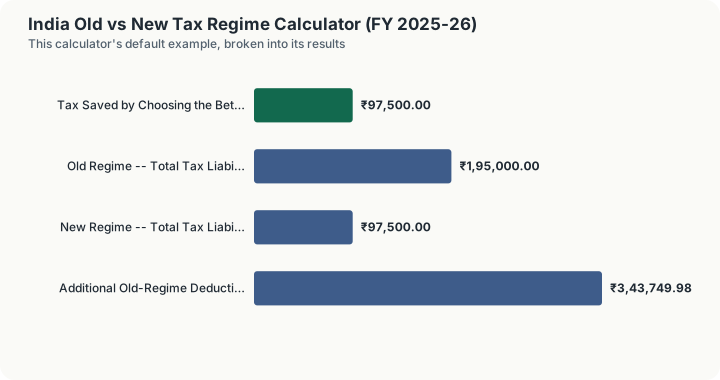
Quick Answer: For an Indian taxpayer earning ₹15,00,000 in FY2025-26 (AY2026-27) with ₹2,00,000 of old-regime deductions, the New Tax Regime wins, with a total tax liability of ₹97,500 versus ₹1,95,000 under the Old Regime -- a saving of ₹97,500. To make the Old Regime break even at this income, you would need ₹3,43,750 in additional old-regime deductions (80C, 80D, HRA, home loan interest, etc.), for a total of ₹5,43,750.
Overview
Every Indian taxpayer filing for Financial Year 2025-26 (Assessment Year 2026-27) must choose between two parallel income-tax systems: the New Tax Regime under Section 115BAC of the Income-tax Act, 1961 (the default regime unless you actively opt out), and the Old Tax Regime, which retains the traditional deductions and exemptions (Section 80C, 80D, HRA, home loan interest, and dozens more) in exchange for higher slab rates. There is no single "better" regime -- the right answer depends entirely on how much you can genuinely claim in old-regime deductions relative to your income.
This calculator computes your exact total tax liability -- tax plus surcharge plus the 4% Health & Education Cess -- under both regimes side by side for FY2025-26/AY2026-27, tells you which one wins and by how much, and then runs a breakeven search to answer the question salaried taxpayers ask every single filing season: "how much more would I need in deductions for the Old Regime to actually pay off?" If you're deciding between maximizing HRA and 80C claims versus taking the simpler new-regime path, this number is the one that actually settles it.
How This Is Calculated
- Compute taxable income under each regime. Old regime taxable income subtracts the ₹50,000 standard deduction and your entered old-regime deductions from gross income. New regime taxable income subtracts only the ₹75,000 standard deduction (effective FY2025-26 onward), since most Chapter VI-A deductions are disallowed under Section 115BAC(2).
- Apply each regime's own slab rates. New regime slabs run 0% up to ₹4,00,000, then 5%/10%/15%/20%/25%/30% in ₹4,00,000 steps up to ₹24,00,000 and above. Old regime slabs (for those below 60) run 0% up to ₹2,50,000, 5% to ₹5,00,000, 20% to ₹10,00,000, and 30% above that, with higher basic exemptions for senior (₹3,00,000) and super senior (₹5,00,000) citizens.
- Apply Section 87A rebate with marginal relief. New regime: a full rebate up to ₹60,000 wipes out tax entirely for total income up to ₹12,00,000, with marginal relief so crossing that line by a small amount never costs more tax than the excess itself. Old regime: the same mechanic caps out at ₹12,500 rebate up to ₹5,00,000 total income.
- Add surcharge (only above ₹50 lakh) and 4% cess. Surcharge is a flat percentage of tax based on income slab (10%/15%/25%, capped there under the new regime; old regime adds a 37% tier above ₹5 crore), each with its own marginal relief at the threshold. The 4% Health & Education Cess applies to (tax + surcharge) under both regimes, with no relief on the cess itself.
- Find the breakeven deduction. Since old-regime tax falls (or stays flat) as claimed deductions rise, the calculator runs a numerical search to find the minimum additional old-regime deduction -- on top of what you already entered -- needed to make the old regime's total liability no worse than the new regime's, at your same gross income.
Worked Example
Using the calculator's default inputs:
- Annual Gross Income: ₹15,00,000
- Total Old-Regime Deductions: ₹2,00,000
- Age Category: Below 60
Old Regime: 1. Taxable income: ₹15,00,000 − ₹50,000 − ₹2,00,000 = ₹12,50,000 2. Tax: 0% on the first ₹2.5L, 5% on ₹2.5L-5L (₹12,500), 20% on ₹5L-10L (₹1,00,000), 30% on the remaining ₹2.5L (₹75,000) = ₹1,87,500 3. Income far exceeds the ₹5,00,000 rebate threshold, so no 87A rebate applies. 4. No surcharge (income under ₹50 lakh). Cess: 4% × ₹1,87,500 = ₹7,500. 5. Total old-regime tax: ₹1,95,000
New Regime: 1. Taxable income: ₹15,00,000 − ₹75,000 = ₹14,25,000 2. Tax: 0% on the first ₹4L, 5% on ₹4L-8L (₹20,000), 10% on ₹8L-12L (₹40,000), 15% on the remaining ₹2.25L (₹33,750) = ₹93,750 3. Income exceeds the ₹12,00,000 rebate threshold by more than the tax itself, so no 87A rebate applies here either. 4. No surcharge. Cess: 4% × ₹93,750 = ₹3,750. 5. Total new-regime tax: ₹97,500
Result: The new regime wins by ₹97,500. To make the old regime break even at this income, deductions would need to rise from ₹2,00,000 to ₹5,43,750 -- pushing old-regime taxable income down to ₹9,06,250, the point where old-regime tax (before cess) equals ₹93,750.
What This Does Not Account For
- Section 80CCD(2) employer NPS contributions. This is the one Chapter VI-A deduction available under BOTH regimes (14% of basic+DA salary for government employers, 10% under the old regime or 14% under the new regime for private employers). It is not included in this calculator's "Old-Regime Deductions" input since it would apply symmetrically to some degree under either regime; add it to your own comparison if your employer contributes to NPS on your behalf.
- Capital gains, lottery winnings, and other income taxed at special flat rates rather than slab rates are not modeled here; this calculator assumes your entire taxable income is regular slab-rate income.
- TDS already deducted, advance tax paid, or interest under Sections 234A/234B/234C are not netted against the totals shown; those affect your final payment/refund timing, not the underlying regime comparison. See the companion Advance Tax Calculator for that.
- State-level professional tax and any surcharge-adjacent cess beyond the 4% Health & Education Cess are not included.
- The one-opt-in-per-lifetime restriction for taxpayers with business/professional income who switch back into the new regime after opting out via Form 10-IEA; this calculator only compares tax outcomes, not the procedural switching rules.
Common Pitfalls
- Assuming the new regime always wins because it's the default. It is only mathematically better once your real, usable old-regime deductions fall below the breakeven point this calculator finds -- high-HRA renters in metro cities with a home loan and maxed-out 80C/80D routinely still come out ahead in the old regime.
- Forgetting the new regime disallows HRA, 80C, 80D, and most other Chapter VI-A deductions. Only the standard deduction and Section 80CCD(2) survive; comparing "gross income" apples-to-apples without adjusting for this is the single most common modeling mistake.
- Ignoring marginal relief near the ₹12,00,000 (new) or ₹5,00,000 (old) rebate cliffs. Earning ₹1 over either threshold does not suddenly cost the full un-rebated tax bill; marginal relief caps the increase at the amount of income by which you exceeded the threshold.
- Not re-running the comparison every year. Because the new regime's slabs, standard deduction, and rebate threshold have all moved in recent Finance Acts, a comparison done for last year's numbers can be stale -- always use the current FY's figures.
- Treating the breakeven deduction figure as a target to blindly chase. Contributing more to 80C/NPS purely to "beat" the new regime only makes sense if you would make that investment anyway; the tax saving should not be the only reason to lock money into ELSS, PPF, or insurance.
Frequently Asked Questions
Which is better, old or new tax regime, for FY 2025-26?
Is the new tax regime automatically applied if I don't choose?
How much extra deduction do I need for the old regime to make sense?
Does the new regime allow any deductions at all?
I'm a senior citizen -- does that change which regime is better?
Can I switch regimes every year?
Sources
- Income Tax Department official portal (incometax.gov.in) -- "Salaried Individuals," "Senior Citizens and Super Senior Citizens," and "Individual having Income from Business/Profession" help pages for AY2026-27. incometax.gov.in/iec/foportal
Also consulted: Finance Act, 2025 (Act No. 7 of 2025) -- Sections 20 and 25, amending Sections 87A and 115BAC(1A), and the First Schedule, Part III; Finance (No. 2) Act, 2024 -- amendment to Section 16(ia), raising the new-regime standard deduction to ₹75,000; Union Budget 2026-27, Finance Bill 2026 Memorandum (indiabudget.gov.in) -- confirms all FY2025-26 rates, thresholds, and the new-regime 25% surcharge cap carry forward unchanged into FY2026-27.