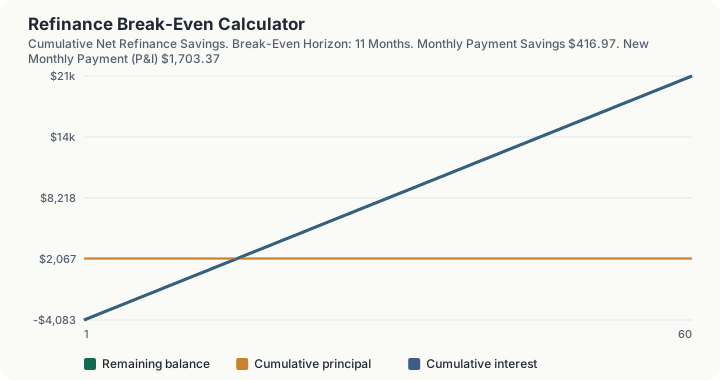
Quick Answer: Refinancing a $300,000 balance from 7.0% to 5.5% with $4,500 in closing costs saves $416.97 a month, so the upfront cost is fully recovered in 11 months, after which every additional month in the home is pure savings.
Overview
Refinancing lowers your rate, but it never happens for free. Closing costs, origination fees, title insurance, and appraisal charges typically run somewhere between 2% and 6% of the new loan amount, and that cash outlay only pays for itself if you keep the loan long enough for the lower monthly payment to catch up to what you spent getting it. The number of months required to reach that crossover point is the break-even horizon, and it is the single most useful number in deciding whether a refinance is actually worth doing, more useful than the rate drop by itself.
A lender pitching a refinance will usually lead with the rate improvement and the monthly savings, both of which sound good in isolation. What that pitch often skips is how the new loan's term interacts with the old one. Resetting the amortization clock, for example refinancing 25 remaining years on the original loan into a fresh 30-year term, can produce a monthly payment reduction that looks larger than it really is, because part of the "savings" comes from stretching the payoff further into the future rather than from the lower rate alone. This calculator isolates both effects: the pure payment comparison, the break-even month count, and the net lifetime savings once the reset term is factored in.
How This Is Calculated
- Current loan payment. The existing balance is amortized at the current rate over the remaining term to determine what the borrower is paying today:
currentMonthlyPayment = amortize(balance, currentRate, remainingMonths). - New loan payment. The same balance is re-amortized at the new rate over the new loan's full term:
newMonthlyPayment = amortize(balance, newRate, newTermMonths). - Monthly savings. The difference between the two payments is the recurring monthly benefit:
monthlySavings = currentMonthlyPayment − newMonthlyPayment. - Break-even month. Closing costs are divided by the monthly savings and rounded up to the next whole month:
breakEvenMonths = ceiling(closingCosts / monthlySavings). This is the point at which cumulative savings first exceed the upfront cost. - Lifetime savings. Total cost under the current loan (
currentMonthlyPayment × remainingMonths) is compared against total cost under the new loan plus closing costs (newMonthlyPayment × newTermMonths + closingCosts), and the difference is the net savings or cost of refinancing over the full remaining life of both loans, not just the break-even window.
Worked Example
Scenario 1: Standard rate reduction. A borrower with a $300,000 balance, 7.0% current rate, and 300 months (25 years) remaining refinances into a new 30-year loan at 5.5% with $4,500 in closing costs.
- Current monthly payment: $2,120.34
- New monthly payment: $1,703.37
- Monthly savings: $416.97
- Break-even point: 11 months
- Net lifetime savings: $18,388.80 or more once the full term is compared
Scenario 2: Lower-cost refinance. Same rate and balance, but closing costs are negotiated down to $2,000 instead of $4,500.
- Monthly savings: $416.97 (unchanged, since the loan terms are identical)
- Break-even point: 5 months
Cutting closing costs from $4,500 to $2,000 does not change the monthly payment savings at all, but it more than doubles how quickly those savings become net-positive, since the break-even calculation only divides the same $416.97 monthly figure into a smaller upfront number.
Scenario 3: Refinance into a shorter term. A $250,000 balance at 6.5% with 300 months remaining refinances into a 15-year (180-month) term at 5.0% with $4,000 in closing costs.
- New monthly payment: $1,976.98
- Net lifetime savings: over $50,000
Even though the shorter 15-year term produces a higher monthly payment than a 25-year-remaining comparison would, the dramatically reduced total interest from both the lower rate and the shorter payoff window makes this the largest lifetime savings scenario of the three, which is exactly the kind of tradeoff a pure monthly-payment comparison would miss.
What This Does Not Account For
- Points and rate buydowns. Paying discount points to lower the new rate further changes the closing cost input and the effective new rate simultaneously; this calculator treats closing costs and the new rate as independent inputs you supply.
- Cash-out refinancing. This model assumes the new loan pays off exactly the existing balance; it does not add extra cash proceeds to the new balance the way a cash-out refinance would.
- Tax deductibility of mortgage interest. Any change in deductible interest from a lower rate or different term is not factored into the savings figures shown here.
- The possibility of moving before break-even. If the home is sold or the loan is paid off before the break-even month, the closing costs are never fully recovered, regardless of how favorable the rate improvement looked on paper.
- Rate float and lock fees, appraisal contingencies, and lender credits. Real closing cost quotes often bundle in optional lender credits that trade a slightly higher rate for lower upfront costs; this calculator expects a single net closing cost figure as the input.
Common Pitfalls
- Refinancing into a fresh 30-year term without noticing the reset. If only 20 years remained on the original loan, restarting a full 30-year amortization can produce a lower monthly payment while quietly increasing total lifetime interest, even at a lower rate; the lifetime savings figure catches this, the monthly savings figure alone does not.
- Chasing break-even speed while ignoring the plan to move. A 5-month break-even sounds attractive, but if there is no intention to stay in the home past that point by much, the absolute dollar savings may still be small.
- Treating rate drop size as the only signal. A 1.5-point rate drop with high closing costs can have a longer break-even than a smaller 0.75-point drop with low or lender-covered closing costs.
- Forgetting that monthly savings do not account for term length differences. Two refinances can produce identical monthly savings figures while having very different lifetime savings, depending on whether the new term is longer or shorter than the remaining term on the old loan.
- Ignoring closing costs that get rolled into the new balance. Some refinances add closing costs to the new loan principal instead of collecting them in cash; this calculator assumes closing costs are a separate cash outlay, not added to the financed balance.
Frequently Asked Questions
What counts as a good break-even period?
Does a shorter break-even always mean a better refinance?
Why did my new monthly payment go up even though my rate went down?
How is the break-even month rounded?
Does this calculator include the cost of an appraisal or title search separately?
Sources
- Consumer Financial Protection Bureau: "Should I refinance my mortgage?" guidance and closing cost disclosure standards under Regulation Z and the TILA-RESPA Integrated Disclosure rule. ecfr.gov/current/title-12/chapter-X/part-1026
- Federal Housing Finance Agency: mortgage rate and refinance volume data. fhfa.gov
Also consulted: Freddie Mac: refinance break-even analysis methodology and Primary Mortgage Market Survey rate history; Urban Institute Housing Finance Policy Center: research on mortgage refinance incentive and term-reset effects.