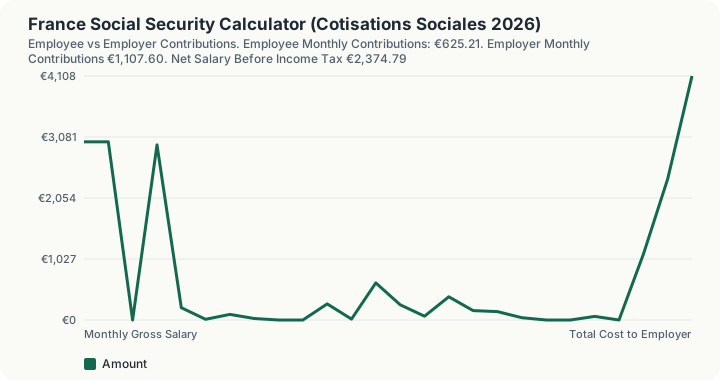
Quick Answer: On a monthly gross salary of EUR 3,000 for a non-cadre private-sector employee in 2026, employee cotisations sociales come to EUR 625.21 a month, leaving EUR 2,374.79 of net salary before the prélèvement à la source income tax. Employer contributions add EUR 1,107.60 on the rates modelled here, so the total monthly cost of the hire is EUR 4,107.60. That is an employee effective rate of 20.84%, an employer effective rate of 36.92%, and a combined 57.76% of gross pay.
What does this calculator do?
French payroll is not one contribution but roughly a dozen, each with its own base, its own rate, and in several cases a different rate above and below the plafond de la sécurité sociale. The PASS for 2026 is EUR 4,005 a month, EUR 48,060 a year, and it does not do what a cap normally does. Pay below it sits in Tranche 1; pay between one and eight PASS sits in Tranche 2, where the complementary pension rates are roughly three times higher. Crossing the plafond therefore raises the marginal contribution rate rather than lowering it, which is the opposite of what people expect from a ceiling.
Two things changed materially for 2026 and this calculator implements both.
First, the reduced employer rates are gone. The reduced maladie rate of 7% below 2.5 SMIC and the reduced allocations familiales rate of 3.45% below 3.5 SMIC were abolished with effect from 1 January 2026. Articles L. 241-2-1 and L. 241-6-1 of the Code de la sécurité sociale were abrogated by article 23 of LOI n. 2025-199 du 28 février 2025, and replaced by a single réduction générale dégressive unique. This calculator therefore applies the full 13% maladie and 5.25% allocations familiales rates and implements no SMIC-threshold logic, because those thresholds are no longer law.
Second, salary CSG did not rise. The 2026 increase to 10.6% reaches only capital income, under CSS articles L. 136-6 and L. 136-7. Revenus d'activité stay at 9.2% CSG plus 0.5% CRDS.
Two inputs are deliberately left to you rather than guessed, and both are explained in the sources section below.
How is this calculated?
Tranche 1 = min(gross, PASS); Tranche 2 = max(0, min(gross, 8 PASS) − PASS)
CSG/CRDS base = 0.9825 × min(gross, 4 PASS) + max(0, gross − 4 PASS)
Step 1: Split the salary across the tranches. Tranche 1: min(EUR 3,000, EUR 4,005) = EUR 3,000.00 Tranche 2: EUR 3,000 is below the PASS, so EUR 0.00
Step 2: Build the CSG and CRDS base. EUR 3,000 x 98.25% = EUR 2,947.50
The 1.75% abatement is a réduction représentative de frais professionnels under CSS article L. 136-2. It applies only to the first four PASS; above that the base is 100% of gross.
Step 3: Employee vieillesse plafonnée, 6.90% on Tranche 1. EUR 3,000.00 x 6.90% = EUR 207.00
Step 4: Employee vieillesse déplafonnée, 0.40% on total pay. EUR 3,000.00 x 0.40% = EUR 12.00
Step 5: Employee AGIRC-ARRCO complementary pension, 3.15% on Tranche 1. EUR 3,000.00 x 3.15% = EUR 94.50
Above the PASS this rate becomes 8.64% on the Tranche 2 slice.
Step 6: Employee CEG, 0.86% on Tranche 1. EUR 3,000.00 x 0.86% = EUR 25.80
Step 7: Employee CET. The CET at 0.14% is charged on Tranche 1 plus Tranche 2 only where the salary reaches Tranche 2. At EUR 3,000 there is no Tranche 2, so the CET is EUR 0.00.
Step 8: Employee APEC. Cadres only, at 0.024%. This employee is not a cadre, so EUR 0.00.
Step 9: Employee CSG, 9.2% on the abated base. EUR 2,947.50 x 9.2% = EUR 271.17
Step 10: Employee CRDS, 0.5% on the same base. EUR 2,947.50 x 0.5% = EUR 14.74
Step 11: Total employee contributions. EUR 207.00 + EUR 12.00 + EUR 94.50 + EUR 25.80 + EUR 0.00 + EUR 0.00 + EUR 271.17 + EUR 14.74 = EUR 625.21
Step 12: Net salary before income tax. EUR 3,000.00 - EUR 625.21 = EUR 2,374.79
Step 13: Employer side, line by line. Vieillesse plafonnée, 8.55% on Tranche 1: EUR 3,000 x 8.55% = EUR 256.50 Vieillesse déplafonnée, 2.11% on total pay: EUR 3,000 x 2.11% = EUR 63.30 Maladie, 13.00% on total pay: EUR 3,000 x 13.00% = EUR 390.00 Allocations familiales, 5.25% on total pay: EUR 3,000 x 5.25% = EUR 157.50 AGIRC-ARRCO, 4.72% on Tranche 1: EUR 3,000 x 4.72% = EUR 141.60 CEG, 1.29% on Tranche 1: EUR 3,000 x 1.29% = EUR 38.70 CET and APEC: EUR 0.00 each, for the reasons given in steps 7 and 8 AT/MP, at the 2% rate you supplied: EUR 3,000 x 2% = EUR 60.00 Other employer contributions, at the 0% you supplied: EUR 0.00
Step 14: Total employer contributions. EUR 256.50 + EUR 63.30 + EUR 390.00 + EUR 157.50 + EUR 141.60 + EUR 38.70 + EUR 60.00 = EUR 1,107.60
Step 15: Total cost of the hire. EUR 3,000.00 + EUR 1,107.60 = EUR 4,107.60 a month, or EUR 49,291.20 a year.
Step 16: Effective rates. Employee: EUR 625.21 / EUR 3,000 = 20.84% Employer: EUR 1,107.60 / EUR 3,000 = 36.92% Combined: EUR 1,732.81 / EUR 3,000 = 57.76%
Worked Example
The steps above are the worked example at EUR 3,000. What makes the system worth understanding is what happens as pay rises past the plafond.
Take a cadre on EUR 8,000 a month.
Step 1: Split the tranches. Tranche 1: EUR 4,005.00 Tranche 2: EUR 8,000 - EUR 4,005 = EUR 3,995.00
Step 2: Employee complementary pension, Tranche 1. EUR 4,005.00 x 3.15% = EUR 126.16
Step 3: Employee complementary pension, Tranche 2. EUR 3,995.00 x 8.64% = EUR 345.17
Almost the same amount of salary attracts nearly three times the pension contribution once it crosses the plafond. That single line is the reason a French salary negotiation around EUR 48,000 a year behaves so strangely.
Step 4: CEG jumps too. Tranche 1 at 0.86%: EUR 34.44. Tranche 2 at 1.08%: EUR 43.15.
Step 5: CET now applies, at 0.14% on Tranche 1 plus Tranche 2: EUR 8,000.00 x 0.14% = EUR 11.20
Step 6: APEC applies, because this employee is a cadre, at 0.024% on the same base: EUR 8,000.00 x 0.024% = EUR 1.92
Step 7: Vieillesse behaves the opposite way. The 6.90% plafonnée rate applies only to the first EUR 4,005, so that line stops growing entirely: EUR 4,005 x 6.90% = EUR 276.35 whatever the salary. Only the 0.40% déplafonnée line keeps rising.
The net effect is that the marginal employee rate on the slice above the PASS is materially higher than the rate below it, while one contribution genuinely caps. Both facts are true at once and neither is intuitive.
At EUR 20,000 a month a third boundary appears: four PASS is EUR 16,020, and the 1.75% CSG abatement stops there. The slice above EUR 16,020 carries CSG and CRDS on 100% of its value rather than 98.25%.
What does this calculator not account for?
- The réduction générale dégressive unique (RGDU) is not modelled. This is the largest omission and it runs in the employer's favour. From 1 January 2026 the RGDU replaced the old reduced maladie and allocations familiales rates with a single dégressive reduction computed on annual pay up to 3 SMIC, parameterised by décret n. 2026-509 du 12 juin 2026. It is a reduction, not a rate change, and folding it into a rate would misstate the mechanism. An employer eligible for it will pay less than the employer total shown here.
- FNAL, the contribution solidarité autonomie, the contribution au dialogue social, chômage and AGS are not built in. They are collected as a single user-supplied "other employer contributions" percentage, which defaults to zero. Leaving it at zero understates the true employer cost. See the sources section for why these were not hardcoded.
- AT/MP has no default that means anything. There is no national rate. The 2% used here is a placeholder.
- No income tax. The prélèvement à la source is deducted from net salary after everything computed here, at a rate the tax administration supplies to your employer. It is not modelled.
- No 13th month, bonuses, primes, intéressement or participation, each of which has its own contribution treatment.
- No apprenticeship or professional training contributions, no versement mobilité, and no forfait social.
- Private-sector employee only. Public-sector schemes, the régime agricole, and independent workers are all outside scope.
- No mutuelle or prévoyance, which are contractual rather than statutory and vary by collective agreement.
- Annual regularisation is ignored. The plafond is applied monthly here, whereas real payroll operates a cumulative annual regularisation that matters for irregular pay.
- The CET treatment. The engine charges the CET only where the salary reaches Tranche 2, so it is zero on a Tranche 1 salary.
What mistakes do people make with this?
- Expecting the plafond to cap contributions. Only vieillesse plafonnée genuinely stops at one PASS. The complementary pension rates roughly triple above it, so total contributions accelerate rather than flatten.
- Using the old reduced employer rates. The 7% maladie band below 2.5 SMIC and the 3.45% allocations familiales band below 3.5 SMIC no longer exist. They were abrogated with effect from 1 January 2026. A 2025 calculator applied to a 2026 salary will produce a materially lower employer cost that is simply wrong on the law, though the RGDU may bring the real figure back down by a different route.
- Applying the 2026 CSG increase to salary. The rise to 10.6% reaches capital income only. Salary CSG remains 9.2%.
- Charging CSG on 100% of gross. The base is 98.25% of gross up to four PASS, then 100%. Applying 9.2% to the full gross overstates the deduction on most salaries.
- Treating all 9.2 points of CSG as deductible. Only 6.8 points reduce taxable income; the remaining 2.4 points and the CRDS do not. On this salary that is EUR 200.43 of the EUR 271.17.
- Quoting "brut to net" as a fixed percentage. It is not. It depends on tranche position, cadre status and the abatement boundary, all of which move with salary.
- Forgetting that the employer cost is the real cost. A EUR 3,000 gross salary costs EUR 4,107.60 a month on the rates modelled here, and more once the omitted employer contributions are added.
Frequently Asked Questions
Why do my contributions go up when my salary crosses the plafond?
What is the PASS for 2026?
Did CSG go up in 2026?
Why does this calculator ask me for the AT/MP rate?
Why is the employer total probably too high?
What happened to the reduced rates below 2.5 and 3.5 SMIC?
Sources
- PASS 2026, EUR 4,005 a month. Arrêté du 22 décembre 2025, applicable to contributions for activity periods from 1 January 2026. The arrêté states the monthly value of EUR 4,005 and the daily value of EUR 220; the annual figure of EUR 48,060 is twelve times the monthly. legifrance.gouv.fr/jorf/id/JORFTEXT000053143451
- Assurance vieillesse rates. CSS article D. 242-4, in force 1 January 2026 as modified by décret n. 2025-1446 du 31 décembre 2025: plafonnée 6.90% employee and 8.55% employer; déplafonnée 0.40% employee and 2.11% employer. Note that the employer déplafonnée rate is 2.11%, not the 2.02% widely quoted for earlier years. legifrance.gouv.fr/codes/article_lc/LEGIARTI000029924557
- Assurance maladie employeur 13.00%. CSS article D. 242-3. legifrance.gouv.fr/codes/article_lc/LEGIARTI000036679615
- Allocations familiales employeur 5.25%. CSS article D. 241-3-1. legifrance.gouv.fr/codes/article_lc/LEGIARTI000036475197
- AGIRC-ARRCO, CEG, CET and APEC rates, read from agirc-arrco.fr, which is the authoritative source for its own rates, and confirmed unchanged for 2026: retraite complémentaire Tranche 1 at 3.15% employee and 4.72% employer, Tranche 2 at 8.64% and 12.95%; CEG Tranche 1 at 0.86% and 1.29%, Tranche 2 at 1.08% and 1.62%; CET at 0.14% and 0.21%; APEC for cadres at 0.024% and 0.036%. agirc-arrco.fr/entreprises/mon-entreprise/calculer-et-declarer/le-calcul-des-cotisations-de-retraite-complementaire
Also consulted: The 2026 allègements généraux reform. LOI n. 2025-199 du 28 février 2025 article 23 abrogated CSS articles L. 241-2-1 and L. 241-6-1, abolishing the reduced maladie and allocations familiales rates from 1 January 2026. The replacement RGDU is parameterised by décret n. 2026-509 du 12 juin 2026; FNAL, contribution solidarité autonomie, contribution au dialogue social, chômage employeur and AGS. We could not confirm these rates on urssaf.fr or boss.gouv.fr, so rather than hardcode them, these are collected as one "other employer contributions" percentage, defaulting to zero, with the constituent charges named. Enter your own combined rate from your DSN or your URSSAF barème; AT/MP. No national rate exists. It is notified per establishment by the CARSAT from the activity code and the establishment's claims history. A required user input, employer-only, defaulting to a 2% placeholder that is not a statutory figure.
All primary sources read 2026-08-31. Confirmed primary: Figures that could NOT be confirmed, and are therefore user inputs rather than guesses: