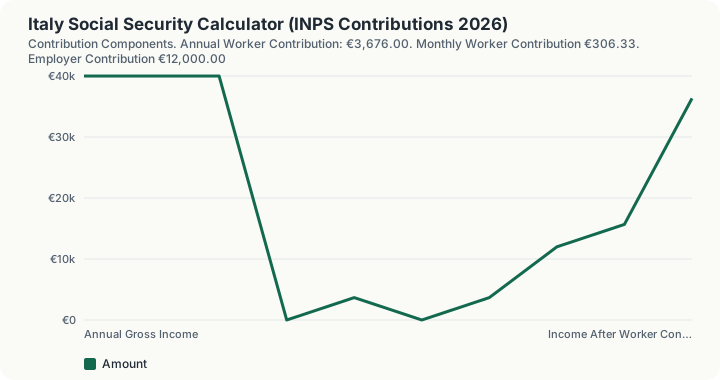
Quick Answer: An employee on EUR 40,000 of annual gross income, at the 9.19% FPLD employee rate, owes EUR 3,676.00 a year of worker contributions, or EUR 306.33 a month, leaving EUR 36,324.00 before IRPEF. At the 30% employer rate supplied by default the employer adds EUR 12,000.00. Neither rate is a national figure: the employee rate is category-dependent and there is no national employer rate.
What does this calculator do?
Italy does not have one social security system; it has several, and which one applies to you is determined by your working relationship, not by choice. An employee falls into the Fondo Pensioni Lavoratori Dipendenti. A freelance professional with a partita IVA and no other coverage falls into the Gestione Separata at 26.07%, paid entirely by themselves. A co.co.co. collaborator falls into the Gestione Separata at 35.03%, split one third to the collaborator and two thirds to the client. An artisan pays 24.00% and a shopkeeper 24.48%, each plus a flat maternity contribution, each on a base that is floored at a minimum income whether they earned it or not. The same EUR 40,000 produces wildly different bills across those schemes.
Three numbers shape every calculation. The prima fascia of annual pensionable pay for 2026 is EUR 56,224.00; above it a 1% worker surcharge can apply. The massimale, the annual contribution ceiling, is EUR 122,295.00 for workers first enrolled after 31 December 1995. The minimale, an income floor of EUR 18,808.00, applies to the self-employed schemes and is the single feature that makes low-earning self-employment in Italy expensive: you contribute on EUR 18,808 even if you earned EUR 5,000.
This calculator computes worker and employer contributions across all seven schemes, applies the floor and the ceiling correctly, and applies the article 3-ter surcharge only where the statute actually allows it.
How is this calculated?
base = min(max(income, minimale), massimale)
worker contribution = base × r + max(0, base − 56,224) × 1% [ if r < 10%]
Step 1: Set the contribution base. Employees have no income floor, and the massimale is EUR 122,295.00. min(max(EUR 40,000, no floor), EUR 122,295) = EUR 40,000.00
For a Gestione Separata professional or an artigiano the same step would first raise anything below EUR 18,808.00 up to that minimale.
Step 2: Split the base at the prima fascia. Within the prima fascia: min(EUR 40,000, EUR 56,224) = EUR 40,000.00 Above the prima fascia: max(0, EUR 40,000 - EUR 56,224) = EUR 0.00
Step 3: Apply the scheme rate to the whole base. EUR 40,000.00 x 9.19% = EUR 3,676.00
Step 4: Test the article 3-ter surcharge. The 1% surcharge under article 3-ter of D.L. 384/1992 is worker-borne, applies only to the slice above the prima fascia, and is due only where the scheme's worker rate is below 10%. Both conditions are checked. Here the slice above the prima fascia is zero, so the surcharge is EUR 0.00.
Step 5: Total worker contribution. EUR 3,676.00 + EUR 0.00 = EUR 3,676.00
Step 6: Monthly worker contribution. EUR 3,676.00 / 12 = EUR 306.33
Step 7: Employer contribution, at the rate you supplied. EUR 40,000.00 x 30% = EUR 12,000.00
The employer side applies only to the dipendente scheme. The self-employed schemes have no employer.
Step 8: Total contributions. EUR 3,676.00 + EUR 12,000.00 = EUR 15,676.00
Step 9: Income after worker contributions. EUR 40,000.00 - EUR 3,676.00 = EUR 36,324.00
IRPEF is charged separately and is not applied here.
Step 10: Effective rate on gross income. EUR 3,676.00 / EUR 40,000.00 = 9.19%
The effective rate equals the headline rate here because neither the floor nor the ceiling bound, and no surcharge applied. It diverges as soon as either does.
Worked Example
Take the same employee and raise the salary to EUR 80,000 to bring the surcharge into play.
Step 1: Base. EUR 80,000 is below the EUR 122,295 massimale, so the base is EUR 80,000.00.
Step 2: Split at the prima fascia. Within: EUR 56,224.00 Above: EUR 80,000 - EUR 56,224 = EUR 23,776.00
Step 3: Contribution at the headline rate on the whole base. EUR 80,000.00 x 9.19% = EUR 7,352.00
Step 4: Article 3-ter surcharge on the slice above the prima fascia. The employee rate of 9.19% is below 10%, so the surcharge is due. EUR 23,776.00 x 1% = EUR 237.76
Step 5: Total worker contribution. EUR 7,352.00 + EUR 237.76 = EUR 7,589.76
The marginal rate on income above EUR 56,224 is therefore 10.19%, not 9.19%.
Now change the scheme rather than the salary. Take the original EUR 40,000 as a freelance professionista in the Gestione Separata.
Step 1: Base. EUR 40,000 is above the EUR 18,808 minimale and below the massimale, so the base is EUR 40,000.00.
Step 2: Rate. The professionista rate is 26.07%, made up of 25.00% IVS, 0.72% aggiuntiva and 0.35% ISCRO.
Step 3: Contribution. EUR 40,000.00 x 26.07% = EUR 10,428.00
Step 4: Surcharge. The scheme rate of 26.07% is at or above 10%, so the article 3-ter surcharge is not due whatever the income.
Step 5: Compare. The employee paid EUR 3,676.00 and the freelancer pays EUR 10,428.00 on identical income, nearly three times as much, and the freelancer bears all of it personally. The employee's total cost to the system was higher once the employer's EUR 12,000 is counted, but it was not their money.
Finally, the minimale in action. A freelance professional earning EUR 5,000.
Step 1: Base. max(EUR 5,000, EUR 18,808) = EUR 18,808.00
Step 2: Contribution. EUR 18,808.00 x 26.07% = EUR 4,903.25
Step 3: Effective rate on actual income. EUR 4,903.25 / EUR 5,000 = 98.07%
The floor does not scale down. That is the arithmetic that makes marginal self-employment in Italy unworkable, and it is why the effective rate output on this page exists separately from the headline rate.
What does this calculator not account for?
- IRPEF is not applied. Income tax is a separate charge computed on income after deductible contributions, and it is not modelled on this page.
- Regional and municipal surtaxes (addizionale regionale and addizionale comunale) are set locally and are out of scope.
- The employer contribution is whatever rate you enter. There is no national employer rate and nothing here validates the figure. See the sources section.
- The 9.19% employee rate is category-dependent, not national. It is 8.89% IVS plus a 0.30% CIGS share that is owed only where the employer is subject to CIGS. Override it with the rate on your own busta paga.
- No sector-specific components. CIGS, CIGO, mobilità, fondo di garanzia, ANF and the various contributi minori vary by industry, company size, legal form and worker qualification, and none of them is broken out.
- No contribution reliefs or exonerations. Italy runs numerous decontribuzioni for young hires, southern regions, women, and new self-employed enrolments. None is applied.
- TFR is not included. The trattamento di fine rapporto accrues separately and is not an INPS contribution.
- The Gestione Separata onere split is not applied to the employer field. For a co.co.co. the statutory split is one third to the collaborator and two thirds to the client; this calculator charges the full scheme rate to the worker for every Gestione Separata type, which is correct for a professionista bearing 100% personally and overstates the collaborator's own share.
- INAIL is not modelled. Workplace accident insurance is a separate compulsory charge outside the INPS contribution structure.
- No pro-rating for part-year work, and the monthly figure is simply the annual figure divided by twelve rather than a real payroll month.
What mistakes do people make with this?
- Assuming the employer rate is 30%. It is not a statutory figure and INPS says so explicitly: rates vary by production sector, company size, legal form and worker qualification. The commonly quoted "about 30% employer, about 38 to 40% total" has no primary source and is not asserted anywhere in this engine.
- Treating 9.19% as a national employee rate. It is not one. INPS's own aliquote tables show employee totals of 8.54%, 8.89%, 9.19%, 10.033% and 11.09% across sectors and qualifications, and INPS circolare 6/2026 sets the prima fascia threshold without stating any employee rate. Check your payslip.
- Applying the article 3-ter surcharge to the Gestione Separata. It is due only where the scheme's worker rate is below 10%, so it reaches employees and the artisan and shopkeeper schemes but never the Gestione Separata rates of 24% and above.
- Applying the surcharge to the whole income. It applies only to the slice above EUR 56,224, not to the entire base. On EUR 80,000 that is EUR 237.76, not EUR 800.
- Expecting a minimale for employees. There is none. The floor applies to the Gestione Separata and to artigiani and commercianti only.
- Using the wrong massimale for an artisan or shopkeeper. Those enrolled with contributory seniority at 31 December 1995 use EUR 93,707.00; those first enrolled from 1 January 1996 use EUR 122,295.00.
- Forgetting the maternity contribution for artigiani and commercianti. A flat EUR 0.62 a month, EUR 7.44 a year, added on top of the percentage.
- Comparing an employee's 9.19% to a freelancer's 26.07% as though they bought the same thing. They do not. The employee's pension is funded by a combined charge more than three times their own contribution; the freelancer's is funded by their contribution alone.
Frequently Asked Questions
Why does this calculator ask me for the employer rate instead of using the standard one?
Is the 9.19% employee rate correct?
What is the article 3-ter 1% surcharge and when does it apply?
Why does a freelancer on the same income pay so much more?
What happens if I earn less than the minimale?
Which massimale applies to me?
Sources
- INPS circolare n. 6 del 30-01-2026 (FPLD, lavoro dipendente). Prima fascia di retribuzione pensionabile annua 2026: EUR 56,224.00, monthly EUR 4,685.00 (2025 was EUR 55,448). Massimale annuo della base contributiva e pensionabile 2026 under article 2 comma 18 of L. 335/1995: EUR 122,295.40, rounded to EUR 122,295.00, applying only to workers first enrolled after 31 December 1995 and to contributivo opt-ins. The circolare states the article 3-ter D.L. 384/1992 surcharge is "a carico del lavoratore, nella misura di un punto percentuale, sulle quote eccedenti il limite della prima fascia", and that it is due only where the scheme's employee rate is below 10%. inps.it/it/it/inps-comunica/atti/circolari-messaggi-e-normativa/dettaglio.circolari-e-messaggi.2026.01.circolare-numero-6-del-30-01-2026_15151.html
- There is no national employer rate. INPS states this itself. inps.it/it/it/inps-comunica/diritti-e-obblighi-in-materia-di-sicurezza-sociale-nell-unione-e/per-le-imprese/aliquote-contributive.html The 30% default is a common approximation for private industry and is not a statutory figure.
Also consulted: INPS circolare n. 8 del 03-02-2026 (Gestione Separata). Professionisti with partita IVA, no other coverage and not pensioners: 26.07%, being 25.00% IVS under L. 232/2016 article 1 comma 165, plus 0.72% aggiuntiva under L. 449/1997 article 59 comma 16 and D.M. 12.7.2007 article 7, plus 0.35% ISCRO under L. 213/2023 article 1 comma 154. Pensioners or those with other mandatory coverage: 24.00% under L. 247/2007 article 1 comma 79. Co.co.co. collaboratori and assimilati: 35.03%, being 33.00% IVS plus 0.50% malattia, maternità and ANF plus 0.22% maternità plus 1.31% DIS-COLL. Collaboratori not owing DIS-COLL: 33.72%. Massimale 2026 EUR 122,295.00; minimale di reddito 2026 EUR 18,808.00 under L. 233/1990 article 1 comma 3; INPS circolare n. 14 del 09-02-2026 (artigiani e commercianti). Artigiani IVS 24.00%; commercianti 24.48%, being 24% plus the 0.48% aliquota aggiuntiva per l'indennizzo cessazione attività under D.Lgs. 207/1996 article 5 comma 2 as raised by L. 178/2020 article 1 comma 380. Minimale di reddito 2026 EUR 18,808.00. Maternità EUR 0.62 a month, EUR 7.44 a year. Massimale EUR 93,707.00 for members with contributory seniority at 31 December 1995, EUR 122,295.00 for those first enrolled from 1 January 1996; The 9.19% employee FPLD rate is category-dependent, not a national rate. It is 8.89% plus a 0.30% CIGS share that not every employer owes, for the reasons set out in the FAQ above. It is a user input defaulting to 9.19 and it should not be treated as a single statutory figure. The composition is documented by INPS; no 2026 INPS instrument restates an FPLD employee total, so this page attributes the build-up rather than asserting a 2026 headline rate.
All primary sources read 2026-08-31. INPS pages are JavaScript-rendered and return only a navigation shell to plain HTTP fetching; the circolari below were rendered and their article text extracted. Confirmed primary: Figures that are NOT sourced, and are exposed as user inputs rather than guessed: IRAP and the IRES premiale are recorded in this project as unresolvable and are not touched by this calculator. Regional and municipal surtaxes are set locally and are likewise out of scope.