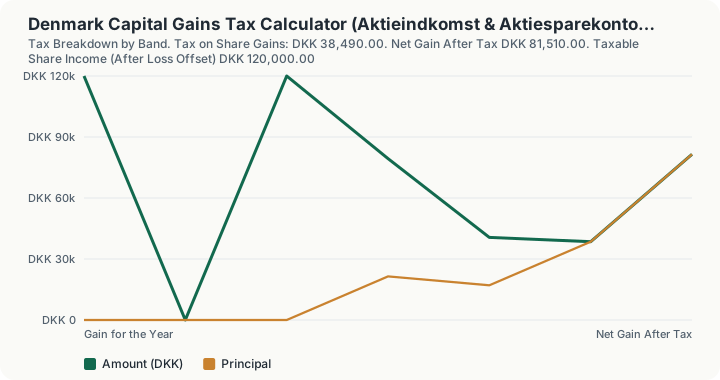
Quick Answer: A single investor with DKK 120,000.00 of share income (aktieindkomst) in an ordinary account in 2026 pays DKK 38,490.00 in tax -- 27% on the first DKK 79,400.00 (DKK 21,438.00) and 42% on the remaining DKK 40,600.00 (DKK 17,052.00) -- leaving DKK 81,510.00 net, an effective rate of 32.08%. The same DKK 120,000 gain inside an Aktiesparekonto would be taxed at a flat 17%.
Overview
Denmark taxes gains on shares and share-based funds as aktieindkomst (share income) -- a separate income category with its own two-rate table, entirely outside the bundskat/topskat structure that applies to salary. Realised gains, dividends, and the annual mark-to-market movement on certain funds all land in the same pot, and the pot is taxed at 27% up to a threshold and 42% above it.
Since 2019 Danish residents have had a second option: the Aktiesparekonto (ASK), a dedicated share-savings account taxed at a flat 17% with no progression at all. The trade-off is that an ASK is taxed on the lagerprincip (mark-to-market): you owe tax each year on the account's change in value whether or not you have sold anything, and contributions are capped at DKK 174,200 for 2026.
This calculator handles both regimes for tax year 2026, applies carried-forward share losses under Denmark's ring-fencing rules, and shows what the same gain would cost in the other regime so the 17%-versus-27%/42% comparison is explicit.
Denmark's currency is the Danish krone (DKK), and every figure in this calculator is denominated in DKK.
How This Is Calculated
- Determine the taxable gain. Two timing principles feed the same rate table: - Realisationsprincippet -- ordinary listed shares and distributing funds are taxed when you actually sell, plus dividends when received. - Lagerprincippet (mark-to-market) -- "investeringsselskaber", in practice most accumulating (non-distributing) funds and ETFs, are taxed on the difference in value between 1 January and 31 December, or between the purchase and sale dates within the year. Nothing needs to be sold for tax to fall due.
- Apply ring-fenced losses. Losses on listed shares and share-based funds are kildeartsbegrænsede (source-restricted): they may only offset gains and dividends from other listed shares and share-based funds. They cannot reduce salary, interest, or property income. Unused losses transfer to a spouse first, and only then carry forward indefinitely.
- Apply the rate structure.
Ordinary account (aktieindkomst):
where $B$ is taxable share income and $T$ is the 2026 low-rate threshold -- DKK 79,400 for a single person, or DKK 158,800 for a married couple pooling an unused allowance between them.
Aktiesparekonto (ASK):
No threshold, no progression, and no spousal pooling -- an ASK is strictly individual and cannot be jointly owned even by a married couple. Each person may hold only one.
Worked Example
Example 1 -- single investor, ordinary account, DKK 120,000 share income:
- Taxable share income: DKK 120,000.00 (no carried-forward losses).
- Low band: min(120,000; 79,400) = DKK 79,400.00 × 27% = DKK 21,438.00.
- High band: 120,000 - 79,400 = DKK 40,600.00 × 42% = DKK 17,052.00.
- Total tax: DKK 21,438.00 + DKK 17,052.00 = DKK 38,490.00. Net gain DKK 81,510.00; effective rate 32.08%.
If that same investor were married and pooling the allowance, the 27% band would stretch to DKK 158,800 -- the entire DKK 120,000 would sit inside it, and the tax would be DKK 32,400.00 instead. The DKK 6,090.00 difference is purely the value of the transferred allowance.
Example 2 -- Aktiesparekonto, DKK 100,000 invested, DKK 8,000 unrealised value gain:
- The ASK is taxed on the lagerprincip, so the year's DKK 8,000.00 rise in account value is taxable even though nothing was sold.
- Tax: DKK 8,000.00 × 17% = DKK 1,360.00.
- Contribution headroom: DKK 174,200.00 - DKK 100,000.00 = DKK 74,200.00 may still be paid in during 2026.
The same DKK 8,000 gain in an ordinary account would be taxed at 27% (DKK 2,160.00), so the ASK saves DKK 800.00 on this gain -- at the cost of paying the tax annually rather than deferring it until sale.
What This Does Not Account For
- Funds taxed as kapitalindkomst rather than aktieindkomst. Whether an accumulating fund is taxed at 27%/42% or at your marginal capital-income rate depends on whether it appears on Skattestyrelsen's positive list of aktiebaserede investeringsselskaber (share-based investment companies). Funds outside that list are kapitalindkomst, taxed at marginal rates that this calculator does not model at all. Check the list for each specific fund before relying on a 27%/42% result.
- The parcelhusregel (primary residence exemption). A gain on the sale of your own home is tax-free in Denmark if the property served as your residence for some or all of the ownership period and the total land area is under 1,400 m² (with exceptions where subdivision is legally barred). That is a different asset class with different rules and is not part of this calculator.
- Property, crypto, and other non-share assets. Danish taxation of cryptocurrency, investment property, and speculative assets follows separate regimes.
- Unlisted shares, employee share schemes, and founder shares. These have their own valuation and timing rules.
- Transferring losses to a spouse. The statutory order is spouse first, then carry-forward. This calculator models only the carry-forward leg, so a married investor with a spouse who has share gains may in reality use losses a year earlier than shown here.
- Pension-wrapped investments. Assets inside a Danish pension scheme are taxed under PAL-skat (currently 15.3%), an entirely different regime.
- Foreign withholding tax and double-taxation relief on dividends from non-Danish shares.
Common Pitfalls
- Assuming the whole gain is taxed at 42% once you cross the threshold. It is not. The 42% rate applies only to the portion above DKK 79,400 -- the first DKK 79,400 always stays at 27%.
- Adding 15% and 25%, or 27% and 42%, and treating the sum as a rate. Neither of Denmark's progressive structures works by adding rates together; each band is taxed on its own slice.
- Forgetting that an ASK owes tax in a year with no sales. The lagerprincip means a purely paper gain triggers a cash tax bill. If the account is fully invested, you may have to sell something to pay the tax.
- Expecting a spouse to share an Aktiesparekonto. Each person may open exactly one ASK, and it cannot be jointly owned. A couple can hold two accounts with two separate DKK 174,200 ceilings, but never one shared account.
- Trying to offset share losses against salary. Ring-fencing (kildeartsbegrænsning) blocks this absolutely. A large share loss in a year with no other share gains produces no immediate tax benefit at all -- only a carry-forward.
- Reading the DKK 174,200 ASK ceiling as a cap on gains. It caps what you may deposit. An account that has grown well above the ceiling keeps growing and keeps being taxed at 17%; you simply cannot pay more in.
Frequently Asked Questions
Is the Aktiesparekonto always better than an ordinary account?
What exactly is the lagerprincip and why does it apply without a sale?
Can my spouse and I share the DKK 158,800 threshold?
What happens to a share loss I cannot use this year?
Do siblings, thresholds, or rates change for 2027?
Is the gain on selling my house taxed here?
Sources
- Skattestyrelsen (skat.dk) -- Aktiesparekonto guidance: the flat 17% rate, the lagerprincip basis, one account per person, the bar on joint ownership, and the 2026 DKK 174,200 contribution ceiling. skat.dk
Also consulted: Personskattelovens §8 a -- the two-rate aktieindkomst structure (27% up to the threshold, 42% above), with the 2026 threshold of DKK 79,400 for a single person and DKK 158,800 for a married couple pooling an unused allowance, corroborated across three independent current Danish sources. This threshold figure is medium-high confidence rather than directly fetched from skat.dk; Skattestyrelsen -- the positive list of "aktiebaserede investeringsselskaber" determining whether an accumulating fund is taxed as aktieindkomst (27%/42%) or as kapitalindkomst at marginal rates; Aktieavancebeskatningsloven -- kildeartsbegrænsning (source-restricted share losses), the spouse-first transfer rule, and indefinite carry-forward; Ejendomsavancebeskatningsloven -- the parcelhusregel exempting gains on a primary residence where the land area is under 1,400 m².