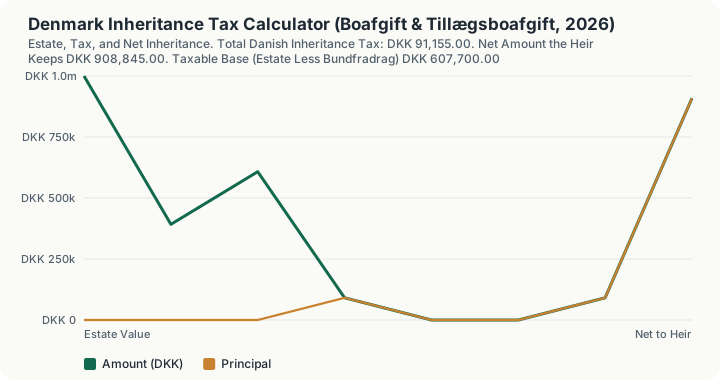
Quick Answer: On an estate of DKK 1,000,000.00 in 2026, a child pays DKK 91,155.00 in boafgift -- 15% of the DKK 607,700.00 remaining after the DKK 392,300.00 bundfradrag -- and keeps DKK 908,845.00. An unrelated heir on the same estate pays DKK 220,291.25, because a 25% tillægsboafgift is charged on top. That is 36.25% of the taxable base, not 40%: the 25% is applied to what remains after the 15% has been subtracted, not to the full base.
Overview
Denmark charges inheritance tax as an estate duty (boafgift), levied on the estate itself rather than on each heir's personal income. The structure is unusually simple by European standards -- one flat threshold and at most two rates -- but the way those two rates combine is the single most commonly mis-stated point in Danish estate planning.
Three things determine the bill:
- The bundfradrag -- a tax-free threshold of DKK 392,300 for 2026, deducted once from the estate before anything is taxed.
- The boafgift -- 15% of whatever is left, payable by almost every heir.
- The tillægsboafgift -- a further 25% charged only on heirs outside the close-family circle, and charged on a reduced base.
A surviving spouse or registered partner pays nothing at all -- a complete exemption, regardless of estate size.
Denmark's currency is the Danish krone (DKK), and every figure in this calculator is denominated in DKK.
How This Is Calculated
- Deduct the bundfradrag.
This allowance belongs to the estate (boet), not to each heir. Several heirs sharing one estate share one allowance.
- Calculate the 15% boafgift on that base.
- Calculate the 25% tillægsboafgift -- on the remainder, not the base. This applies only to heirs outside the close-family class. Critically, it is charged on what is left of the base after the boafgift has been subtracted, and it gets no bundfradrag of its own:
- Total.
The combined effective rate is 36.25%, not 40%. Adding the two headline rates together is the standard error, and on a DKK 1,000,000 estate it overstates the tax by DKK 22,788.75.
Who falls into which class
| Heir | Boafgift 15% | Tillægsboafgift 25% | Combined rate on the base |
|---|---|---|---|
| Spouse or registered partner | No | No | 0% |
| Child, stepchild, grandchild, other direct descendant | Yes | No | 15% |
| Parent | Yes | No | 15% |
| Cohabitant of 2+ years | Yes | No | 15% |
| Sibling (in tax year 2026) | Yes | Yes | 36.25% |
| Niece, nephew, aunt, uncle | Yes | Yes | 36.25% |
| Friend or unrelated person | Yes | Yes | 36.25% |
Siblings in 2026: legislation removes the tillægsboafgift for siblings only from 1 January 2027. For deaths in tax year 2026 a sibling is still in the "other heirs" class and still pays the 25% supplement. This calculator applies the 2026 rule.
Worked Example
Example 1 -- a child inherits DKK 1,000,000:
- Taxable base: DKK 1,000,000.00 - DKK 392,300.00 = DKK 607,700.00.
- Boafgift: DKK 607,700.00 × 15% = DKK 91,155.00.
- Tillægsboafgift: none -- a child is close family.
- Total tax DKK 91,155.00; net to the heir DKK 908,845.00. That is 15.00% of the taxable base and 9.12% of the whole estate.
Example 2 -- an unrelated heir (or, in 2026, a sibling) inherits the same DKK 1,000,000:
- Taxable base: DKK 607,700.00 -- identical.
- Boafgift: DKK 607,700.00 × 15% = DKK 91,155.00.
- Remainder after the boafgift: DKK 607,700.00 - DKK 91,155.00 = DKK 516,545.00. This, not the DKK 607,700.00 base, is what the supplement is charged on.
- Tillægsboafgift: DKK 516,545.00 × 25% = DKK 129,136.25.
- Total tax DKK 91,155.00 + DKK 129,136.25 = DKK 220,291.25, exactly 36.25% of DKK 607,700.00. Net to the heir: DKK 779,708.75.
Had the rates simply been added (15% + 25% = 40%), the answer would have been DKK 243,080.00 -- DKK 22,788.75 too much.
What This Does Not Account For
- Splitting one estate across several heirs. The DKK 392,300 bundfradrag belongs to the estate, not to each heir, and different heirs in the same estate can fall into different classes with different rates. This calculator models one estate against one heir class; a real multi-heir estate needs the allowance apportioned and each share rated separately.
- Assets that bypass the estate. Life-insurance payouts and pension balances with a named beneficiary generally pass outside the estate and are charged their own afgift (commonly 15% for close family) without drawing on the estate's bundfradrag.
- Gaveafgift (gift tax). Lifetime gifts to close family have their own separate annual tax-free allowance and their own 15% rate above it. Gifts made within a short window before death can be pulled back into the estate.
- Business-succession relief. Reduced rates and deferral options exist for the transfer of an active business or holding company to the next generation, subject to conditions this calculator does not test.
- Charitable and public-benefit exemptions. Approved charities and certain public-benefit organisations are exempt from boafgift entirely.
- Foreign estates, foreign assets, and cross-border double taxation. Danish boafgift interacts with foreign inheritance regimes under rules well beyond this calculator's scope.
- Debts, funeral costs, and administration expenses. Enter the estate value net of these -- the calculator takes the figure you give it as the final net estate.
- Deferred payment (henstand) for illiquid estates, such as an estate consisting mainly of a property or a business.
Common Pitfalls
- Adding 15% + 25% to get 40%. This is the error the calculator exists to prevent. The supplement is charged on the base minus the 15% already taken, giving 36.25%. On larger estates the gap between the two answers runs into six figures.
- Assuming the bundfradrag is per heir. It is per estate. Three children splitting one estate get one DKK 392,300 allowance between them, not three.
- Assuming a sibling is exempt from the supplement in 2026. The sibling exemption starts 1 January 2027. A death in 2026 leaves a sibling paying the full 36.25%.
- Thinking a long-term partner automatically counts as close family. Cohabitants qualify for the 15%-only treatment after two years of shared residence (or where they have or are expecting a child together). Below that threshold, they fall into the "other heirs" class at 36.25%.
- Confusing boafgift with income tax. Boafgift is a duty on the estate, settled by the estate before distribution. Heirs do not report the inheritance as taxable income.
- Entering a gross estate. Debts, funeral costs, and administration expenses come off first -- entering the gross figure overstates the tax.
Frequently Asked Questions
Why is the combined rate 36.25% and not 40%?
Does a surviving spouse really pay nothing?
When exactly does the sibling rule change?
How long does a cohabiting partner have to live with the deceased to get the 15% rate?
Is a life-insurance payout to a named beneficiary counted in the estate?
Does the bundfradrag change each year?
Sources
- Skattestyrelsen (skat.dk) -- boafgift guidance: the 2026 bundfradrag of DKK 392,300, the 15% boafgift rate, the 25% tillægsboafgift, the complete spousal exemption, and the enumerated close-family heir classes including cohabitants of 2+ years. skat.dk
Also consulted: Skatteministeriet (svmn.dk) -- official satser og beløbsgrænser table confirming the 2026 bundfradrag figure and the boafgift/tillægsboafgift rates; Boafgiftsloven -- the statutory sequential combination method: the tillægsboafgift is levied on the taxable base reduced by the boafgift already calculated, with no separate bundfradrag, yielding a combined effective rate of 36.25%; Danish legislation removing siblings from the tillægsboafgift class with effect from 1 January 2027 -- confirming that siblings remain subject to the 25% supplement throughout tax year 2026.