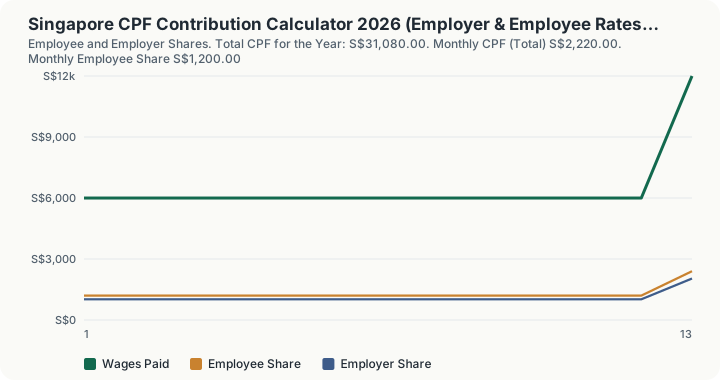
Quick Answer: S$6,000 a month of Ordinary Wages plus a S$12,000 annual bonus, for someone in the "55 and below" age band, generates S$31,080.00 of CPF for the year. That is S$2,220 a month (S$1,200 employee, S$1,020 employer) across twelve months, plus S$4,440 on the bonus. The employee contributes S$16,800 for the year and the employer S$14,280, leaving S$6,660 of headroom below the S$37,740 CPF Annual Limit.
What does this calculator do?
CPF is a defined-contribution savings scheme funded by both sides of the employment relationship, at rates that fall in bands as the employee ages. From 1 January 2026 the headline rates for Singapore Citizens and Singapore Permanent Residents from their third year of PR onwards are 37% of Ordinary Wages for those 55 and below, of which 20 percentage points come out of the employee's pay.
Three details make an accurate CPF calculation harder than multiplying by 37%:
- The employer's share is a residual, not an independent percentage. The CPF Board's own procedure rounds the total contribution to the nearest dollar, rounds the employee's share down, and defines the employer's share as the difference. That is not the same as computing 17% separately, and it can put a dollar in the employer's column that a naive split never shows.
- There are two different ceilings, one monthly on Ordinary Wages and one annual on Additional Wages, and the annual one is not twelve times the monthly one.
- Low wages phase in, and not as a flat percentage. Between S$500 and S$750 a month the employee's share is a slope applied to the excess over S$500, not a reduced rate on the whole wage.
How is this calculated?
Total = round_(half up)(capped OW × total rate)
Employee = round_down(capped OW × employee rate)
Employer = Total − Employee
AW Ceiling = S$102,000 − annual OW subject to CPF
Step by step, in the order the CPF Board's own worked procedure specifies:
Step 1: Cap the month's Ordinary Wages at the ceiling. From 1 January 2026 the Ordinary Wage ceiling is S$8,000 a month. Salary above it attracts no CPF at all.
Step 2: Identify the wage band. Total wages of S$50 or less: no CPF. Above S$50 up to S$500: the employer alone contributes its low-band rate on total wages and the employee's share is nil. Above S$500 but under S$750: the employee's share phases in as a slope times (wages minus S$500), and the employer pays its low-band rate on total wages plus that same slope. S$750 or more: full rates.
Step 3: Apply the age band rates. For 55 and below, 37% total and 20% employee. The other bands are 34%/18% above 55 to 60, 25%/12.5% above 60 to 65, 16.5%/7.5% above 65 to 70, and 12.5%/5% above 70.
Step 4: Round the total to the nearest dollar, down below 50 cents and up at 50 cents and above.
Step 5: Round the employee's share DOWN to the nearest dollar.
Step 6: Take the employer's share as the residual. Total minus employee. This ordering is the single most commonly wrong part of a CPF calculator.
Step 7: Build the annual Ordinary Wage figures. Twelve identical months of the monthly result.
Step 8: Compute the Additional Wage ceiling. S$102,000 minus the Ordinary Wages that actually attracted CPF this year. Note that S$102,000 is not twelve times S$8,000, which would be S$96,000. It is a separate annual figure that was left unchanged when the OW ceiling rose, and the gap is what gives a top-earning employee any bonus room at all.
Step 9: Apply the full age-band rates to the bonus, up to that ceiling, with the same three rounding steps. Additional Wages always attract the full rates; the S$50/S$500/S$750 phase-in is a rule about a month's total wages, not about bonuses.
Step 10: Sum the year and compare to the CPF Annual Limit of S$37,740.
Worked Example
Using the defaults: S$6,000 a month, a S$12,000 bonus, aged 55 or below.
Step 1: Cap the monthly wage. S$6,000 is below the S$8,000 ceiling, so all of it attracts CPF. Wages above the ceiling: S$0.00
Step 2: Identify the band. S$6,000 is at or above S$750, so full rates apply: 37.0% total of which 20.0% is the employee's share.
Step 3: Compute the monthly total contribution. 37% × S$6,000 = S$2,220.00
Step 4: Compute the monthly employee share. 20% × S$6,000 = S$1,200.00
Step 5: Take the employer share as the residual. S$2,220.00 − S$1,200.00 = S$1,020.00
Step 6: Compute monthly take-home pay. S$6,000.00 − S$1,200.00 = S$4,800.00
Step 7: Compute the monthly cost to the employer. S$6,000.00 + S$1,020.00 = S$7,020.00
Step 8: Annualise the Ordinary Wage contributions. S$2,220.00 × 12 = S$26,640.00 total, of which S$14,400.00 employee and S$12,240.00 employer.
Step 9: Compute the Additional Wage ceiling. Annual Ordinary Wages subject to CPF are S$6,000 × 12 = S$72,000.00. S$102,000 − S$72,000 = S$30,000.00
Step 10: Apply the ceiling to the bonus. min(S$12,000, S$30,000) = S$12,000.00 attracts CPF, and S$0.00 escapes.
Step 11: Compute the bonus contributions. Total: 37% × S$12,000 = S$4,440.00. Employee: 20% × S$12,000 = S$2,400.00. Employer residual: S$4,440.00 − S$2,400.00 = S$2,040.00
Step 12: Total the year. S$26,640.00 + S$4,440.00 = S$31,080.00
Step 13: Split the annual total. Employee: S$14,400.00 + S$2,400.00 = S$16,800.00. Employer: S$12,240.00 + S$2,040.00 = S$14,280.00
Step 14: Check against the CPF Annual Limit. S$37,740 − S$31,080 = S$6,660.00 of headroom, with nothing over the limit.
Step 15: Compute annual cash after CPF. (S$6,000 × 12) + S$12,000 − S$16,800 = S$67,200.00
Note that the S$37,740 Annual Limit is exactly 37% of S$102,000, so an employee aged 55 or under sitting at the Ordinary Wage ceiling all year with a large enough bonus lands precisely on it. It is not a separate cap you can breach by accident.
Carrying the Twelve Months and the Bonus Row
Step 16: Month one. Wages S$6,000.00, employee share S$1,200.00, employer share S$1,020.00
Step 17: Month two, and every month to twelve. Identical. Nothing in the Ordinary Wage calculation varies with the month, because S$6,000 sits below the S$8,000 ceiling in all of them.
Step 18: After twelve identical rows. S$26,640.00 of Ordinary Wage contributions, S$14,400.00 employee and S$12,240.00 employer.
Step 19: The thirteenth row, the bonus. Wages S$12,000.00, employee S$2,400.00, employer S$2,040.00, total S$4,440.00
The schedule has thirteen rows for a twelve-month year, and that extra row is the point. Ordinary Wages are capped month by month, so twelve identical rows tell you nothing you did not know after the first. Additional Wages are capped once, annually, against what the Ordinary Wages already used, and that is a calculation you cannot do until the twelve rows are behind you. It is why a bonus paid in January and a bonus paid in December can attract different CPF.
What does this calculator not account for?
- Graduated rates for 1st and 2nd year Permanent Residents. This is the largest omission on the page. New PRs on graduated (G/G) rates contribute materially less than the full rates modelled here, and there is also a joint election for full rates. If you are in your first or second year of PR status, these figures are too high.
- Foreign employees on work passes, who are outside CPF entirely.
- Public sector pensionable employees, who are on a different rate table.
- Allocation across the Ordinary, Special, MediSave and Retirement Accounts. The calculator produces one total; it does not split the contribution between accounts, and those allocation ratios also change by age band.
- Income tax. Singapore income tax is a separate computation.
- Voluntary contributions, top-ups, and the Retirement Sum Topping-Up Scheme.
- Uneven monthly wages. The model assumes twelve identical months of Ordinary Wages plus one lump of Additional Wages. Real pay with mid-year rises or a variable component will differ, and the AW ceiling is computed against the actual annual OW that attracted CPF.
- The employer's Skills Development Levy and other statutory contributions outside CPF.
- CPF interest rates and account growth. This is a contribution calculator, not a projection.
What mistakes do people make with this?
- Computing the employer's share as 17% directly. It is a residual: total rounded half-up, minus employee rounded down. Independently rounding 17% can be a dollar out.
- Assuming the Additional Wage ceiling is S$96,000. The base is S$102,000, and the difference is real money for high earners.
- Applying CPF to salary above S$8,000 a month. It attracts nothing from either side.
- Applying the low-wage phase-in as a reduced flat percentage. Between S$500 and S$750 the employee's share is a slope on the excess over S$500, which is a different shape.
- Applying the phase-in to a bonus. Additional Wages take the full age-band rates regardless of the month's wage level.
- Using the wrong age band. The bands are read as "above 55 to 60" and so on, so an employee who has just turned 55 is still in the "55 and below" band.
- Using these rates for a first or second year PR. They are on graduated rates and will over-contribute if these figures are used.
Frequently Asked Questions
What is the CPF contribution rate in 2026?
What is the Ordinary Wage ceiling for 2026?
Why is the Additional Wage ceiling S$102,000 and not S$96,000?
Does my bonus attract CPF?
What is the CPF Annual Limit?
I am a new Permanent Resident. Do these figures apply to me?
Sources
- CPF Board, "CPF Contribution Rate Table from 1 January 2026 for Singapore Citizens or Singapore Permanent Residents (3rd year onwards)", Private Sector / Non-Pensionable Employees, cpf.gov.sg/content/dam/web/employer/employer-obligations/documents/CPFcontributionratesfrom1Jan2026.pdf: the rates by age band, the wage-band phase-in below S$750, the note that Ordinary Wages are "capped at OW ceiling of $8,000", and the three rounding steps ("Compute the total CPF contribution (rounded to the nearest dollar)... Compute the employee's share of CPF contribution (rounded down to the nearest dollar)... Employer's share = Total contribution - Employee's share"). Read 2026-08-30.
- CPF Board, "What is the Additional Wage (AW) ceiling?", cpf.gov.sg/service/article/what-is-the-additional-wage-aw-ceiling: "$102,000 - Total Ordinary Wage subject to CPF for the year". Read 2026-08-30.
- CPF Board, "What is the CPF Annual Limit?", cpf.gov.sg/service/article/what-is-the-cpf-annual-limit: "the current CPF Annual Limit is $37,740." Read 2026-08-30.