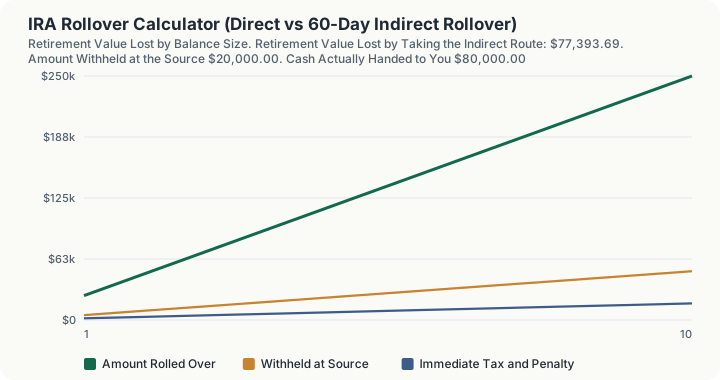
Quick Answer: Moving $100,000 out of a 401(k) before 59 1/2 by the indirect route, with no other savings to replace the 20% withheld, costs $77,393.69 of retirement balance by the time you withdraw in twenty years, on top of $6,800 of tax and penalty payable now. Only $80,000 of the $100,000 ever reaches the new account, where a direct trustee-to-trustee rollover would have moved all of it.
What does this calculator do?
There are two ways to move a retirement balance from one custodian to another, and they are not equivalent. A direct trustee-to-trustee rollover sends the money from the old plan straight to the new one. An indirect rollover sends it to you, and gives you 60 days to redeposit it.
The indirect route contains a trap that is invisible until the cheque arrives. An eligible rollover distribution from a 401(k), 403(b) or governmental 457(b) that is paid to the participant rather than to a receiving plan is subject to mandatory 20% federal income tax withholding under IRC section 3405(c). You cannot waive it. The Treasury regulation is explicit that the 20% applies unless the distributee elects to have the distribution paid directly to an eligible retirement plan.
That creates an arithmetic problem most people do not see coming. To roll over the full amount you must deposit 100% of the gross distribution within 60 days, which means finding the withheld 20% from your own pocket. The withholding comes back only as a credit against tax when you file your return, months later. Anything you cannot make up within 60 days is treated as a distribution: ordinary income, plus the 10% additional tax under section 72(t)(1) if you are under 59 1/2 and no exception applies.
A direct rollover avoids all of this, because a direct rollover is not a designated distribution and nothing is withheld from it.
How is this calculated?
Both branches are projected forward, and the headline is the gap between the retirement balances they reach:
Value Lost = FV (Rolled Direct) − FV (Rolled Indirect); FV = A × (1 + g)ⁿ
Step 1: Apply the statutory withholding to the indirect branch. The source is an employer plan, so the mandatory 20% applies. A direct rollover has nothing withheld. $100,000 x 20% = $20,000 withheld
Step 2: Work out the cash actually handed to you. $100,000 - $20,000 = $80,000
Step 3: Determine what reaches the new account. At the default you cannot fund the withheld 20% from other savings, so only the cash received is redeposited. $80,000 rolled over indirectly, against $100,000 rolled over directly
Step 4: Identify the shortfall, which is treated as a taxable distribution. $100,000 - $80,000 = $20,000
Step 5: Tax the shortfall at your marginal ordinary rate. $20,000 x 24% = $4,800
Step 6: Add the 10% additional tax, because you are under 59 1/2. $20,000 x 10% = $2,000
Step 7: Total the immediate cost. $4,800 + $2,000 = $6,800
Step 8: Project the direct branch forward twenty years at 7%. $100,000 x 1.07^20 = $386,968.45
Step 9: Project the indirect branch on the same terms. $80,000 x 1.07^20 = $309,574.76
Step 10: Difference the two. This is the headline. $386,968.45 - $309,574.76 = $77,393.69
Note what the arithmetic is doing and what it is not. The withholding itself is not counted as a cost: it is a credit against tax that you get back when you file. The cost is the tax and penalty on the portion that fails to make it into a retirement account, plus the permanent loss of that portion's future compounding.
Worked Example
A 52-year-old leaves a job with $100,000 in her 401(k) and asks for a cheque, intending to open an IRA that week. She is in the 24% bracket and expects 7% returns over the twenty years to her withdrawal.
Step 1: What arrives. The plan withholds $20,000 and sends her $80,000.
Step 2: What she deposits. She has $80,000 in hand and no spare $20,000, so $80,000 goes into the IRA.
Step 3: What the missing $20,000 becomes. A taxable distribution: $4,800 of income tax plus $2,000 of additional tax under section 72(t)(1), for $6,800 payable with her return.
Step 4: What the accounts are worth at 72. The direct route would have reached $386,968.45. Her indirect route reaches $309,574.76.
Step 5: The total damage. $77,393.69 of retirement balance, plus the $6,800 paid now, from a single choice of paperwork.
Two changes rescue this. If she could deposit the full $100,000 within 60 days, replacing the withheld $20,000 from savings, the indirect route lands exactly where the direct route does: no tax, no penalty, and the $20,000 comes back as a credit at filing. And if she were 60 rather than 52, the $2,000 additional tax would fall away, though the $4,800 of income tax and the entire $77,393.69 of lost compounding would not.
What does this calculator not account for?
- State income tax withholding. Several states also impose withholding on retirement distributions, on top of the federal 20%. Only federal amounts are modelled.
- The section 72(t) exceptions. Separation from service at 55 or later for a plan distribution, disability, substantially equal periodic payments and the rest are not tested. You state whether the 10% applies.
- The IRS self-certification procedure for a missed 60-day deadline under Revenue Procedure 2020-46, which can sometimes rescue a late rollover.
- Reinvestment of the recovered withholding. When the $20,000 comes back as a tax credit it is not re-invested anywhere in this model.
- Variable returns. Growth is a single annually-compounded nominal rate applied to both branches equally, so the comparison is not distorted by the rate you choose.
- Plan-specific fees, surrender charges, or blackout periods at either end of the transfer.
What mistakes do people make with this?
- Asking for a cheque "made out to me" to save time. This is the single decision that triggers everything on this page. Ask instead for a direct rollover payable to the new custodian for your benefit.
- Assuming you can waive the 20%. You cannot. The regulation is explicit: the only way to avoid it is to elect a direct rollover.
- Thinking the withholding is the loss. It is not. The withholding is recoverable as a credit. The loss is the tax and penalty on the shortfall, plus the compounding on money that permanently left the retirement system.
- Missing the 60 days. The window is 60 days from receipt, not 60 business days, and not two months. Miss it and the entire distribution becomes taxable.
- Doing a second IRA-to-IRA 60-day rollover in twelve months. Section 408(d)(3)(B) permits only one, counted across all your IRAs. A second is not a rollover at all: it is a taxable distribution and potentially an excess contribution to the receiving IRA. Trustee-to-trustee transfers are unlimited and are not counted.
- Assuming the one-per-year rule applies to plan rollovers. It does not. It applies only to IRA-to-IRA 60-day rollovers.
Frequently Asked Questions
Why did my 401(k) rollover cheque arrive 20% short?
Can I still roll over the full amount after the 20% is withheld?
What happens if I only deposit what I received?
Does the 20% withholding apply to IRA-to-IRA moves?
How many rollovers can I do per year?
Is a direct rollover a taxable event?
Sources
- 26 CFR 31.3405(c)-1, mandatory 20% withholding on eligible rollover distributions (Q&A-1, A-2 and A-8, including that a direct rollover is not a designated distribution). ecfr.gov/current/title-26/section-31.3405(c)-1
- IRC section 402(c)(3), the 60-day rollover period. law.cornell.edu/uscode/text/26/402
- IRC section 72(t)(1), the 10% additional tax on early distributions. law.cornell.edu/uscode/text/26/72
- IRC section 408(d)(3)(B), one IRA-to-IRA rollover per 12 months, as construed in Bobrow v. Commissioner, 142 T.C. 84 (2014) and adopted by the IRS in Announcement 2014-15 and Revenue Ruling 2014-9. law.cornell.edu/uscode/text/26/408