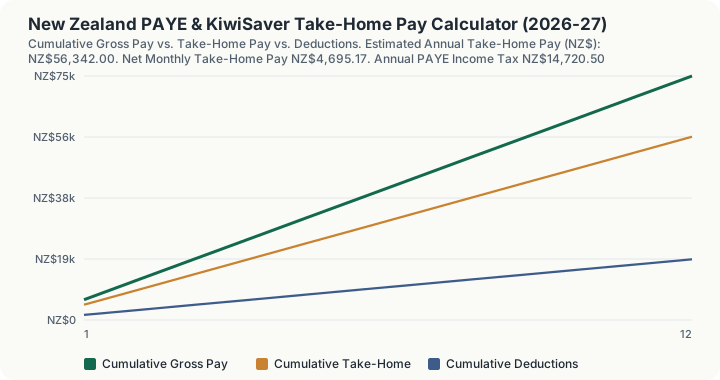
Quick Answer: A New Zealand employee earning NZ$75,000 gross, with no student loan and contributing the current 3.5% default KiwiSaver rate matched by the employer, takes home approximately NZ$56,342 a year (NZ$4,695.17 a month) after NZ$14,720.50 of income tax, NZ$1,312.50 of ACC earner's levy and a NZ$2,625 KiwiSaver deduction. The employer's matching NZ$2,625 falls to about NZ$1,837.50 after ESCT.
Overview
This calculator is built specifically for New Zealand's PAYE (Pay As You Earn) system and reports every figure in New Zealand dollars (NZ$). It is not a US, UK, or Australian payroll calculator -- it applies Inland Revenue (IRD)'s current 2026-27 income tax brackets, the ACC earner's levy, KiwiSaver contribution mechanics (including the government contribution's tax-side counterpart, Employer Superannuation Contribution Tax), and the 12% student loan repayment obligation, all in one place.
Most take-home-pay calculators stop at income tax. This one goes further by modelling what actually happens to every dollar deducted from a New Zealand payslip: the ACC earner's levy that funds no-fault accident cover, the KiwiSaver deduction taken from your own pay, the employer's matching KiwiSaver contribution (which is not tax-free -- it is taxed at source via ESCT before it reaches your account), and the 12% student loan deduction that only applies above a fixed annual threshold. Understanding each piece separately is the difference between guessing at a payslip and actually reconciling it.
How This Is Calculated
Step 1 -- PAYE income tax. New Zealand uses a progressive marginal tax system with five bands for the 2026-27 tax year (1 April 2026-31 March 2027): 10.5% up to NZ$15,600, 17.5% from NZ$15,600 to NZ$53,500, 30% from NZ$53,500 to NZ$78,100, 33% from NZ$78,100 to NZ$180,000, and 39% above NZ$180,000. Only the income inside each band is taxed at that band's rate -- moving into a higher bracket never reduces your take-home pay on the dollars already taxed at a lower rate.
Step 2 -- ACC earner's levy. Every employee pays the ACC (Accident Compensation Corporation) earner's levy, which funds no-fault injury cover for accidents outside the workplace. For the 2026-27 levy year the rate is 1.75% of liable earnings, capped at NZ$156,641 of annual income -- so the maximum anyone pays is NZ$2,741.22, no matter how high their salary goes above that cap.
Step 3 -- KiwiSaver deduction. If you're a KiwiSaver member, your chosen contribution rate -- 3.5%, 4%, 6%, 8%, or 10% of gross pay (3.5% is the current default minimum since 1 April 2026) -- is deducted before you receive your pay. Your employer must match at least 3.5% of your gross salary as their own contribution, though this employer contribution is subject to Employer Superannuation Contribution Tax (ESCT) before it reaches your KiwiSaver account: ESCT is charged at a flat rate based on which income band your total remuneration (salary plus employer KiwiSaver contribution) falls into, using the same rate bands as PAYE income tax.
Step 4 -- Student loan repayment. If you have an outstanding New Zealand student loan, 12% of every dollar of income above the annual repayment threshold (NZ$24,128 for the 2026 tax year) is deducted automatically through PAYE, on top of income tax, the ACC levy, and any KiwiSaver deduction.
Step 5 -- net pay. Take-home pay is gross income minus income tax minus the ACC earner's levy minus the student loan repayment (if any) minus your own KiwiSaver deduction. The employer's KiwiSaver contribution and the Government's KiwiSaver contribution (the "member tax credit," modeled in the companion KiwiSaver Retirement Calculator) sit outside your payslip entirely -- they go straight into your KiwiSaver account, not your bank account.
Worked Example
Consider Aroha, earning NZ$75,000 gross a year, with no student loan, contributing the 3.5% KiwiSaver default rate, matched by her employer's 3.5% minimum contribution.
Income tax: NZ$15,600 at 10.5% = NZ$1,638.00, plus NZ$37,900 (the slice from NZ$15,600 to NZ$53,500) at 17.5% = NZ$6,632.50, plus the remaining NZ$21,500 (from NZ$53,500 to her NZ$75,000 salary) at 30% = NZ$6,450.00. Total: NZ$14,720.50, putting her in the 30% marginal bracket.
ACC earner's levy: NZ$75,000 × 1.75% = NZ$1,312.50.
KiwiSaver employee deduction: NZ$75,000 × 3.5% = NZ$2,625.00, deducted from her pay.
Total deductions: NZ$14,720.50 + NZ$1,312.50 + NZ$2,625.00 = NZ$18,658.00, leaving NZ$56,342.00 in annual take-home pay, or NZ$4,695.17 a month.
Employer's KiwiSaver contribution: Aroha's employer also contributes 3.5% × NZ$75,000 = NZ$2,625.00 gross. Because her total remuneration for ESCT purposes (NZ$75,000 salary + NZ$2,625 employer contribution = NZ$77,625) falls in the 30% ESCT band, ESCT of NZ$2,625 × 30% = NZ$787.50 is deducted before the contribution reaches her account, leaving a net employer contribution of NZ$1,837.50 actually credited to her KiwiSaver balance for the year.
Carrying Into the Second Month of the Tax Year
The New Zealand tax year runs 1 April to 31 March, so month one below is April 2026 and month twelve is March 2027. The schedule spreads the annual result evenly across the twelve months rather than modelling individual pay runs.
Step 1 -- Month one (April). Gross NZ$6,250.00, take-home NZ$4,695.17, deductions NZ$1,554.83
Step 2 -- Month two (May), cumulative. Gross NZ$12,500.00, take-home NZ$9,390.33, deductions NZ$3,109.67
Step 3 -- Half the year gone, at the end of September. Gross NZ$37,500.00, take-home NZ$28,171.00, deductions NZ$9,329.00
Step 4 -- The full year to 31 March 2027. Gross NZ$75,000.00, take-home NZ$56,342.00, deductions NZ$18,658.00
The cumulative deduction line is a straight NZ$1,554.83 a month because PAYE, the ACC levy and the KiwiSaver deduction are all computed on an annualised basis and applied evenly. It only bends in real life when the salary itself changes mid-year, and the deductions then rebase from that point rather than being retrospectively smoothed.
What This Does Not Account For
- Secondary income and tax codes. This calculator assumes all income comes from a single, primary job taxed at standard PAYE rates. Income from a secondary job is taxed at a flat secondary tax code rate rather than through the progressive brackets shown here, and is not modeled.
- KiwiSaver Government contribution. The annual "member tax credit" (25 cents per dollar you contribute, up to NZ$260.72 a year, income-tested out at NZ$180,000+) is not included in this calculator's take-home-pay figures since it is a KiwiSaver-account credit, not a payslip item -- see the companion New Zealand KiwiSaver Retirement Calculator for that projection.
- Other payslip deductions. ACC CoverPlus Extra, salary sacrifice, union fees, workplace savings schemes other than KiwiSaver, child support deductions, and voluntary extra tax (e.g. for a secondary tax code shortfall) are not modeled.
- Tax credits and rebates. Independent Earner Tax Credit (IETC), Working for Families entitlements, and any end-of-year square-up (over- or under-payment of PAYE) are outside this calculator's scope; it estimates in-year PAYE deductions only, not your final annual tax position after IRD's automatic income tax assessment.
- Temporary KiwiSaver rate reductions. Members who apply for a temporary contribution rate reduction back to 3% (available for 3-12 months at a time) are not modeled; this calculator uses your selected standard contribution rate for the full year.
- Self-employed and contractor income. This calculator is built for PAYE (salary and wage) employees. Self-employed New Zealanders pay ACC levies differently (see the companion ACC Levy Calculator) and do not have KiwiSaver or income tax deducted at source in the same way.
Common Pitfalls
- Assuming the employer's KiwiSaver contribution is untaxed. Many employees are surprised that their employer's matching contribution shrinks before it reaches their account -- ESCT is a real deduction, not a rounding error, and can take 10.5% to 39% off the gross employer contribution depending on total remuneration.
- Forgetting the ACC earner's levy has a cap. High earners sometimes assume the 1.75% levy applies to their entire salary; it stops accruing once liable earnings reach NZ$156,641 for the 2026-27 year, capping the levy at NZ$2,741.22.
- Confusing the KiwiSaver default rate with "the minimum you can ever contribute." 3.5% is the current default and statutory minimum contribution rate; it is not a suggestion -- most providers will not let a standard member drop below it without a formal temporary rate reduction application.
- Applying the student loan 12% rate to all income, not just income above the threshold. The 12% rate only bites on income above the NZ$24,128 annual threshold, not on the full salary -- a common overestimate when people do this math by hand.
- Not distinguishing marginal from effective tax rate. Being "in the 30% bracket" does not mean 30% of the whole salary goes to tax -- only the portion of income inside that specific band is taxed at 30%, which is why the effective (average) rate shown here is always lower than the marginal rate for anyone earning above the first bracket.
Frequently Asked Questions
What tax year do these rates apply to?
Does the ACC earner's levy apply to self-employed people too?
Why did my employer's KiwiSaver contribution show a smaller number than expected?
Is the 3.5% KiwiSaver rate permanent?
Do I have to be a KiwiSaver member?
How is the student loan threshold applied if I'm paid weekly or fortnightly rather than annually?
Sources
- Inland Revenue (IRD), "Tax rates for individuals" (ird.govt.nz/income-tax/income-tax-for-individuals/tax-codes-and-tax-rates-for-individuals/tax-rates-for-individuals) -- 2026-27 income tax brackets, effective 31 July 2024, confirmed unchanged by Budget 2026. ird.govt.nz
Also consulted: Inland Revenue (IRD), "ACC earners' levy rates" (ird.govt.nz/income-tax/income-tax-for-individuals/acc-clients-and-carers/acc-earners-levy-rates) -- 2026-27 rate (1.75%) and maximum liable earnings (NZ$156,641); Inland Revenue (IRD), "KiwiSaver changes" (ird.govt.nz/kiwisaver-changes) -- employee/employer contribution rate schedule (3.5% from 1 April 2026, 4% from 1 April 2028) and Government contribution changes; Inland Revenue (IRD), "Employer superannuation contribution tax (ESCT)" (ird.govt.nz/employing-staff/deductions-from-income/employer-superannuation-contriibution-tax-esct) -- ESCT mechanics; specific rate bands corroborated by secondary sources (business.govt.nz) as mirroring the income tax brackets; Inland Revenue (IRD), "Repaying my student loan when I earn salary or wages" (ird.govt.nz/student-loans/living-in-new-zealand-with-a-student-loan/repaying-my-student-loan-when-i-earn-salary-or-wages) -- 12% repayment rate and NZ$24,128 annual threshold, 2026 tax year.