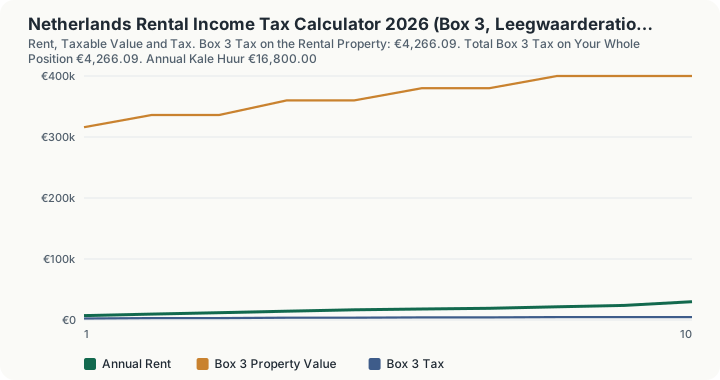
Quick Answer: A EUR 400,000 WOZ dwelling let at EUR 1,500 a month with EUR 100 of service charges, carrying a EUR 200,000 mortgage, attracts EUR 4,266.09 of box 3 tax for 2026. The rent itself is never taxed. The leegwaarderatio of 95% cuts the taxable value to EUR 380,000, box 3 imputes a 6.00% notional return on it, and the resulting tax consumes 30.91% of the EUR 13,800 the property actually nets before tax.
What does this calculator do?
Dutch rental income is not taxed as income. For an ordinary passive letting it never enters box 1 at all, and it never appears as a receipt in box 3 either. Box 3 taxes a notional return on the value of what you own, not what you earned.
The actual rent enters the calculation exactly once, and backwards. It enters through the leegwaarderatio, a table that reduces the WOZ value of a let dwelling according to how the annual bare rent compares to that WOZ value. A lower rent produces a lower taxable value. That is the entire role rent plays.
This has a consequence worth sitting with. Raising the rent raises your taxable value, because it pushes you up the leegwaarderatio table, while the extra rent itself is not taxed. The two effects are unconnected, and neither is what a landlord expects.
The other structural fact is that box 3 taxes equity, not property. The mortgage secured on the house is a box 3 debt, deductible from the base above the schuldendrempel of EUR 3,800. Interest is irrelevant: box 3 imputes a fixed 2.70% notional cost on the deductible debt no matter what rate you actually pay.
How is this calculated?
The 2026 parameters are a 36% rate, a 6.00% notional return on investments (which is what a let dwelling is), 1.28% on bank savings, 2.70% imputed on deductible debt, a heffingsvrij vermogen of EUR 59,357 (EUR 118,714 with a fiscal partner) and a schuldendrempel of EUR 3,800 (EUR 7,600 with a partner).
box 3 value = WOZ × leegwaarderatio
blended rate = (0.0128S + 0.06I − 0.027D)/(S + I − D); tax = 0.36 × blended rate × (base − allowance)
Step 1: Strip the service charges from the monthly rent to reach the kale huur, and multiply by twelve. This is the figure the leegwaarderatio table is measured on. Including service charges overstates the ratio and can push you into a worse band.
Step 2: Express the annual kale huur as a percentage of the WOZ value. That percentage alone selects the band.
Step 3: Read the leegwaarderatio from the table: 73% below 1%, 79% for 1% up to 2%, 84% for 2% up to 3%, 90% for 3% up to 4%, 95% for 4% up to 5%, and 100% at 5% and above. A ratio landing exactly on a band edge falls into the higher band.
Step 4: Apply it to the WOZ value to get the property's box 3 value. Where the leegwaarderatio does not apply (a temporary letting, or a letting to a connected party on terms you would not offer a stranger) the full WOZ value is used instead.
Step 5: Assemble the box 3 position. The property joins any other investments as "overige bezittingen"; bank savings are separate; the mortgage is a debt.
Step 6: Reduce the debt by the schuldendrempel to get the deductible debt.
Step 7: Compute the rendementsgrondslag as total assets less deductible debt.
Step 8: Compute the notional return per category: 1.28% on savings, 6.00% on investments, less 2.70% on deductible debt.
Step 9: Blend those into a single effective return rate by dividing the total notional return by the rendementsgrondslag.
Step 10: Subtract the heffingsvrij vermogen from the rendementsgrondslag to get the taxable base, floored at zero.
Step 11: Apply the blended rate to that taxable base to get box 3 income, then tax it at 36%.
Step 12: Attribute the tax to the property in proportion to its share of the total positive notional return. With no other box 3 assets this is simply the whole tax.
Step 13: Compare against reality. Annual kale huur less running costs gives the real net rent before tax, and the difference between that and the notional return is the gap the tegenbewijsregeling exists to address.
Worked Example
WOZ EUR 400,000, rent EUR 1,500 a month, service charges EUR 100, running costs EUR 3,000 a year, mortgage EUR 200,000, no other assets, no fiscal partner, ordinary let with rent protection.
Step 1: The monthly kale huur. EUR 1,500 - EUR 100 = EUR 1,400
Step 2: The annual kale huur. EUR 1,400 x 12 = EUR 16,800
Step 3: Rent as a share of the WOZ value. EUR 16,800 / EUR 400,000 = 4.2%
Step 4: The leegwaarderatio band. 4.2% falls in the "4% up to 5%" band: 95%
Step 5: The property's box 3 value. EUR 400,000 x 95% = EUR 380,000
Step 6: The reduction the leegwaarderatio bought. EUR 400,000 - EUR 380,000 = EUR 20,000
Step 7: Deductible debt after the schuldendrempel. EUR 200,000 - EUR 3,800 = EUR 196,200
Step 8: Rendementsgrondslag. EUR 380,000 - EUR 196,200 = EUR 183,800
Step 9: Notional return on the investment side. EUR 380,000 x 6.00% = EUR 22,800
Step 10: Notional cost of the debt. EUR 196,200 x 2.70% = EUR 5,297.40
Step 11: Total notional return. EUR 22,800 - EUR 5,297.40 = EUR 17,502.60
Step 12: The blended effective return rate. EUR 17,502.60 / EUR 183,800 = 9.52%
Step 13: Taxable base after the heffingsvrij vermogen. EUR 183,800 - EUR 59,357 = EUR 124,443
Step 14: Box 3 income. EUR 124,443 x 9.52% = EUR 11,850.25
Step 15: Box 3 tax at 36%. EUR 11,850.25 x 36% = EUR 4,266.09
Step 16: What the property really nets before tax. EUR 16,800 - EUR 3,000 = EUR 13,800
Step 17: Real net rent minus the return the law assumes. EUR 13,800 - EUR 22,800 = -EUR 9,000
Step 18: Tax as a share of real net rent. EUR 4,266.09 / EUR 13,800 = 30.91%
Step 19: Net rent after box 3 tax. EUR 13,800 - EUR 4,266.09 = EUR 9,533.91
Step 20: What the same house costs on a temporary let. With no leegwaarderatio the box 3 value is the full EUR 400,000 and the tax is EUR 4,771.96, so losing the ratio costs EUR 505.87 a year
Step 17 is the sentence that matters. The law assumes this property earned EUR 22,800. It earned EUR 13,800. A 36% headline rate on a return that did not happen consumed 30.91% of the return that did.
What does this calculator not account for?
- The tegenbewijsregeling is not modelled. You may elect to be taxed on your actual return where it is lower, following the Hoge Raad's June 2024 rulings. For real estate, actual return must include the unrealised change in the property's value over the year, which this calculator does not ask for and could not honestly guess.
- Running costs are not deductible for Dutch tax. The EUR 3,000 input is used only to show the real net yield. Maintenance, VvE contributions, insurance, letting agent fees and municipal charges reduce your cash and not your tax.
- Mortgage interest is not deductible against the rent. The debt reduces the box 3 base instead, at a fixed imputed 2.70%. Paying 5% on your mortgage does not improve the box 3 position at all.
- The savings and debt rates are provisional. For 2026 the 1.28% savings rate and the 2.70% debt rate are provisional figures set retrospectively; only the 6.00% investment rate is fixed. A property-only position is unaffected by the savings rate but is affected by the debt rate.
- Box 1 is entirely absent. Where letting rises to the level of "meer dan normaal vermogensbeheer" (active development, substantial personal labour, or short-let operation resembling a business) the income can fall into box 1 as result uit overige werkzaamheden, at box 1 rates. This calculator models ordinary passive letting.
- Only one property is modelled. A portfolio with several dwellings on different rent ratios needs each valued separately.
- The WOZ value has a lag. For the 2026 return the relevant WOZ has a value date of 1 January 2025, so a market move during 2025 or 2026 does not show up.
- The leegwaarderatio eligibility question is your answer, not a test. The calculator does not verify whether your letting is temporary or whether the tenant is a connected party.
- No transfer tax, no VvE reserves, no vacancy allowance, and no move to an actual-return system, which is delayed to at least 2028.
What mistakes do people make with this?
Thinking the rent is taxed. It is not. Nothing in this calculation is a percentage of the rent. The rent's only role is to select a band in the leegwaarderatio table.
Including service charges in the rent figure. The table is measured on the kale huur. Adding EUR 100 a month of service charges to a EUR 1,400 bare rent takes the ratio from 4.2% to 4.5%, which is still the 95% band here, but on other numbers it is exactly the sort of error that crosses a band edge and adds EUR 20,000 to the taxable value.
Using the market price or the purchase price instead of the WOZ. The WOZ value with a 1 January 2025 value date is the statutory figure for a 2026 return. It is often materially below market.
Assuming a temporary let is a smaller commitment and therefore smaller tax. It is the reverse. A temporary letting loses the leegwaarderatio entirely and is taxed on the full WOZ value. On these figures that is EUR 505.87 a year more.
Letting to a family member below market. Where the terms are not ones you would offer a stranger, the highest percentage applies and the full WOZ value is taxed, exactly as for a temporary let.
Reading 36% as the effective rate. The 36% applies to a notional income, not to your rent. Here it works out at 30.91% of the property's actual net rent, and on a lower-yielding property it can exceed the real return entirely.
Frequently Asked Questions
Is my Dutch rental income taxed as income?
Why does charging a lower rent reduce my tax?
Can I deduct my mortgage interest?
What is the tegenbewijsregeling and should I use it?
When does the leegwaarderatio not apply?
Does a fiscal partner help?
Sources
- Belastingdienst, "Berekening box 3-inkomen 2026": banktegoeden 1.28%, overige bezittingen 6.00%, schulden 2.70%, tarief 36%. belastingdienst.nl/wps/wcm/connect/nl/box-3/content/berekening-box-3-inkomen-2026
- Belastingdienst, "Tabel waarde verhuurde of verpachte woning", the leegwaarderatio table (73 / 79 / 84 / 90 / 95 / 100 percent), which the page publishes as one table covering 2023 through 2026, together with the two situations in which the ratio does not apply: "Vanaf 2023 geldt de leegwaarderatio niet meer voor tijdelijk verhuurde woningen", and letting to a connected party, where the highest percentage must be used. belastingdienst.nl/wps/wcm/connect/bldcontentnl/belastingdienst/prive/vermogen_en_aanmerkelijk_belang/vermogen/wat_zijn_uw_bezittingen_en_schulden/uw_bezittingen/overige_onroerende_zaken/waarde_verhuurde_woning_als_overige_onroerende_zaak/tabellen_waarde_verhuurde_of_verpachte_woning/tabellen_waarde_verhuurde_of_verpachte_woning
Also consulted: Belastingdienst, Fiscale informatie 2026, chapter 13, heffingsvrij vermogen EUR 59,357 single and EUR 118,714 with a fiscal partner; schuldendrempel EUR 3,800 and EUR 7,600; The annual rent for the table is the kale huur on 1 January of the tax year, times twelve, as a percentage of the WOZ value with value date 1 January of the preceding year.
All read 2026-08-30. Full citations in engine/primitives/netherlands-tax.ts sections 1 and 7.
The tegenbewijsregeling, legislated retrospectively to 2017 following the Hoge Raad's rulings of 6 June 2024, and the delayed move to a full actual-return system from 2028 at the earliest, are both outside this calculator's model and are disclosed above.