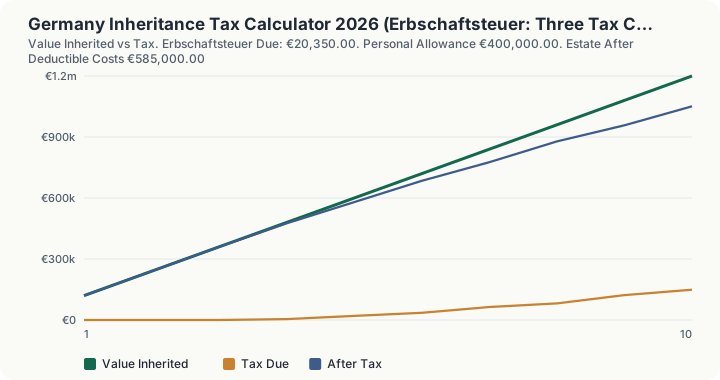
Quick Answer: €600,000 passing to a child, less the €15,000 Erbfallkostenpauschale, carries €20,350.00 of Erbschaftsteuer. The €400,000 allowance under §16 Abs.1 Nr.2 ErbStG leaves a taxable acquisition of €185,000, taxed at the Steuerklasse I slab rate of 11%. The child keeps €579,650.00, an effective rate of 3.39% on the whole inheritance.
What does this calculator do?
German inheritance tax is levied on each acquirer separately, not on the estate as a whole. Everything turns on one input: the heir's relationship to the deceased. That single choice sets both the personal allowance and the rate ladder, and it moves the bill far more than the size of the estate does. The same €600,000 costs a child €20,350 and an unmarried partner far more, because the partner falls into Steuerklasse III with a €20,000 allowance and a 30% rate.
§15 ErbStG defines three classes. Class I covers spouses and registered life partners, children and stepchildren and their descendants, and parents and grandparents where the acquisition is on death. Class II covers siblings, nieces and nephews, step-parents, parents-in-law, children-in-law and divorced spouses. Class III is "alle übrigen Erwerber": everyone else, which notably includes unmarried partners however long the relationship.
The second structural feature is that the §19 Abs.1 rate table is a slab table, not a bracket table. The whole taxable acquisition is taxed at a single rate determined by its size, rather than being sliced. One euro over a ceiling would therefore jump the entire acquisition to a higher rate, which is why §19 Abs.3 exists: the Härteausgleich caps the extra tax at 50% of the excess over the previous ceiling where the rate is at most 30%, and 75% where it is above.
How is this calculated?
Tax = min(r⋅A, C_prev⋅r_prev + f⋅(A − C_prev))
where $A$ is the taxable acquisition, $r$ its slab rate, C_prev the previous band ceiling and $f$ the Härteausgleich factor.
Step 1: Deduct estate costs from the value inherited. §10 Abs.5 Nr.3 ErbStG allows funeral, probate and estate-administration costs. €15,000 is deductible without evidence; more requires proof. The result is the net estate, floored at zero.
Step 2: Look up the tax class and allowance from the relationship. Spouse or registered partner €500,000 (Nr.1), child or stepchild €400,000 (Nr.2), grandchild €200,000 (Nr.3), parent or grandparent inheriting on death €100,000 (Nr.4), class II persons €20,000 (Nr.5), class III persons €20,000 (Nr.7).
Step 3: Subtract the allowance. Net estate less the allowance, floored at zero.
Step 4: Round down to full €100. §10 Abs.1 ErbStG: "Der steuerpflichtige Erwerb wird auf volle 100 Euro nach unten abgerundet." This is applied after the allowance, not before.
Step 5: Find the band the taxable acquisition falls in. The §19 Abs.1 ceilings are €75,000, €300,000, €600,000, €6,000,000, €13,000,000, €26,000,000 and then open-ended.
Step 6: Read the slab rate for that band and tax class. Class I runs 7 / 11 / 15 / 19 / 23 / 27 / 30 per cent. Class II runs 15 / 20 / 25 / 30 / 35 / 40 / 43. Class III runs 30 / 30 / 30 / 30 / 50 / 50 / 50.
Step 7: Apply the rate to the whole taxable acquisition. Not to the excess over a threshold. The entire amount is taxed at the one rate.
Step 8: Compute the Härteausgleich cap. The tax that would have been due at the previous band's ceiling, plus the excess above that ceiling multiplied by 50% (where the rate is at most 30%) or 75% (where it is above).
Step 9: Take the lower of the slab tax and the cap. That is the tax due. The relief reported is the difference.
Step 10: Report what is left and the effective rate. Value inherited minus tax due, and tax due as a percentage of the value inherited.
Worked Example
€600,000 passing to a child of the deceased, with the standard €15,000 of deductible costs.
Step 1: Net estate after costs. €600,000 - €15,000 = €585,000.00
Step 2: Tax class and allowance. Child, so Steuerklasse I with an allowance of €400,000 under §16 Abs.1 Nr.2 ErbStG
Step 3: After the allowance. €585,000 - €400,000 = €185,000.00
Step 4: Rounded down to full €100. €185,000 is already a multiple of €100, so the taxable acquisition is €185,000
Step 5: The band. €185,000 is above €75,000 and at or below €300,000, so the second band applies
Step 6: The slab rate. Second band, class I, so 11%
Step 7: Slab tax. €185,000 x 11% = €20,350.00
Step 8: The Härteausgleich comparison, at the previous ceiling. €75,000 x 7% = €5,250.00
Step 9: Plus half the excess (the rate is at most 30%). (€185,000 - €75,000) x 50% = €110,000 x 50% = €55,000.00
Step 10: The cap. €5,250.00 + €55,000.00 = €60,250.00
Step 11: Which binds? €20,350.00 is well below €60,250.00, so the slab tax stands and the Härteausgleich relief is €0.00
Step 12: Tax due. €20,350.00
Step 13: Inheritance after tax. €600,000.00 - €20,350.00 = €579,650.00
Step 14: Effective rate on the inheritance. €20,350.00 / €600,000 = 3.39%
The relationship dominates the result. Change the heir to a spouse and the €500,000 allowance leaves only €85,000 taxable at 7%, cutting the bill to €9,350. Change it to an unmarried partner and class III applies a €20,000 allowance and a 30% rate to everything above it.
What does this calculator not account for?
- The §13a and §13b Betriebsvermögen relief for business assets is not modelled. For an estate containing a trading business or qualifying shareholding, this relief can remove most or all of the tax, and its absence here makes the figure materially too high for such estates.
- The §13d 10% rebate on let residential property is not modelled.
- The §13 Abs.1 Nr.4b/4c Familienheim exemption is not modelled. A family home passing to a surviving spouse or to children, subject to occupation conditions, can be exempt entirely. This is a very common fact pattern and its omission is significant.
- The §17 Versorgungsfreibetrag is not modelled. Surviving spouses and children are entitled to a further pension allowance beyond the §16 personal allowance.
- The §14 ten-year aggregation of earlier gifts is not modelled. Gifts from the same donor within ten years are aggregated with the inheritance in German law, so an heir who received earlier lifetime gifts will face a higher bill than this page shows. The calculator sees only the amount you enter.
- Only one heir is computed at a time. German inheritance tax is per acquirer, so a multi-heir estate needs one run per heir with each heir's own share and relationship. The calculator does not divide an estate.
- Valuation is taken as given. The Bewertungsgesetz rules for valuing property, business assets and shares are not applied; you enter a value.
- Class II parents on lifetime gifts are not offered as an option. Parents and grandparents are class I only on acquisitions on death; on lifetime gifts they fall into class II. The relationship list here is written for the inheritance case.
- International aspects are absent. Unlimited versus limited tax liability, double taxation treaties and foreign tax credits under §21 ErbStG are all out of scope.
What mistakes do people make with this?
- Treating the rate table as a bracket table. It is a slab table. At €300,001 of taxable acquisition in class I, the whole amount is taxed at 15%, not just the last euro. This is exactly why the Härteausgleich exists, and why the tax can jump sharply near a ceiling.
- Applying the allowance to the estate rather than to each heir's share. Every acquirer has their own allowance. An estate split between two children gets two €400,000 allowances, one per child, applied to each child's own share.
- Assuming an unmarried partner is treated like a spouse. They are class III with a €20,000 allowance and a 30% starting rate. The gap between a spouse and a long-term unmarried partner on the same inheritance is the single largest cliff in the German system.
- Rounding before the allowance. §10 Abs.1 rounds the taxable acquisition down to full €100 after the allowance has been subtracted, not the estate value beforehand.
- Forgetting the ten-year gift aggregation. Lifetime gifts within ten years are pulled back in. Planning that uses the allowance twice inside a decade does not work, and this calculator cannot see prior gifts.
- Ignoring the Familienheim exemption. A great many German estates are dominated by the family home, and where the occupation conditions are met the exemption changes the answer completely. The figure here does not apply it.
- Deducting more than €15,000 of costs without evidence. The €15,000 is a Pauschale. Higher amounts are deductible but must be proved.
Frequently Asked Questions
What is the inheritance tax allowance in Germany?
Why does an unmarried partner pay so much more than a spouse?
What is the Härteausgleich?
Is the tax charged on the estate or on each heir?
Do earlier gifts count?
What costs can I deduct?
Sources
- §15 ErbStG, gesetze-im-internet.de/erbstg_1974/__15.html, read 2026-08-30: the three Steuerklassen, including class III as "alle übrigen Erwerber und die Zweckzuwendungen".
- §16 ErbStG, gesetze-im-internet.de/erbstg_1974/__16.html, read 2026-08-30, the personal allowances: Nr.1 €500,000, Nr.2 €400,000, Nr.3 €200,000, Nr.4 €100,000, Nr.5 €20,000, Nr.7 €20,000 (Nr.6 repealed).
- §10 ErbStG, gesetze-im-internet.de/erbstg_1974/__10.html, read 2026-08-30: Abs.1, "Der steuerpflichtige Erwerb wird auf volle 100 Euro nach unten abgerundet", and Abs.5 Nr.3, the €15,000 Erbfallkostenpauschale.
- §19 ErbStG, gesetze-im-internet.de/erbstg_1974/__19.html, read 2026-08-30: the Abs.1 slab rate table, reproduced verbatim in the primitive, and the Abs.3 Härteausgleich.
Full citation block, and the explicit list of reliefs deliberately not modelled, is in engine/primitives/germany-business-tax.ts section 4.