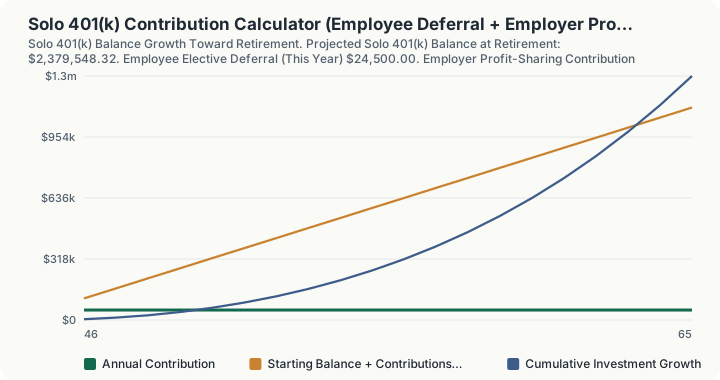
Quick Answer: For 2026, a self-employed individual with $150,000 of net self-employment income can put roughly $52,381 into a Solo 401(k): a $24,500 employee elective deferral plus about $27,881 of employer profit sharing (20% of the $139,402.83 of net earnings left after the deductible half of self-employment tax). Repeating $52,380.57 from age 45 to 65 on a $60,000 starting balance at 7% projects to $2,379,548.32.
Overview
A Solo 401(k), sometimes called a one-participant 401(k) or an individual 401(k), is a 401(k) plan built for a business with exactly one owner and no full-time employees other than a spouse. Because you are simultaneously the "employer" and the "employee" of your own business, you get to make two separate contributions to the same account: an employee elective deferral, capped at a fixed dollar amount regardless of income, and an employer profit-sharing contribution, sized as a percentage of what the business earned.
That combination is what makes the Solo 401(k) the highest-ceiling retirement account available to most self-employed people. A SEP-IRA gets you the employer side only. A SIMPLE IRA caps the employee side much lower. The Solo 401(k) stacks both, up to the same overall combined limit that applies to any 401(k) plan, currently $72,000 for 2026 before catch-up contributions, or as much as $83,250 for someone eligible for the SECURE 2.0 age 60-63 super catch-up.
The tradeoff is administrative. Solo 401(k)s require more paperwork than a SEP-IRA (a one-time plan adoption document, and an annual Form 5500-EZ filing once the account passes $250,000), and the plan stops working the moment the business hires a non-spouse employee who meets standard eligibility requirements. For a genuinely solo operation, though, it is usually the most powerful option on the table.
How This Is Calculated
The math runs in three stages, and the middle stage is where most online calculators get it wrong.
First, net earnings from self-employment. Your employer profit-sharing contribution is not calculated off raw Schedule C profit. IRC Sec. 401(c)(2) requires you to first subtract the deductible one-half of your self-employment tax, the same self-employment tax computed on Schedule SE (12.4% Social Security up to the 2026 wage base of $184,500, plus 2.9% Medicare, applied to 92.35% of net profit). What's left is "net earnings from self-employment," the self-employed equivalent of a W-2 employee's compensation.
Second, the employer profit-share reduced rate. A Solo 401(k)'s maximum stated employer contribution rate is 25% of compensation. But you cannot apply 25% directly to net earnings from self-employment, because the contribution itself would need to be subtracted from that same number first, a circular calculation. IRS Publication 560 resolves this with a "reduced rate": divide the stated rate by (1 plus the stated rate). For 25%, that reduced rate is 25% / 125%, which comes out to exactly 20%. So the employer profit-share contribution is 20% of net earnings from self-employment, not 25% of raw business profit, and not 25% of net earnings either. Skipping this adjustment, or applying 25% to the wrong base, is the single most common error people make sizing their own Solo 401(k) contribution.
Third, the employee deferral and the combined cap. The employee elective deferral for 2026 is $24,500, plus a $8,000 catch-up at age 50 or older, or a $11,250 SECURE 2.0 "super catch-up" for anyone who turns 60, 61, 62, or 63 during the year (this replaces, rather than stacks with, the standard catch-up). The employee deferral and employer profit-share are then added together, and the non-catch-up portion of that total is capped at $72,000 for 2026 under IRC Sec. 415(c). Catch-up contributions sit outside that combined cap, added on top. Finally, nothing you contribute, in total, can exceed your actual net earnings from self-employment; you cannot contribute more than you earned.
Worked Example
The calculator's default: $150,000 of Schedule C profit at age 45
Step 1 -- SE-taxable earnings. $150,000 x 92.35% = $138,525.00
Step 2 -- Self-employment tax. $138,525 x 15.3% = $21,194.33. That figure is below the 2026 Social Security wage base of $184,500, so the full 12.4% applies alongside the 2.9% Medicare rate.
Step 3 -- The deductible half. $21,194.33 / 2 = $10,597.17
Step 4 -- Net earnings from self-employment. $150,000 - $10,597.17 = $139,402.83
Step 5 -- Employer profit share at the reduced rate. 25% / 125% = 20%, so $139,402.83 x 20% = $27,880.57
Step 6 -- Employee elective deferral. Age 45 means no catch-up tier, so the 2026 limit of $24,500.00 applies in full, well inside net earnings
Step 7 -- Combined contribution. $24,500.00 + $27,880.57 = $52,380.57, comfortably under the $72,000 IRC Sec. 415(c) cap
Carrying it to retirement
The remaining defaults are a $60,000 existing balance, retirement at 65 and a 7% return.
Step 8 -- Age 46, the first year. ($60,000 + $52,380.57) x 1.07 = $116,580.57, of which $4,200.00 is growth
Step 9 -- Age 47, the second year. ($116,580.57 + $52,380.57) x 1.07 = $177,121.78, cumulative growth $12,360.64
Step 10 -- Age 55, the halfway mark. Balance $841,742.50, split $583,805.70 paid in and $257,936.80 earned
Step 11 -- Age 65. Balance $2,379,548.32, from $1,047,611.40 of contributions and $1,271,936.92 of growth
At 55 the account is 69% contributions; at 65 growth has edged ahead of them. That crossover happens in the last decade of a twenty-year run, which is the argument for opening the plan early rather than waiting for a better income year -- the years that matter most are the ones at the end, and you only get them by starting.
What another $50,000 of profit is actually worth
Step 12 -- The same trace at $100,000 of profit. Net earnings $92,935.22, employer share $92,935.22 x 20% = $18,587.04, deferral $24,500.00, total $43,087.04
Step 13 -- The difference the extra $50,000 bought. $52,380.57 - $43,087.04 = $9,293.53
That is 18.6 cents of contribution room per extra dollar of profit, not 25 cents and certainly not 35. The employee deferral was already maxed at $100,000 of profit, so only the employer side grows, and it grows at 20% of a base that is itself about 93% of profit. Anyone sizing a Solo 401(k) against a projected income should use that 18.6% figure rather than the headline 25%.
Step 14 -- Where the 415(c) cap finally starts to matter. At $225,000 of profit the total reaches $66,609.62 ($24,500 deferral plus $42,109.62 of profit share), still under the $72,000 cap
Step 15 -- Age 61 on the default profit, with the super catch-up. $24,500 deferral + $11,250 SECURE 2.0 catch-up = $35,750.00, plus the same $27,880.57 profit share = $63,630.57
The catch-up sits outside the $72,000 cap rather than inside it, so it is genuinely additive: the same $150,000 of profit supports $11,250 more at 61 than at 45, and it would still be additive at a profit level where the $72,000 cap had already bound the other two components. That four-year window, ages 60 through 63, is the largest contribution any self-employed person can make to a Solo 401(k), and it closes at 64 when the standard $8,000 catch-up resumes.
If Your Business Is an S-Corporation, This Calculator's Formula Does Not Apply
Everything above assumes you are a sole proprietor or single-member LLC reporting business income on Schedule C. If your business is an S-corporation (or an LLC that elected S-corp taxation), the employer contribution is computed on a completely different, and considerably simpler, basis.
An S-corp owner is a W-2 employee of their own corporation. There is no self-employment tax on the owner's share of business income, so there is no half-of-SE-tax deduction to subtract, and because the contribution base is W-2 wages rather than a figure that shrinks when the contribution is deducted from it, there is no circularity to resolve and therefore no reduced-rate adjustment. The employer contribution is a straight 25% of the owner's W-2 wages (Box 1 wages, capped by the IRC Sec. 401(a)(17) compensation limit of $360,000 for 2026). Distributions, K-1 income, and any other profit that is not run through payroll do not count toward the contribution base at all.
So an S-corp owner paying themselves $150,000 in W-2 wages gets an employer contribution of up to 25% × $150,000 = $37,500, plus the same $24,500 employee elective deferral (which is withheld from those wages), for $62,000 total, still subject to the same $72,000 combined 415(c) cap. That is a different number from the $27,880.57 this calculator reports for $150,000 of Schedule C profit, and it is arrived at by a different formula. Enter your figures here only if your income is Schedule C net profit; if you are an S-corp owner, apply the flat 25%-of-W-2-wages calculation to your own payroll figure instead.
The practical consequence is that an S-corp owner's contribution room is a direct function of how much salary they choose to run through payroll. Setting a low "reasonable compensation" salary to minimize payroll tax also shrinks the retirement contribution base, and that tradeoff is not something this calculator models.
Solo 401(k) vs. Employer 401(k): What Changes When You're Self-Employed
The mechanics of investing inside a Solo 401(k), fund selection, tax-deferred (or Roth) growth, required minimum distributions, are identical to a traditional employer-sponsored 401(k). What changes is who's writing the checks. At a regular job, your employer's match is free money layered on top of your own deferral, sized by a formula your employer chose. In a Solo 401(k), you are both parties, and the "employer" contribution is real money the business would otherwise keep, not a bonus, so it competes directly with reinvesting in the business, paying down debt, or building a cash reserve.
Common Pitfalls
- Applying 25% straight to Schedule C profit. This overstates the allowed contribution because it skips both the self-employment tax adjustment and the reduced-rate conversion; the correct multiplier on net earnings from self-employment is 20%, not 25%.
- Forgetting the deferral deadline is earlier than the profit-share deadline. The employee elective deferral election generally must be made by December 31 of the plan year, while the employer profit-sharing contribution can be made up until the business's tax filing deadline, including extensions.
- Not opening the plan before year-end. Unlike a SEP-IRA, which can be opened as late as the tax filing deadline, a Solo 401(k) plan document generally must be adopted by December 31 of the year you want to make an employee deferral for (the SECURE 2.0 Act now allows a new plan to be adopted up until the filing deadline solely for the employer contribution, but not for that year's employee deferral).
- Missing the $250,000 Form 5500-EZ filing threshold. Once total plan assets cross $250,000, an annual Form 5500-EZ filing becomes required; many solo filers are surprised by this once their account grows.
- Assuming the spouse exception means any employee is fine. The "no employees" requirement for a Solo 401(k) allows a spouse who works in the business, but hiring any other employee who works 1,000+ hours a year generally ends the plan's Solo 401(k) status going forward.
What This Does Not Account For
- Roth vs. traditional election. This calculator projects pre-tax growth; if your plan offers a Roth employee-deferral option, the tax treatment of the deferral portion differs (contributed after-tax, grows tax-free) even though the dollar limits are identical.
- S-corporation compensation. This calculator computes the employer contribution the Schedule C way (SE-tax deduction, then the 20% reduced rate). An S-corp owner's employer contribution is instead a flat 25% of W-2 wages with neither adjustment; see the S-corporation section above.
- The SECURE 2.0 mandatory Roth catch-up rule. Beginning in 2026, a participant whose prior-year FICA wages from the employer sponsoring the plan exceeded $145,000 (indexed) must make any age-50+ catch-up contribution as a Roth contribution rather than pre-tax. This calculator projects the full balance without splitting the catch-up portion into a separate Roth bucket; see the FAQ below for who this actually binds.
- Multiple businesses or W-2 income. If you have W-2 wages from another job with its own 401(k), the $24,500 employee deferral limit is shared across all plans combined, not per plan; this calculator assumes the Solo 401(k) is your only elective-deferral opportunity.
- Plan fees and investment costs. Custodian fees, fund expense ratios, and any plan administration costs are not modeled.
- Mid-year changes in net profit. The calculation assumes a stable net profit figure repeated each year of the projection; a real business's income typically varies year to year.
Frequently Asked Questions
Solo 401(k) vs. SEP-IRA, which is better for me?
Can my spouse also contribute to the Solo 401(k)?
What happens if I contribute more than the limit?
I'm an S-corp owner. Can I use this calculator?
Does SECURE 2.0's mandatory Roth catch-up rule affect me?
Does the employer profit-share percentage ever change?
Sources
- Internal Revenue Service, "401(k) limit increases to $24,500 for 2026, IRA limit increases to $7,500," irs.gov/newsroom, IRS Notice 2025-67. irs.gov
- Internal Revenue Service, COLA Increases for Dollar Limitations on Benefits and Contributions (IRC Sec. 415(c) overall limit, 2026). sec.gov
- Internal Revenue Service, Publication 560, "Retirement Plans for Small Business (SEP, SIMPLE, and Qualified Plans)," Chapter 5, "Table and Worksheets for the Self-Employed.". irs.gov/publications/p560
- Social Security Administration, 2026 Social Security Wage Base. ssa.gov
Also consulted: Internal Revenue Service, "Self-employed individuals: Calculating your own retirement plan contribution and deduction," irs.gov; SECURE 2.0 Act of 2022, Sec. 603 (mandatory Roth treatment of catch-up contributions for participants with prior-year FICA wages above $145,000, indexed); IRS final regulations under IRC Sec. 414(v)(7), applicable beginning in 2026; Internal Revenue Service, "One-participant 401(k) plans," irs.gov (employer contribution of up to 25% of compensation for a common-law employee, including an S-corporation owner-employee); Internal Revenue Service, IRC Sec. 401(a)(17) annual compensation limit, 2026 ($360,000).