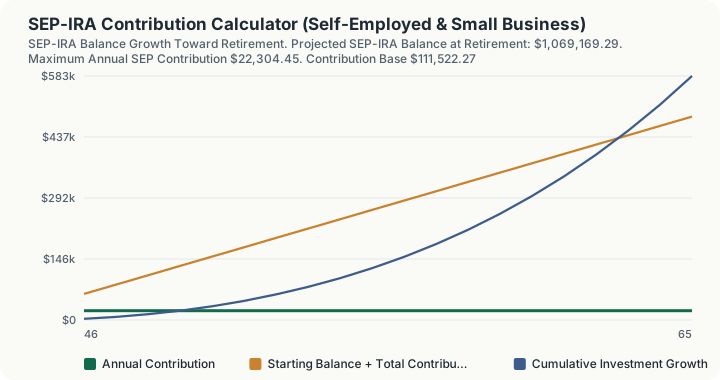
Quick Answer: A self-employed sole proprietor with $100,000 of net self-employment income can contribute up to $18,587.04 to a SEP-IRA for 2026: 20% of net earnings from self-employment, capped at $72,000. The whole contribution is employer money. On the defaults, $120,000 of net profit supports $22,304.45 a year, which from age 45 to 65 on a $40,000 starting balance at 7% projects to $1,069,169.29.
Overview
A Simplified Employee Pension, or SEP-IRA, is the plainest retirement plan available to a small business or a self-employed individual. There's no plan document to draft in the same way a 401(k) requires, no annual filing, and setup can be as simple as opening the account and making a contribution before the tax filing deadline. In exchange for that simplicity, a SEP-IRA gives up two things a Solo 401(k) has: there is no employee elective-deferral component at all, and every dollar contributed is an employer contribution, and if the business has any other eligible employees, they are legally entitled to a contribution at the same percentage of their pay as the owner.
That second point makes the SEP-IRA best suited to two situations: a genuinely solo operation with no other workers, where the "must cover employees equally" rule never comes into play, or a small team where the owner is comfortable extending the same contribution rate to everyone. For a growing business with several employees, the cost of covering everyone at the owner's contribution rate often makes a 401(k) with more flexible employer contribution design a better fit.
How This Is Calculated
For a W-2 owner-employee of a corporation, the calculation is simple: the SEP contribution is 25% of compensation, capped at the 2026 dollar limit of $72,000, and capped further by the $360,000 IRC Sec. 401(a)(17) compensation limit (25% of $360,000 is $90,000, so the $72,000 dollar cap is what actually binds at that income level).
For a self-employed sole proprietor, the calculation has an extra, frequently mishandled step. You cannot apply 25% directly to your Schedule C net profit. Two adjustments come first. First, subtract the deductible one-half of self-employment tax from net profit, per IRC Sec. 401(c)(2), to arrive at "net earnings from self-employment." Second, because the 25% contribution rate would otherwise need to be applied to a number that already has the contribution subtracted out of it (a circular definition), IRS Publication 560 provides a "reduced rate" shortcut: divide the stated rate by (1 plus the stated rate). For the maximum 25% SEP rate, that reduced rate works out to exactly 20%. So the actual formula for a sole proprietor is 20% of net earnings from self-employment, not 25% of net profit, and the two descriptions ("25% of compensation" and "20% of net self-employment earnings") aren't competing methods, they're the same worksheet, expressed from two different starting points.
Either way, the resulting contribution is then capped at $72,000 for 2026, the SEP-IRA's dollar limit, which is identical to the overall IRC Sec. 415(c) defined-contribution plan limit.
Worked Example
The contribution: a sole proprietor at $100,000 of net profit
Step 1 -- SE-taxable earnings. $100,000 x 92.35% = $92,350.00
Step 2 -- Self-employment tax. $92,350 x 15.3% = $14,129.55. The 12.4% Social Security piece stays well under the 2026 wage base of $184,500, and the 2.9% Medicare piece is uncapped.
Step 3 -- The deductible half. $14,129.55 / 2 = $7,064.78
Step 4 -- Net earnings from self-employment. $100,000 - $7,064.78 = $92,935.22
Step 5 -- Apply the reduced rate. 25% / 125% = 20%, so $92,935.22 x 20% = $18,587.04
Step 6 -- Test the dollar cap. $18,587.04 is below $72,000, so the cap does not bind and the contribution stands at $18,587.04
Note what step 5 did not do. It did not take 25% of $100,000, which would have been $25,000, and it did not take 25% of $92,935.22 either. The reduced rate exists because the contribution is itself deducted from the base it is measured against, and 20% is the algebraic solution to that circularity, not an approximation of it.
Carrying the default case forward year by year
The calculator's own defaults are a $120,000 net profit, a $40,000 existing balance, ages 45 to 65 and a 7% return. That profit supports an annual contribution of $22,304.45 on the same six steps above.
Step 7 -- Age 46, the first year. ($40,000 + $22,304.45) x 1.07 = $65,104.45, of which $2,800.00 is growth
Step 8 -- Age 47, the second year. ($65,104.45 + $22,304.45) x 1.07 = $91,966.21, cumulative growth now $7,357.31
Step 9 -- Age 55, the halfway mark. Balance $386,854.33, of which $263,044.50 is money paid in and $123,809.83 is growth
Step 10 -- Age 65, retirement. Balance $1,069,169.29, from $446,089.00 of contributions and $583,080.29 of investment growth
The crossover is the thing to notice. At age 55 the account is still mostly contributions; by 65 growth has overtaken them. Twenty years of a contribution that never changes turns $446,089 into a shade over a million dollars, and more than half of the ending balance is money the owner never earned in the business.
Where the cap bites, and where the W-2 route diverges
Step 11 -- A consultant at $1,000,000 of net profit. Net earnings from self-employment $975,170.25, and 20% of that is $195,034.05 -- so the contribution is capped at $72,000.00
Step 12 -- A corporate owner-employee paid $150,000 of W-2 wages. $150,000 x 25% = $37,500.00, because W-2 compensation takes the stated 25% directly with no SE-tax adjustment and no reduced rate
Step 12 is worth dwelling on. The corporate owner drawing a $150,000 salary contributes $37,500, while the sole proprietor with $150,000 of Schedule C profit would contribute $27,880.57, because their base is reduced twice before the rate is applied. That gap is one of the real arguments for an S-Corp election, and it is entirely a function of which line the 25% is measured from. Above $360,000 of W-2 pay the IRC Sec. 401(a)(17) compensation limit caps the base, but 25% of $360,000 is $90,000, so the $72,000 dollar cap binds first in every case.
The Employee Coverage Rule
If a business sponsoring a SEP-IRA has any common-law employees who meet the plan's eligibility requirements, generally: at least age 21, worked for the employer in at least 3 of the last 5 years, and earned at least the 2026 minimum compensation threshold of $800, the employer must contribute the same percentage of compensation for those employees as it contributes for the owner. This is a real compliance requirement under IRC Sec. 408(k)(3), not a suggestion. A sole owner contributing 20% of their own net earnings to themselves, while employing someone eligible for the plan and contributing nothing to that employee's SEP-IRA, is a disqualifying error that can unwind the plan's tax-favored status. Businesses expecting to hire should model the cost of covering future employees at the same rate before committing to a SEP over a plan with more contribution-design flexibility.
Common Pitfalls
- Applying 25% to raw net profit instead of net earnings from self-employment. This overstates the contribution; the correct self-employed multiplier is 20% of net profit minus the deductible half of SE tax, not 25% of net profit directly.
- Ignoring the employee coverage requirement. Assuming a SEP-IRA works like a Solo 401(k) once the business has employees is a costly mistake; every SEP-eligible employee must get the same contribution rate as the owner.
- Contributing after the tax filing deadline (with extensions). A SEP-IRA is one of the few plans that can be opened and funded as late as the business's extended tax filing deadline for the prior year, but that deadline is firm.
- Confusing SEP-IRA and Traditional IRA contribution limits. A SEP-IRA contribution does not use up your separate $7,500 (2026) Traditional or Roth IRA contribution room; they are independent limits.
- Assuming a SEP-IRA allows employee salary deferrals. Unlike an older SARSEP (no longer available for new plans), a modern SEP-IRA has no elective-deferral feature; participants cannot choose to defer their own salary into it.
What This Does Not Account For
- Employees other than the owner. This calculator computes the owner's own maximum contribution; it does not model the cost of covering other eligible employees at the same percentage, which the compliance note above flags as a real, separate cost.
- Multiple SEP or 401(k) plans. If the same business also sponsors a 401(k) or another defined-contribution plan, the $72,000 combined limit generally applies across all employer plans for that business, not per plan.
- Plan and custodian fees. Account maintenance or investment fees are not modeled in the growth projection.
- Year-to-year income volatility. The projection assumes the same net profit or compensation figure repeats every year.
Frequently Asked Questions
SEP-IRA vs. Solo 401(k), which is better for me?
Can I contribute to a SEP-IRA and a Traditional or Roth IRA in the same year?
Is the SEP-IRA contribution tax-deductible?
What's the minimum compensation to be an eligible employee under a SEP?
Sources
- Internal Revenue Service, COLA Increases for Dollar Limitations on Benefits and Contributions (SEP-IRA dollar cap and minimum compensation, 2026). irs.gov
- Internal Revenue Service, Publication 560, "Retirement Plans for Small Business (SEP, SIMPLE, and Qualified Plans)," Chapter 5, "Table and Worksheets for the Self-Employed.". irs.gov/publications/p560
- Internal Revenue Code Sec. 408(k)(3), SEP nondiscrimination and uniform contribution percentage requirement. sec.gov
Also consulted: Internal Revenue Service, "Self-employed individuals: Calculating your own retirement plan contribution and deduction," irs.gov.