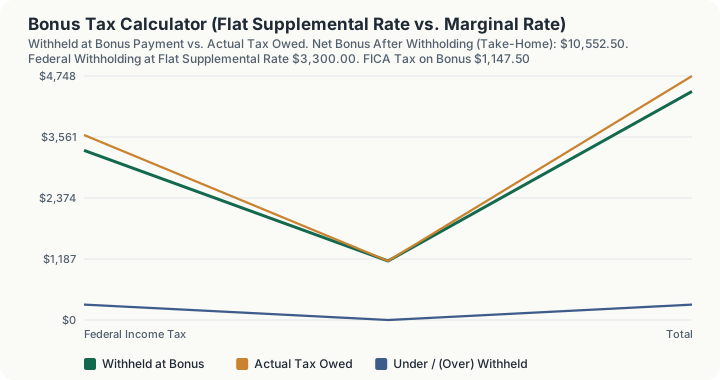
Quick Answer: A $15,000.00 bonus stacked on top of $140,000.00 in other W-2 wages (single filer) is actually taxed at $3,600.00 in federal income tax plus $1,147.50 in FICA, for $4,747.50 in real total tax. Because the employer withholds at the flat 22% supplemental rate instead, only $4,447.50 gets withheld at payment, leaving $300.00 under-withheld that comes due at filing. Net take-home on the bonus check is $10,552.50.
Overview
A bonus is not taxed at a special "bonus rate." It is ordinary income, taxed exactly like the rest of your salary, at your marginal federal tax bracket once it is stacked on top of everything else you earned that year. The confusion comes from how it is withheld, not how it is taxed.
The IRS classifies a bonus as a "supplemental wage," the same category as commissions, severance pay, and RSU vesting income. Publication 15 (Circular E) gives employers a shortcut for withholding on supplemental wages paid separately from a regular paycheck: a flat 22% federal rate, rising to a mandatory 37% on any cumulative supplemental wages above $1,000,000 from that employer in the calendar year. Most employers use the flat rate because it is simple to apply consistently across every employee regardless of salary.
That flat rate is a withholding convenience, not a tax calculation. If your real marginal bracket on the bonus is above 22%, which happens for most single filers once stacked income crosses roughly $50,000-$105,700 in taxable income (and even sooner filing separately), the flat withholding falls short of what you actually owe, and the shortfall becomes a balance due at filing. If your real marginal bracket is below 22%, the opposite happens: too much gets withheld, and the excess comes back as part of your refund. This calculator computes both numbers side by side so you know which situation you are in before the check even arrives.
How This Is Calculated
- Actual marginal tax on the bonus. Computed by running this platform's progressive-bracket engine twice against the full 2026 federal bracket schedule for your filing status: once on your other W-2 wages alone, and once with the bonus stacked on top. The difference is the bonus's true incremental tax cost.
- Actual FICA on the bonus. Social Security tax (6.2%) applies up to the annual wage base limit, tracking how much of that base your other wages already used up; Medicare tax (1.45%) applies with no cap; Additional Medicare tax (0.9%) applies once combined wages cross the filing-status threshold. FICA is statutory, not elective, so the amount withheld always equals the amount actually owed.
- Flat-rate federal withholding. Computed against the $1,000,000 cumulative supplemental-wage cliff: 22% on the portion of this bonus that keeps cumulative supplemental wages at or below $1,000,000 for the year, 37% on any portion above it.
- The gap. Actual total tax due (marginal income tax plus FICA) minus total withheld at payment (flat-rate income tax plus FICA) is the amount you will owe, or get back, when you file.
Worked Example
Using the calculator's default inputs:
- Bonus Amount: $15,000.00
- Other W-2 Wages This Year: $140,000.00
- Prior Supplemental Wages This Year: $0.00
- Filing Status: Single
Step by step:
- Taxable income without the bonus: $140,000 − $16,100 standard deduction = $123,900.00, already inside the 24% bracket ($105,700-$201,775). Tax on that base: $22,334.00.
- Taxable income with the bonus: $140,000 + $15,000 − $16,100 = $138,900.00, still inside the same 24% bracket. Tax on that combined amount: $25,934.00.
- Marginal tax on the bonus: $25,934.00 − $22,334.00 = $3,600.00 (exactly 24% of $15,000, since the entire bonus lands within one bracket).
- FICA on the bonus: Social Security on the remaining $44,500 of wage base capacity ($930.00) plus Medicare on the full $15,000 ($217.50); combined wages of $155,000 stay under the $200,000 Additional Medicare threshold, so that component is $0.00. Total FICA: $1,147.50.
- Actual total tax due: $3,600.00 + $1,147.50 = $4,747.50.
- Flat-rate federal withholding: $15,000 × 22% = $3,300.00 (well under the $1M cliff). Total withheld at payment: $3,300.00 + $1,147.50 = $4,447.50.
- Gap: $4,747.50 − $4,447.50 = $300.00 under-withheld. That amount becomes part of your balance due at filing unless you adjust withholding elsewhere or make an estimated payment.
- Net bonus check after flat-rate withholding: $15,000.00 − $4,447.50 = $10,552.50.
The $1,000,000 Supplemental Wage Cliff
The 22% flat rate is not unconditional. IRS rules require the employer to withhold at a mandatory 37% flat rate on any cumulative supplemental wages paid to one employee that exceed $1,000,000 in a calendar year, counting every bonus, commission, severance payment, and RSU vest from that employer combined. This most commonly affects senior executives, large one-time severance packages, or employees whose RSU vests and cash bonuses stack up within the same year. The calculator's "Prior Supplemental Wages This Year" input tracks how much of that $1,000,000 ceiling is already used, so a bonus that crosses the cliff mid-payment gets split correctly between the 22% and 37% portions.
What This Does Not Account For
- State and local supplemental wage withholding. Many states apply their own flat supplemental withholding rate (or use the regular percentage method) on top of federal withholding; this calculator computes federal income tax and FICA only.
- Pre-tax deductions taken from the bonus. If your employer runs 401(k) deferral, HSA contributions, or other pre-tax elections against bonus pay, actual taxable wages and take-home will differ from the gross figures shown here.
- The aggregate withholding method. Some employers instead fold the bonus into a regular paycheck and withhold using the standard percentage method on the combined total, which produces a different (often closer to accurate) withholding number than the flat supplemental rate modeled here. Check your pay stub to see which method your employer actually used.
- State income tax on the bonus itself. Only federal tax and FICA are modeled; use a state paycheck calculator for the state-tax side of the same bonus.
- Employer-side payroll tax. This calculator reports only the employee's FICA withholding, not the employer's matching share.
Common Pitfalls
- Assuming 22% is your bonus's real tax rate. It is a withholding shortcut, not a tax bracket. Your bonus is taxed at whatever your marginal rate is once stacked on your other income for the year, which is frequently higher than 22% for anyone earning a solid salary before the bonus even arrives.
- Being surprised by a smaller-than-expected bonus check. A $15,000 bonus that nets $10,552.50 after federal withholding and FICA is normal math, not a payroll error. Compare your actual pay stub against this calculator's flat-withholding figures to confirm your employer used the standard 22%/37% method.
- Not planning for the shortfall at filing. If your marginal rate exceeds 22%, the gap does not disappear, it shows up as a larger balance due (or smaller refund) at tax filing. Increasing withholding elsewhere in the year, via Form W-4 Line 4c, or making an estimated tax payment can close that gap in advance.
- Ignoring the $1,000,000 cliff on stacked supplemental income. Executives or employees with large RSU vests earlier in the year can unexpectedly cross into 37% withholding on a subsequent bonus, even if their overall marginal bracket is lower than 37%. That produces temporary over-withholding on the excess portion, correctable at filing.
- Confusing FICA withholding with income tax withholding. FICA is not adjustable and always equals what is actually owed; only the federal (and state) income tax portion of a bonus is subject to the flat-rate-versus-marginal-rate mismatch this calculator explains.
Frequently Asked Questions
Is my bonus really taxed at a higher rate than my salary?
Can I ask my employer to withhold at a different rate?
Why is my bonus withheld differently from my regular paycheck?
Does this apply to RSU vesting income too?
What if my bonus is combined with my regular paycheck instead of paid separately?
Sources
- Internal Revenue Service: Publication 15 (Circular E), Employer's Tax Guide, Section 7, "Supplemental Wages.". irs.gov/publications/p15
- Internal Revenue Service: Publication 15-T, Federal Income Tax Withholding Methods. irs.gov/publications/p15t
- Internal Revenue Service: Revenue Procedure 2025-32, 2026 federal income tax brackets and standard deduction amounts. irs.gov
- Social Security Administration: 2026 COLA Fact Sheet, Social Security wage base and FICA rates. ssa.gov