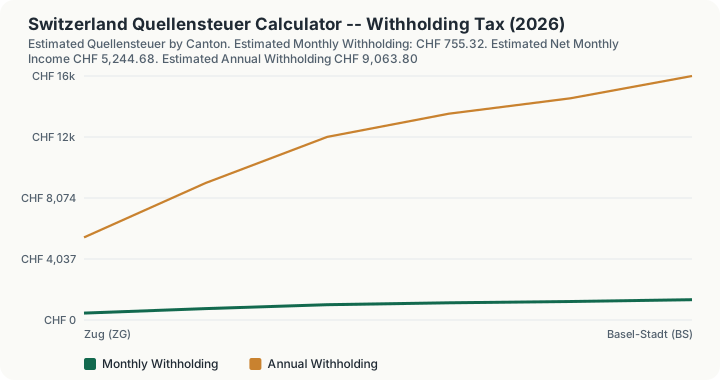
Quick Answer: A single foreign worker (Tariff A, no children) earning CHF 6,000 a month gross in Zurich has an estimated CHF 755.32 withheld monthly under Quellensteuer, leaving roughly CHF 5,244.68 net, an effective rate of about 12.6%. The identical worker in Zug is estimated at CHF 455.64. This is an ESTIMATE from this platform's own income-tax model, not the official cantonal withholding table.
Overview
Quellensteuer ("tax at source", also called withholding tax) is how Switzerland collects income tax from most foreign employees who do not hold a permanent C settlement permit, plus cross-border commuters working in Switzerland. Instead of filing an ordinary annual tax return like a Swiss citizen or C-permit holder, these workers have income tax deducted directly from every paycheck by their employer, based on an official tariff code that encodes marital status, number of children, and whether church tax is included.
The tariff code itself is a short string like A0N or C2Y: the first letter identifies the household type (A for single with no children, B for a married single-earner household, C for a married household where both spouses earn income, H for a single parent with children), the number that follows is the child count, and the final letter indicates whether church tax is bundled in (Y) or not (N). Each canton publishes its own detailed monthly withholding tables by gross-wage band for every tariff code combination -- large official PDFs, not a single formula.
This calculator does NOT reproduce those official tables. It ESTIMATES your withholding using this platform's own Switzerland income-tax model (the same federal-bracket-plus-cantonal-estimate approach used across this platform's Swiss calculators), applying a marital-status-appropriate tax table to your annualized income and a rough per-child reduction. This gets you into a broadly correct range for planning purposes, but it will not match your actual payslip to the franc -- for that, use your employer's payroll department or your canton's official Quellensteuer tables.
How This Is Calculated
- Annualize gross income. Your entered gross monthly income is multiplied by 12 to get an annual figure.
- Apply a marital-status-appropriate combined tax model. Tariff codes A and C are estimated using this platform's single-filer combined (federal + cantonal + communal) tax model; tariff codes B and H use the married-filer model, reflecting that B and H recipients are taxed on a household basis in the real tariff system.
- Apply an illustrative per-child reduction. Each dependent child reduces the effective rate by an illustrative 1 percentage point, reflecting the real tariff system's built-in child allowance (the exact reduction in the official tables is more granular and canton-specific than this flat approximation).
- Convert back to monthly. The resulting effective rate is applied to your annualized income for an estimated annual withholding figure, then divided by 12 for the monthly estimate shown as the headline result.
Worked Example
Using the calculator's default inputs -- CHF 6,000/month gross, Tariff A (single, no children), Zurich:
- Annualized income: CHF 6,000 × 12 = CHF 72,000.
- This platform's Zurich single-filer model estimates combined tax of CHF 9,063.80 at CHF 72,000 (federal tax of CHF 1,027.80 in the 2.97% bracket that starts at CHF 58,000, plus cantonal and communal tax of CHF 8,036.00 interpolated between this platform's CHF 50,000 and CHF 80,000 reference points).
- Effective rate: CHF 9,063.80 ÷ CHF 72,000 ≈ 12.59%.
- Estimated monthly withholding: CHF 9,063.80 ÷ 12 ≈ CHF 755.32.
- Estimated net monthly income: CHF 6,000.00 − CHF 755.32 = CHF 5,244.68.
- Switching only the canton to Zug (same income, same tariff): estimated combined tax falls to CHF 5,467.67, a monthly withholding of CHF 455.64 and a 7.59% effective rate, leaving CHF 5,544.36 net. The federal component is identical in both cantons; the entire gap is cantonal and communal.
What This Does Not Account For
- The exact official monthly tariff table. Each canton publishes detailed Quellensteuer tables by gross-wage band and tariff code -- large, precise, and updated periodically. This calculator's estimate is built from a general income-tax model, not those exact tables, and will diverge from your actual payslip, sometimes by a meaningful amount.
- The deductions the official tariffs build in. The real tariff bands are built on a wage figure net of AHV/IV/EO, ALV and BVG contributions and a set of flat-rate professional and insurance deductions. This calculator applies its ordinary-assessment tax model straight to your GROSS annualized pay with no deduction at all, so its estimate will generally run higher than the published tariff at the same gross wage, not lower.
- Church tax (the Y/N tariff letter). This calculator does not distinguish between the church-tax-inclusive and church-tax-exclusive versions of each tariff code.
- Tariff C's real dual-earner mechanics. The real Tariff C system applies a specific rate designed to approximate a dual-earner household's combined liability; this calculator instead applies the single-filer model to your entered income as a simplification, which may not match the official Tariff C rate.
- The precise per-child reduction. The official tables build in child allowances that are more specific (and can vary somewhat by canton) than this calculator's flat 1-percentage-point-per-child approximation.
- Annual reconciliation (nachträgliche ordentliche Veranlagung). Some Quellensteuer payers -- notably those earning above certain thresholds, or C-permit applicants, or those requesting it -- must or may file an ordinary annual tax return that reconciles withheld tax against actual liability, potentially producing a refund or additional bill. Not modeled here.
- Your actual commune, not just the capital city. Like ordinary cantonal tax, Quellensteuer tables vary by commune within a canton; this calculator uses the capital city as a representative example.
Common Pitfalls
- Treating this calculator's output as your actual payslip figure. It is explicitly an estimate for planning purposes. Compare it against your real payslip and flag large discrepancies with your employer's payroll department, not this tool.
- Forgetting that getting a C permit changes everything. Once you hold a C settlement permit (or marry a Swiss/C-permit citizen, in some cases), you generally exit the Quellensteuer system and file an ordinary tax return instead -- often with more deduction opportunities than the withholding tariff assumes.
- Not requesting an annual reconciliation when you qualify. If your circumstances changed mid-year (marriage, a new child, a permit change) or your income crosses certain thresholds, you may be entitled to a reconciliation that could produce a refund -- Quellensteuer withholding is not always perfectly matched to your true annual liability.
- Confusing tariff code C with code B. Code B assumes a single earner in a married household; code C assumes both spouses earn -- using the wrong one (a common employer administrative error when a spouse's employment status changes) can meaningfully over- or under-withhold.
- Ignoring cantonal variation. Just like ordinary income tax, Quellensteuer rates differ by canton for the same income and tariff code -- always check the canton of actual employment, not residence, if they differ.
Frequently Asked Questions
Who actually pays Quellensteuer?
How do I know my tariff code?
Can I get money back if too much was withheld?
Why is this calculator's figure different from my actual payslip?
Does getting married change my tariff code?
Does Quellensteuer cover cantonal and communal tax, or just federal tax?
What if I work in one canton but live in another?
Sources
- Swiss Federal Tax Administration (ESTV): Form 58c 2026 federal tax tariff and official interactive tax calculator (swisstaxcalculator.estv.admin.ch), used for this calculator's underlying combined income-tax model. This calculator does NOT use each canton's official Quellensteuer monthly withholding tables directly -- consult those tables or your payroll department for exact figures. estv.admin.ch
Also consulted: Taxolution Advisory, hopli, Livingease, Zürcher Treuhand GmbH, and Swiss Relocation Portal: 2026 Quellensteuer tariff-code structure guidance (A/B/C/H family-status letters, child-count digit, Y/N church-tax letter), cross-corroborated.