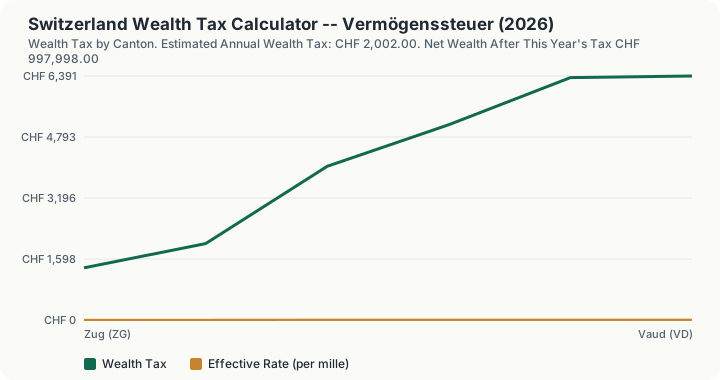
Quick Answer: A single filer in Zurich with CHF 1,000,000 of net wealth owes an estimated CHF 2,002.00 in annual Vermögenssteuer (net wealth tax) for 2026 -- an effective rate of about 2.00 per mille. The same net wealth in Zug, a much lower wealth-tax canton, owes only an estimated CHF 1,368.00.
Overview
Vermögenssteuer (net wealth tax) is an annual, recurring Swiss tax on your total net worth -- bank balances, securities, real estate at its cantonal tax value, and other assets, minus your debts -- charged every year in addition to, not instead of, ordinary income tax. This combination (income tax AND wealth tax, both recurring annually) is unusual among developed economies, where most countries either have no general wealth tax or have phased theirs out. Switzerland's cantons have kept it as a core, independently set revenue source.
Like income tax, there is no single national wealth-tax rate. Each of the 26 cantons sets its own rate schedule and exemption threshold, and each commune within a canton applies its own additional multiplier on top of the cantonal figure. This calculator covers 6 representative cantons by their capital city -- Zurich, Geneva, Vaud, Bern, Basel-Stadt, and Zug -- sourced directly from the Federal Tax Administration's own official interactive tax calculator, at a range of net-wealth levels. The spread between cantons is large: at the same net wealth, Geneva or Basel-Stadt can charge several times what Zug charges.
Wealth-tax rates are conventionally quoted per mille (‰, meaning per CHF 1,000 of wealth) rather than as a percentage, reflecting how small the individual rate typically is -- but because it applies EVERY year, not just once, a seemingly tiny per-mille rate compounds into a meaningful recurring cost over a long holding period, which is why wealth tax matters materially in Swiss retirement and estate planning even though the headline rates look small.
How This Is Calculated
- Net wealth. Total assets (at their applicable cantonal valuation, which for real estate is typically a lower official tax value, not market value) minus total debts, as of the relevant assessment date (typically 31 December).
- Cantonal + communal wealth tax. This calculator's model is built directly from the Federal Tax Administration's own official tax calculator, queried at a matrix of net-wealth reference points for each canton's capital city. Between reference points, this calculator interpolates; above the highest reference point (CHF 5,000,000), it extrapolates using that segment's marginal rate.
- Effective rate. Wealth tax divided by net wealth, expressed per mille (multiplied by 1,000 rather than 100).
Worked Example
Using the calculator's default inputs -- CHF 1,000,000 net wealth, Zurich:
- This platform's Zurich model estimates wealth tax of CHF 2,002.00 at exactly CHF 1,000,000 net wealth, sourced directly from ESTV's own official 2026 tax calculator.
- Effective rate: CHF 2,002.00 ÷ CHF 1,000,000 × 1,000 = 2.00‰ (2.00 per mille).
- Net wealth after this year's tax: CHF 1,000,000.00 − CHF 2,002.00 = CHF 997,998.00.
- Switching only the canton to Zug (same net wealth): wealth tax drops to CHF 1,368.00, roughly 32% lower than Zurich.
- Switching only the canton to Geneva (same net wealth): wealth tax rises to roughly CHF 5,116.00, more than double Zug's figure.
The canton-comparison table below repeats this exercise across all 6 covered cantons at whatever net-wealth figure you enter, sorted from lowest to highest.
What This Does Not Account For
- Your actual commune, not just the capital city. Communal multipliers on top of the cantonal wealth-tax rate vary within every canton, exactly as with income tax.
- Marital-status exemption differences. Married couples generally receive a meaningfully higher exemption threshold than single filers in most cantons (roughly double, among the 6 covered here) -- this calculator uses the single-filer schedule regardless of your actual filing status, which will understate the exemption (and therefore overstate the tax) for married couples at lower net-wealth levels.
- Real estate valuation quirks. Real estate is typically included at its official cantonal tax value, which is usually well below market value and varies in its exact calculation method by canton -- this calculator asks for your final net-wealth figure directly rather than computing property valuations itself.
- Debt deduction specifics. Most debts (mortgages, personal loans) are deductible against gross assets to reach net wealth, but some cantons apply specific rules or caps on certain debt types -- not modeled in detail here.
- The wealth-tax "shield" (Steuerbremse) some cantons apply. A few cantons cap combined income-plus-wealth tax at a percentage of income to prevent wealth tax from consuming an unreasonable share of a low-income, high-net-worth household's cash flow -- not modeled here.
- Geneva's 2026 provisional status. Like this platform's Switzerland Income Tax Calculator, Geneva's 2026 wealth-tax figures here are flagged as provisional pending finalization in the Federal Tax Administration's own official calculator.
Common Pitfalls
- Confusing gross assets with net wealth. Wealth tax applies to NET wealth (assets minus debts), not your gross asset total -- a highly leveraged real-estate portfolio can carry a much smaller wealth-tax bill than its gross asset value would suggest.
- Forgetting wealth tax exists at all when relocating to Switzerland. Newcomers from countries without a general wealth tax often budget only for income tax and are surprised by a second, separate annual bill on their net worth.
- Assuming a low-tax canton for income is automatically low-tax for wealth, or vice versa. The two rankings correlate but are not identical -- always check both if you are comparing cantons for a relocation decision.
- Not accounting for wealth-tax drag in long-term investment planning. A 2-3‰ annual wealth tax compounds meaningfully over decades and should be factored into long-run return expectations for Swiss residents, similar to (though usually smaller than) an ongoing fee drag.
- Overlooking real estate's typically favorable tax valuation. Because real estate is usually included at an official tax value below market value, a portfolio heavy in owned real estate can have a materially lower wealth-tax bill than the same net worth held in liquid securities at full market value.
Frequently Asked Questions
Why does Switzerland still have a wealth tax when most countries have abolished theirs?
Is wealth tax charged on top of income tax on investment gains?
Does wealth tax apply to foreign assets too?
Is Geneva's figure reliable?
How is wealth tax different from Eigenmietwert?
Does wealth tax apply to pension assets like Pillar 3a or Pillar 2?
Do I need to declare foreign bank accounts and investments for wealth tax purposes?
Sources
- Swiss Federal Tax Administration (ESTV): official interactive tax calculator, swisstaxcalculator.estv.admin.ch, tax year 2026 (net wealth tax totals for Zurich, Geneva, Vaud, Bern, Basel-Stadt, and Zug capital cities, single filer). estv.admin.ch