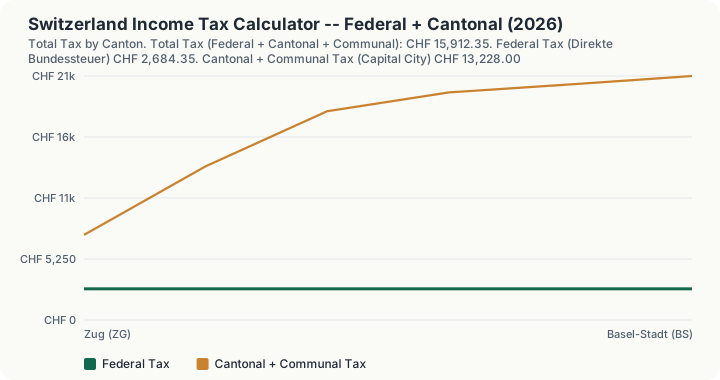
Quick Answer: A single filer in Zurich with CHF 100,000 of taxable income owes an estimated CHF 15,912.35 in combined 2026 Swiss income tax: CHF 2,684.35 in federal tax (Direkte Bundessteuer, identical everywhere in Switzerland) plus CHF 13,228.00 in cantonal and communal tax at Zurich city's rates. The same income and filing status in Zug, Switzerland's lowest-tax canton in this comparison, owes only CHF 10,009.35 total.
Overview
Switzerland does not have a single national income-tax rate. This calculator is built around that fact: it always shows you two very different numbers stacked together. The first, federal tax (direkte Bundessteuer), is genuinely national -- every taxpayer in Switzerland with the same taxable income and filing status pays exactly the same federal tax, whether they live in a mountain village or downtown Zurich. The second, cantonal and communal tax, is anything but national. Switzerland's 26 cantons each set their own income-tax law, their own tariff, and their own multiplier (Steuerfuss); every commune within a canton then applies its own additional multiplier on top of the cantonal figure. The result is that the SAME income can produce a combined tax bill roughly two to three times higher in one canton's capital than in another's.
This calculator covers 6 representative cantons -- Zurich, Geneva, Vaud, Bern, Basel-Stadt, and Zug -- each estimated at its OWN capital city (Zurich city, Geneva city, Lausanne, Bern city, Basel city, Zug city). These are not the only 26 possibilities, and even within one of these 6 cantons, moving to a different commune changes your communal tax multiplier and therefore your total bill. Treat the figures here as a representative estimate for that canton's capital, not a replacement for your own commune's tax office calculation.
Use the canton selector to see how dramatically the same income is taxed differently depending on where in Switzerland you live -- this is the single most important thing to understand about Swiss income tax, and the reason a generic "Switzerland income tax rate" is a meaningless number.
How This Is Calculated
- Federal tax (direkte Bundessteuer). Computed from the official 2026 ESTV Form 58c tariff table, which applies a series of progressive marginal-rate brackets (different schedules for single filers and married couples) up to a flat 11.5% cap that applies to the ENTIRE taxable income once you cross roughly CHF 794,000 (single) or CHF 941,500 (married).
- Cantonal + communal tax. Estimated for your selected canton's capital city, using this platform's own model built directly from Switzerland's official federal tax administration (ESTV) online tax calculator at a matrix of reference incomes. Between reference points, this calculator interpolates; above the highest reference point (CHF 500,000), it extrapolates using that segment's marginal rate. This is a representative approximation of each canton's real, much more granular statutory bracket-and-multiplier system, not a bracket-by-bracket replication of cantonal tax law.
- Total tax and rates. Federal and cantonal/communal tax are added together for the headline total. The effective rate divides total tax by taxable income; the marginal rate estimates the tax on your next CHF 1,000 of income, which is the number that actually matters when deciding whether an extra deduction (like a Pillar 3a contribution) is worth making.
Worked Example
Using the calculator's default inputs -- CHF 100,000 taxable income, single, Zurich:
- Federal tax: CHF 100,000 falls in the 6.6% federal bracket that starts at CHF 82,100 (base tax CHF 1,502.95). Federal tax = 1,502.95 + 0.066 × (100,000 − 82,100) = 1,502.95 + 1,181.40 = CHF 2,684.35.
- Cantonal + communal tax (Zurich city): this platform's Zurich model returns CHF 13,228.00 at exactly CHF 100,000 taxable income, sourced from ESTV's own official 2026 tax calculator.
- Total tax: CHF 2,684.35 + CHF 13,228.00 = CHF 15,912.35, an effective rate of about 15.91%.
- Switching only the canton to Zug (identical income, identical filing status): cantonal + communal tax drops to CHF 7,325.00, for a total of CHF 10,009.35 -- nearly 37% less than in Zurich, despite an identical federal tax bill.
- Switching only the canton to Basel-Stadt: cantonal + communal tax rises to CHF 21,000.00, for a total of CHF 23,684.35 -- more than double Zug's bill.
The canton-comparison table below repeats this exercise across all 6 covered cantons at whatever income and filing status you enter, sorted from lowest to highest total tax.
What This Does Not Account For
- Your actual commune, not just the capital city. Every canton's communes set their own multiplier on top of the cantonal rate. A capital city figure is a reasonable anchor but can differ meaningfully from a smaller commune in the same canton -- some rural Zurich communes tax noticeably less than Zurich city itself, for example.
- Church tax (Kirchensteuer). Registered members of a tax-collecting church pay an additional percentage on top of cantonal tax in most cantons. Not modeled here.
- Wealth tax (Vermögenssteuer). A separate annual tax on net worth exists alongside income tax in every canton. See this platform's companion Switzerland Wealth Tax Calculator.
- Deductions you haven't already applied. This calculator starts from your TAXABLE income, meaning social-insurance contributions, occupational pension (Pillar 2), Pillar 3a contributions, professional expenses, and other standard deductions should already be subtracted before you enter a figure here. If you enter gross salary instead, your result will overstate your real tax.
- Geneva's 2026 provisional status. At the time this calculator was built, Geneva's 2026 cantonal tax law had not yet been finalized in the Federal Tax Administration's own official calculator (unlike the other 5 covered cantons). Geneva figures shown here (marked with an asterisk in the comparison table) should be treated as provisional and cross-checked against Geneva's own tax administration once final 2026 rates are published.
- Source tax (Quellensteuer). Foreign workers without a C permit are typically taxed at source via monthly payroll withholding rather than this ordinary assessment process. See this platform's companion Switzerland Quellensteuer Calculator.
Common Pitfalls
- Quoting "the Swiss tax rate" as a single number. There is no such thing. Always specify a canton (and ideally a commune) before comparing Swiss tax burdens -- the spread between this calculator's 6 covered cantons alone can exceed 100% of the tax bill at the same income.
- Confusing gross salary with taxable income. Swiss payroll deductions (AHV/IV/EO, ALV, BVG, Pillar 3a) and standard allowances reduce gross salary substantially before the tax brackets ever apply. Entering gross salary directly into this calculator will overstate your tax.
- Assuming low-tax cantons like Zug and Schwyz are low-tax at every income level. They generally are, but the size of the gap changes (and can compress or widen) as income rises, because each canton's own bracket progression is different in shape, not just in level.
- Ignoring the marginal rate when planning deductions. The effective rate tells you your overall burden; the marginal rate tells you what an additional CHF 1,000 of income (or an additional CHF 1,000 deduction, like part of a Pillar 3a contribution) actually costs or saves you.
- Forgetting that married couples use a different bracket schedule, not just "the same brackets on half the income." Switzerland's federal and cantonal married schedules are separately defined, not derived by halving a single-filer schedule (unlike some countries' income-splitting systems).
Frequently Asked Questions
Why does the same income get taxed so differently depending on the canton?
Which canton is cheapest?
Is this calculator accurate enough to file my taxes?
Why is Geneva marked as provisional?
Does this include wealth tax or church tax?
Sources
- Swiss Federal Tax Administration (ESTV): Form 58c, "Tabelle für die Berechnung der direkten Bundessteuer der natürlichen Personen 2026", published 6 January 2026. estv.admin.ch
Also consulted: Swiss Federal Tax Administration (ESTV): official interactive tax calculator, swisstaxcalculator.estv.admin.ch, tax year 2026 (federal + cantonal + communal totals for Zurich, Geneva, Vaud, Bern, Basel-Stadt, and Zug capital cities).