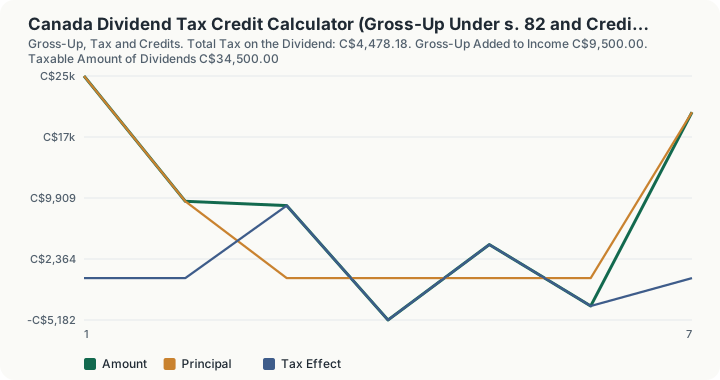
Quick Answer: C$25,000 of eligible dividends, taxed at a 26% federal and 12% provincial marginal rate, cost C$4,478.18. The Income Tax Act s. 82(1)(b) gross-up adds C$9,500, so C$34,500 enters income and attracts C$8,970.00 of federal tax against a s. 121 credit of C$5,181.82, and C$4,140.00 of provincial tax against a C$3,450.00 provincial credit. You keep C$20,521.82; the same cash as interest would cost C$9,500, a dividend advantage of C$5,021.82. All figures are in Canadian dollars.
What does this calculator do?
Canadian dividends are taxed through a two-step mechanism that exists for one reason: the money has already been taxed once, inside the corporation. The system tries to make the total tax on a dollar earned by a corporation and paid out to you roughly equal to the tax on a dollar you earned directly. It does that by grossing the dividend up to an approximation of the corporation's pre-tax income, taxing that larger figure at your ordinary rates, and then giving you a credit for the corporate tax notionally already paid.
Section 82(1)(b) sets the gross-up. Eligible dividends, which come out of income taxed at the higher general corporate rate, carry a 38% gross-up for taxation years ending after 2011. Other than eligible dividends, which come out of income that got the small business rate, carry 15% for years after 2018. Section 121 then gives a federal credit computed on the gross-up itself: 6/11 of the eligible gross-up, and 9/13 of the non-eligible gross-up.
That pairing is easy to get backwards, and getting it backwards mis-prices every dividend. The check that settles it is arithmetic: restate each credit as a share of the grossed-up amount, and the eligible case must come out at 15.0198% and the non-eligible case at 9.0301%, which are the two figures CRA publishes. This calculator derives both from the statutory fractions and reports them, so the pairing is visible rather than assumed.
The practical consequence people underestimate is the gross-up itself. At the defaults, C$9,500 of income appears on your return that never arrived as cash. That phantom income is what drives dividend recipients toward income-tested thresholds, most notably the Old Age Security recovery tax, faster than the same amount of interest income would.
How is this calculated?
Step 1: gross up the cash dividend under s. 82(1)(b).
G = C × g; g = 38% or 15%
Step 2: form the taxable amount of dividends.
T = C + G
Step 3: tax the grossed-up amount at ordinary marginal rates, federal and provincial:
Fed_before = T × r_f; Prov_before = T × rₚ
Step 4: compute the s. 121 federal credit on the GROSS-UP, not on the dividend.
DTC = G × 6/11 (eligible) or G × 9/13 (non-eligible)
Step 5: subtract both credits. Section 121 opens "There may be deducted from the tax otherwise payable under this Part by an individual for a taxation year", so the credit comes off your TOTAL federal tax, not just the tax on the dividend. Where the credit is bigger than the tax on the dividend, the surplus reduces the tax on your other income (entered as an input), down to nil. The credits are non-refundable, so any surplus beyond that is lost. The provincial credit works the same way against provincial tax:
Tax = (Fed_before − DTC) + (Prov_before − PDTC), each term ≥ −(tax on other income)
The result is the change in your total tax caused by the dividend, so it can be negative.
Worked Example
Using the page defaults: C$25,000 of eligible dividends, a 26% federal rate, a 12% provincial rate and a 10% provincial dividend tax credit.
Step 1: apply the s. 82(1)(b)(ii) gross-up. C$25,000 at 38%. C$9,500
Step 2: form the taxable amount of dividends. C$25,000 plus C$9,500. C$34,500
Step 3: federal tax before the credit. C$34,500 at 26%. C$8,970.00
Step 4: the s. 121(b) federal credit. Six elevenths of the C$9,500 gross-up is C$57,000 divided by 11, which is C$5,181.8181 and rounds to C$5,181.82
Step 5: check that against the published figure. C$5,181.82 over C$34,500 is 15.0197%, which rounds to 15.02%
Step 6: federal tax after the credit. C$8,970.00 less C$5,181.82. C$3,788.18
Step 7: provincial tax before the credit. C$34,500 at 12%. C$4,140.00
Step 8: the provincial credit. C$34,500 at 10%. C$3,450.00
Step 9: provincial tax after the credit. C$4,140.00 less C$3,450.00. C$690.00
Step 10: total tax. C$3,788.18 plus C$690.00. C$4,478.18
Step 11: what the same cash would cost as interest. C$25,000 at the combined 38% rate. C$9,500.00
The dividend advantage is C$5,021.82, and the effective rate on the cash received is 17.91% rather than 38%.
What does this calculator not account for?
- The provincial dividend tax credit has no national value and was not verified. Every province legislates its own, at different rates for eligible and non-eligible dividends. The 10% default here is a placeholder chosen to make the arithmetic legible. Look up your own before relying on the result.
- Marginal rates are inputs. A large dividend, grossed up, can push you into a higher bracket, so the last slice may be taxed above the rate you entered. The federal thresholds are indexed under s. 117.1 and are not stated in the Act.
- Excess credits are applied only to the other-income tax you enter. The calculator does not work out the tax on your other income itself, or which of your other non-refundable credits are claimed first; enter the tax actually left on other income after those credits. Excess dividend credits cannot be carried to another year.
- Provincial surtaxes are not modelled. In provinces that levy a surtax on high incomes, the effective rate on a dividend is higher than the headline provincial rate suggests.
- The gross-up's effect on income-tested measures is reported but not calculated. The page shows how much phantom income the gross-up adds, but it does not compute the resulting Old Age Security recovery, age credit reduction, or benefit clawbacks. Use the OAS clawback calculator on this site for the largest of those.
- No corporate side. This models only the shareholder's tax. Whether the corporation should pay a salary or a dividend, and whether a dividend can be designated eligible, depends on the general rate income pool and other corporate accounts not modelled here.
- Foreign dividends get none of this. The gross-up and credit apply only to taxable dividends from taxable Canadian corporations. A US or other foreign dividend is fully taxable at your marginal rate, with a foreign tax credit for withholding instead.
What mistakes do people make with this?
- Thinking the gross-up is a penalty. It is not. It is an estimate of the pre-tax corporate income behind your dividend, and the credit that follows is what gives the money back. Looking at the gross-up alone always makes dividends look worse than they are.
- Forgetting the gross-up counts for income-tested measures. A C$25,000 eligible dividend adds C$34,500 to income for the OAS recovery test. That C$9,500 of income you never received is worth C$1,425 of extra recovery at 15%.
- Assuming all Canadian dividends are treated the same. At identical rates, the same C$25,000 costs C$4,478.18 as an eligible dividend and C$7,466.35 as a non-eligible one, in the default provincial-credit configuration. Which box on your T5 the amount sits in matters a great deal.
- Expecting a refund when the credit exceeds the tax. The dividend tax credit is non-refundable. It reduces tax payable and nothing more.
- Comparing a dividend yield to an interest yield without adjusting for tax. Outside a registered account, a 4% eligible dividend and 4% interest are not the same money. The comparison only makes sense after tax.
Frequently Asked Questions
What is the dividend gross-up in Canada?
What is the federal dividend tax credit worth?
What is the difference between eligible and non-eligible dividends?
Why do dividends push me into the OAS clawback faster than interest?
Is the provincial dividend tax credit the same everywhere?
Sources
- Income Tax Act, R.S.C. 1985, c. 1 (5th Supp.), s. 82(1)(b): subparagraph (i) sets the gross-up on dividends other than eligible dividends at 15% for taxation years after 2018, and subparagraph (ii) sets the eligible dividend gross-up at 38% for years ending after 2011. Justice Laws Website, read 2026-08-31; Act current to 2026-06-21, last amended 2026-06-18. laws-lois.justice.gc.ca/eng/acts/I-3.3/section-82.html
- Income Tax Act, s. 121: paragraph (a) applies 9/13 to the s. 82(1)(b)(i) non-eligible gross-up for years after 2018, and paragraph (b) applies 6/11 to the s. 82(1)(b)(ii) eligible gross-up for years after 2011. Justice Laws Website, read 2026-08-31. laws-lois.justice.gc.ca/eng/acts/I-3.3/section-121.html
- Income Tax Act, s. 117(2), the federal marginal rates applied to the grossed-up amount. Justice Laws Website, read 2026-08-31. laws-lois.justice.gc.ca/eng/acts/I-3.3/section-117.html
Also consulted: Provincial marginal rates and provincial dividend tax credits are set in each province's own legislation and have no national value, so both are user inputs.