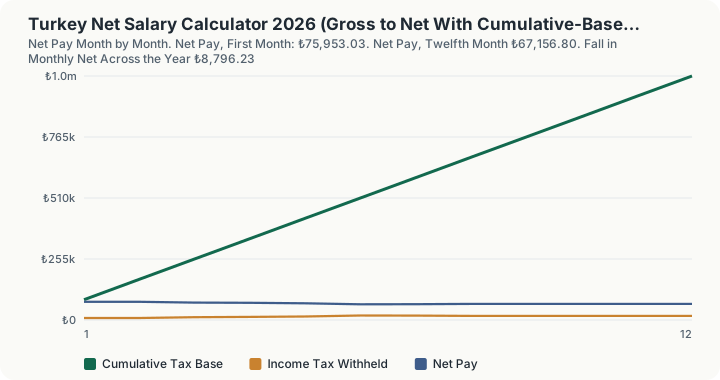
Quick Answer: On a gross salary of 100,000 TL a month in 2026, the first month's net pay is 75,953.03 TL. The twelfth month's net on exactly the same gross is 67,156.80 TL. Nothing about the contract changed. Turkish employers withhold on a running cumulative base, so the tariff is consumed as the year goes on and take-home pay falls month by month.
What does this calculator do?
A Turkish payslip has four deductions and one feature that surprises almost everyone who has been paid anywhere else.
The four deductions are the SGK premium at 14%, the unemployment insurance premium at 1%, income tax under the Gelir Vergisi Kanunu Article 103 tariff, and stamp duty at binde 7,59. The first two are charged on the prime esas kazanc, an earnings base clamped between a floor and a ceiling. The third is charged on gross pay after those two premiums come off. The fourth is charged on gross pay directly.
The feature is the kumulatif vergi matrahi, the cumulative tax base. Turkish wage withholding is not the annual tax divided by twelve. Each month the employer adds that month's taxable base to a running total, applies the whole Article 103 tariff to that running total, and withholds the difference between the result and everything already withheld that year. The tariff bands are therefore consumed progressively as the year advances. An employee whose pay never changes still crosses from 15% into 20%, and later into 27%, part way through the calendar year, and their net pay steps down each time it happens.
Two exemptions push in the other direction, both pinned to the minimum wage. Under GVK Article 23/18 the portion of wage income matching the minimum wage is relieved from income tax, and under the stamp duty law the portion matching the gross minimum wage is relieved from stamp duty. At exactly the minimum wage the two reliefs cancel both taxes outright, which is why the official Ministry payslip for 2026 shows no income tax line and no stamp duty line at all.
How is this calculated?
- Clamp the SGK earnings base. Premiums are charged on the prime esas kazanc, not on gross pay. The base is the gross wage held between the floor and the ceiling, where the ceiling is nine times the floor for 2026.
Base = min(max(Gross, Floor), Floor × 9)
- Take the employee premiums off that base. SGK is 9% for invalidity, old age and death plus 5% for general health insurance, and unemployment insurance is a further 1%.
SGK = Base × 0.14; Unemployment = Base × 0.01
- Form this month's taxable base. Gross pay less the two employee premiums. The income tax base is never the gross wage.
Matrahₘ = Gross − SGK − Unemployment
- Add it to the running cumulative base. This is the step that makes Turkish payroll behave differently from a flat monthly model.
Cumulativeₘ = ∑(k = 1 to m) Matrahₖ
- Apply the Article 103 wage tariff to the cumulative total, then subtract what the tariff gave last month. The difference is this month's tax before relief. Where the cumulative base crosses 190,000 TL, 400,000 TL or 1,500,000 TL, this figure steps up even though pay did not.
Taxₘ = T(Cumulativeₘ) − T(Cumulative_(m − 1))
- Difference the minimum wage credit the same way, on its own parallel cumulative base. The GVK 23/18 relief is a credit measured by the tax the minimum wage itself would bear under the same tariff, and running it cumulatively is what stops the relief drifting as the employee's own base climbs.
Creditₘ = T(CumExemptₘ) − T(CumExempt_(m − 1))
- Net the credit off, floored at zero. An employee cannot be withheld a negative amount.
IncomeTaxₘ = max(0, Taxₘ − Creditₘ)
- Charge stamp duty on the excess over the gross minimum wage. Note the exempt base here is the gross minimum wage, which is deliberately not the same figure as the income tax exemption base formed in step 6.
Stamp = max(0, Gross − MinWage_gross) × 0.00759
- Subtract everything from gross to reach net pay.
Netₘ = Gross − SGK − Unemployment − IncomeTaxₘ − Stamp
- Add the employer premiums to reach the true cost of the job. The employer pays 21.75% for SGK and 2% for unemployment insurance, and the 5510 incentive reduces the SGK portion only.
Cost = Gross + Base × (0.2175 − incentive) + Base × 0.02
Worked Example
An employee on 100,000 TL gross a month, on the 2026 figures.
Step 1: the SGK base. 100,000.00 TL sits between the 33,030.00 TL floor and the 297,270.00 TL ceiling, so the base is the full 100,000.00 TL.
Step 2: the premiums. 100,000.00 x 14% = 14,000.00 TL SGK, and 100,000.00 x 1% = 1,000.00 TL unemployment.
Step 3: the month one taxable base. 100,000.00 less 15,000.00 = 85,000.00 TL.
Step 4: the cumulative base after one month. 85,000.00 TL, entirely inside the 15% band.
Step 5: the tariff. 85,000.00 x 15% = 12,750.00 TL.
Step 6: the credit. The exempt base is the minimum wage net of its own premiums: 33,030.00 less 4,954.50 = 28,075.50 TL. At 15% that is 4,211.325, which rounds to 4,211.33 TL.
Step 7: month one income tax. 12,750.00 less 4,211.33 = 8,538.67 TL.
Step 8: stamp duty. (100,000.00 less 33,030.00) x 0,00759 = 66,970.00 x 0,00759 = 508.2963, which rounds to 508.30 TL.
Step 9: month one net. 100,000.00 less 15,000.00 less 8,538.67 less 508.30 = 75,953.03 TL.
Now run the same arithmetic forward to month three, where the cumulative base has reached 255,000.00 TL and has passed the 190,000 TL band ceiling.
Step 10: the tariff on 255,000.00 TL. 190,000.00 x 15% plus 65,000.00 x 20% = 28,500.00 plus 13,000.00 = 41,500.00 TL.
Step 11: less the tariff on the month two cumulative base of 170,000.00 TL. 170,000.00 x 15% = 25,500.00 TL, so month three's tariff is 41,500.00 less 25,500.00 = 16,000.00 TL.
Step 12: the size of the step. Month two's tariff was 12,750.00 TL. Month three's is 16,000.00 TL, which is 3,250.00 TL more withheld on pay that did not move.
Step 13: month twelve. The cumulative base reaches 1,020,000.00 TL and the 27% band is in play. The tariff for the month is 237,900.00 less 214,950.00 = 22,950.00 TL, the credit is 5,615.10 TL, and income tax is 17,334.90 TL, giving a net of 67,156.80 TL.
Step 14: the year's decline. 75,953.03 less 67,156.80 = 8,796.23 TL of monthly take-home lost between January and December.
At the minimum wage the picture is completely different. On 33,030.00 TL gross the deductions are 4,624.20 TL of SGK and 330.30 TL of unemployment insurance, income tax is relieved to zero and stamp duty to zero, and net pay is 28,075.50 TL in every month of the year. That is the figure the Ministry publishes, reproduced here from the tariff rather than copied.
What does this calculator not account for?
- Irregular pay. Level pay across twelve months is assumed. A bonus, a raise, a mid-year start or unpaid leave all change the cumulative base and none of them are modelled.
- A mid-year minimum wage revision. The minimum wage has historically been reset in July as well as January. This page applies one figure across the whole year.
- Private pension auto-enrolment, which deducts a further amount from many payslips.
- Union dues, court-ordered deductions and employer advances, which are payslip lines this calculator does not carry.
- Foreign employees and the 4/b regime. The rates modelled are 4/a private sector rates.
- Disability relief under GVK 31, which reduces the tax base for qualifying employees.
- Employers with more than one wage. Where an employee holds several jobs, the minimum wage exemption applies only to the highest wage.
- Whether the employer incentive is available at all. It is offered as a choice here and is subject to conditions this page does not test.
What mistakes do people make with this?
- Dividing the annual tax by twelve. That is the single most common error in Turkish gross to net arithmetic, and it overstates early-year pay and understates late-year pay.
- Treating the December net as the real salary. Both figures are real. The January number is what an offer letter usually implies and the December number is what the same job pays by the end of the year.
- Using the net minimum wage as the stamp duty exempt base. The stamp duty exemption uses the gross minimum wage. The income tax exemption uses the base net of premiums. Two figures, two bases.
- Forgetting the SGK ceiling. Above nine times the floor no further premium is charged, so the effective premium rate falls as pay rises.
- Assuming the employer incentive helps the employee. It reduces the employer premium only, and the net pay does not move by a single kurus.
- Applying the non-wage tariff to a salary. The 27% band runs to 1,500,000 TL for wage income but only to 1,000,000 TL for everything else.
Frequently Asked Questions
Why does my net salary fall every year around the middle of the year?
Is the minimum wage exemption a deduction or a credit?
Why is there no income tax on the minimum wage?
What is the SGK ceiling for 2026?
Does the employer incentive change my take-home pay?
Which figures move during the year?
Sources
- Revenue Administration of Turkey (GIB), the official authority for the national tax authority this calculator relates to. gib.gov.tr
All figures verified against primary sources on 31 August 2026
Also consulted: Gelir Idaresi Baskanligi, "Gelir Vergisi Tarifesi 2026", the GVK 193 Article 103 tariff, read 31 August 2026; Sosyal Guvenlik Kurumu, "Prime Esas Kazanc Miktarlari", monthly floor 33,030.00 TL and ceiling 297,270.00 TL for 1/1/2026 to 31/12/2026; Sosyal Guvenlik Kurumu, "Isveren Prim Oranlari", employee 14% plus 1% and employer 21.75% plus 2%; Calisma ve Sosyal Guvenlik Bakanligi, "Asgari Ucretin Net Hesabi ve Isverene Maliyeti", 01.01.2026 to 31.12.2026, gross 33,030.00 TL and net 28,075.50 TL; Damga Vergisi Kanunu 488, (1) sayili tablo IV/1/b at binde 7,59, and the (2) sayili tablo IV/34 wage exemption as amended by Law 7349.