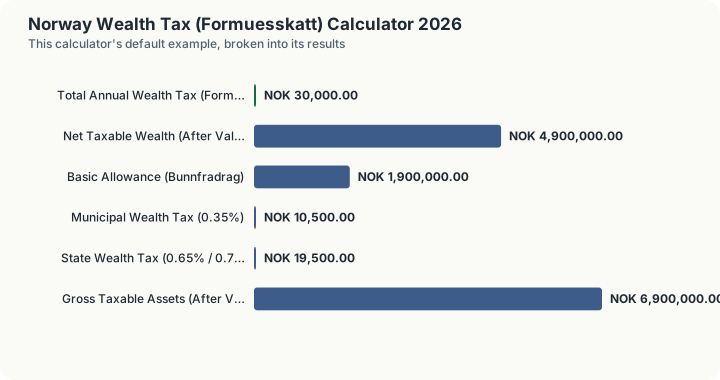
Quick Answer: A single Norwegian taxpayer with NOK 500,000 in cash, NOK 3,000,000 in shares, an NOK 8,000,000 primary home, an NOK 2,000,000 secondary home, and NOK 2,000,000 of debt has NOK 4,900,000 of net taxable wealth in 2026 -- NOK 3,000,000 above the NOK 1,900,000 basic allowance (bunnfradrag) -- and owes NOK 30,000 in total formuesskatt (NOK 10,500 municipal + NOK 19,500 state).
Overview
Formuesskatt (wealth tax) is one of the genuinely distinctive mechanics in the Norwegian tax system: unlike most developed economies, which taxed net wealth once and then largely abolished the practice, Norway still levies an annual tax on individuals' net worth -- bank deposits, shares, real estate, and other assets, minus debt -- above a basic allowance. It is paid in addition to, not instead of, ordinary income tax, and it applies every year regardless of whether the underlying assets produced any income or realized gain.
What makes formuesskatt genuinely tricky to calculate by hand is that different asset classes are not taxed at their full market value. Norway applies statutory "verdsettingsrabatter" (valuation discounts) that vary by asset type: cash is taxed at 100% of face value, shares at 80% of market value, a primary home at a sharply reduced 25% of value (with a steeper 70% rate on any value above NOK 10 million), and secondary homes at the full 100% with no discount at all. This calculator applies each asset-specific discount correctly, nets out debt at full value, and then runs the result through Norway's two-part (municipal + state) rate schedule for income year 2026.
How This Is Calculated
- Apply the statutory valuation discount to each asset class. For 2026:
| Asset | Taxable value |
|---|---|
| Bank deposits / cash | 100% of face value |
| Shares, equity certificates, fund units | 80% of market value (20% discount) |
| Primary home (primærbolig), value up to NOK 10,000,000 | 25% of that value |
| Primary home, value above NOK 10,000,000 | 70% of the excess |
| Secondary homes / other real estate | 100% of market value (no discount) |
- Sum the taxable values and subtract debt at full nominal value. This calculator applies no valuation discount to debt, so every krone of debt reduces net taxable wealth krone-for-krone. That is a simplification: where you hold discounted assets, Norway allocates debt proportionally instead, which raises the real base. See "What This Does Not Account For" below.
- Subtract the basic allowance (bunnfradrag). For 2026, the allowance is NOK 1,900,000 for a single filer, or NOK 3,800,000 for married/registered partners assessed jointly (exactly double). Net wealth at or below this allowance owes zero wealth tax.
- Apply the municipal and state rate schedules to net wealth above the allowance. Municipal wealth tax is a flat 0.35% on everything above the allowance. State wealth tax is two-tiered: 0.65% on the portion between the allowance and NOK 21,500,000, and 0.75% on any amount above NOK 21,500,000 -- giving a combined rate of 1.00% up to NOK 21.5 million and 1.10% above it.
Worked Example
Using the calculator's default inputs -- a single filer with NOK 500,000 cash, NOK 3,000,000 in shares, an NOK 8,000,000 primary home, an NOK 2,000,000 secondary home, and NOK 2,000,000 of debt:
- Cash taxable value: NOK 500,000 (100%)
- Shares taxable value: 80% x 3,000,000 = NOK 2,400,000
- Primary home taxable value: 8,000,000 is below the NOK 10,000,000 tier-1 threshold, so 25% x 8,000,000 = NOK 2,000,000
- Secondary home taxable value: NOK 2,000,000 (100%)
- Gross taxable assets: 500,000 + 2,400,000 + 2,000,000 + 2,000,000 = NOK 6,900,000
- Net taxable wealth: 6,900,000 - 2,000,000 (debt) = NOK 4,900,000
- Amount above the single allowance: 4,900,000 - 1,900,000 = NOK 3,000,000 (all within the first state tier, since it's far below NOK 21,500,000)
- Municipal tax: 3,000,000 x 0.35% = NOK 10,500
- State tax: 3,000,000 x 0.65% = NOK 19,500
- Total formuesskatt: 10,500 + 19,500 = NOK 30,000
If the same taxpayer were married and assessed jointly on identical combined assets, the allowance would double to NOK 3,800,000, leaving only NOK 1,100,000 above it -- cutting the total wealth tax to NOK 11,000, a saving of NOK 19,000 purely from the doubled allowance.
What This Does Not Account For
- Business assets, unlisted operating-company shares valued as a partnership interest, agricultural/forestry property, and commercial rental property each carry their own distinct verdsettingsrabatt (commonly 20-30%, and structured differently from the ordinary-shares rule) that this calculator does not model; if you hold these asset types, treat this as directional, not exact.
- Pension savings, life insurance with a savings element, and most retirement accounts, which are generally exempt from formuesskatt entirely and should not be entered as "cash" or "shares" here.
- The specific documented-value vs. calculated-value election for primary homes, and any dispute process with Skatteetaten over an assessed home value -- this calculator takes your entered market value at face value.
- Foreign assets and any wealth-tax treaty relief for taxpayers with cross-border holdings; Norway's formuesskatt generally applies to worldwide net wealth for residents, but treaty and foreign-tax-credit mechanics are outside this calculator's scope.
- Norway's proportional debt-allocation rules. Where a taxpayer holds assets that carry a valuation discount, Norwegian law reduces the deductible debt proportionally rather than allowing every krone of debt to offset net wealth in full. This calculator deducts debt at its full nominal value, as step 2 above describes, so if you hold discounted assets and carry significant debt your real formuesskatt base will be higher than the figure shown here. Check the allocation with Skatteetaten before relying on this result.
- Municipal rate variation. The 0.35% municipal component is the standard rate used here; individual kommuner are not modelled separately.
- The 80-percent-of-taxable-income wealth tax cap ("skattebegrensning") that can, in some circumstances, limit combined income and wealth tax as a share of income for taxpayers with high wealth but comparatively low income -- this calculator computes the standalone formuesskatt liability only.
- Year-to-year changes. Both the basic allowance and the state's second-tier threshold are typically adjusted annually; always confirm the current year's figures before relying on this for a different income year.
Common Pitfalls
- Valuing shares and cash the same way. Shares get a 20% discount; cash does not. Treating a share portfolio as if it were taxed at full face value overstates the wealth tax bill on that portion of assets by 20%.
- Forgetting the primary home's steep valuation discount. At 25% of value (up to NOK 10 million), a primary home contributes far less to taxable wealth than its market value would suggest -- a common source of people overestimating their own formuesskatt exposure.
- Assuming secondary homes get the same discount as a primary home. They don't -- secondary homes and other real estate are valued at 100% of market value, a meaningfully harsher rule that has driven real behavioral responses (selling second homes, restructuring ownership) since the discount was removed.
- Not subtracting debt, or subtracting it at a discounted value. Debt reduces net taxable wealth at full nominal value, with no haircut -- mortgaging an asset is one of the few genuinely effective ways to reduce formuesskatt exposure on it.
- Ignoring the doubled allowance for married couples. Because Norway assesses formuesskatt on combined household wealth for married/registered partners but also doubles the allowance, the actual tax owed is not simply "half of what a single person with the same total wealth would owe" -- it depends on where the combined wealth falls relative to the doubled thresholds, as this calculator's married scenario illustrates.
Frequently Asked Questions
What is formuesskatt and why does Norway still have it?
Do I pay formuesskatt to my municipality, the state, or both?
Why is my primary home taxed so much more lightly than my shares or secondary home?
Does debt reduce my wealth tax?
Is formuesskatt the same for married couples as for two single people with the same combined wealth?
What happens if my net wealth is exactly at the basic allowance?
Sources
- Skatteetaten (Norwegian Tax Administration), Wealth Tax rates page (skatteetaten.no/en/rates/wealth-tax/) -- basic allowance (bunnfradrag) and the municipal/state rate schedule for income year 2026. skatteetaten.no
Also consulted: Skatteetaten, "Valuation discount in connection with assessment of wealth" (skatteetaten.no/en/person/taxes/get-the-taxes-right/valuation-discount-in-connection-with-assessment-of-wealth/) -- verdsettingsrabatt percentages for shares, primary homes, and secondary homes.