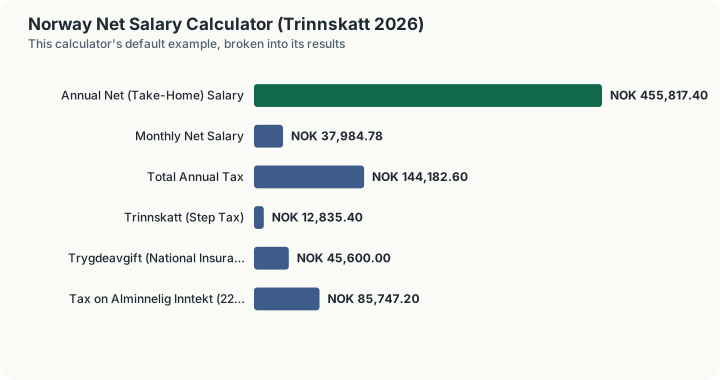
Quick Answer: For a gross annual salary of NOK 600,000 in Norway for income year 2026, take-home pay is NOK 455,817.40 (NOK 37,984.78 per month), after NOK 144,182.60 in total tax -- made up of NOK 85,747.20 tax on alminnelig inntekt (general income), NOK 12,835.40 trinnskatt (step tax), and NOK 45,600 trygdeavgift (national insurance contribution). That is an effective tax rate of 24.03%.
Overview
Norway's personal income tax system is not a single progressive schedule the way many countries' federal income tax is. It is three parallel calculations run on the same salary at once: a flat 22% tax on alminnelig inntekt (general income, after deductions), a separate progressive trinnskatt (step tax) on gross personal income with no deductions at all, and a trygdeavgift (national insurance contribution) that funds the Norwegian welfare state (folketrygden) directly. Your actual tax bill is the sum of all three, and none of them replaces the others.
This calculator runs a Norwegian employee's gross annual salary through all three calculations for income year 2026 using Skatteetaten's own current brackets, rates, and deduction figures, and returns the exact net (take-home) salary, the breakdown by tax type, and both your effective and marginal tax rate. If you've ever tried to reconcile a Norwegian payslip against a generic "income tax calculator" and gotten a number that doesn't match, it's almost always because that calculator missed one of these three layers -- most commonly trinnskatt, which most non-Norwegian tax tools have never heard of.
How This Is Calculated
- Apply minstefradrag (minimum standard deduction) to get alminnelig inntekt. Minstefradrag is a standard deduction for work-related costs, set at 46% of gross wage income for 2026, capped at NOK 95,700. Alminnelig inntekt is then gross income minus minstefradrag, minus the personfradrag (basic personal allowance) of NOK 114,540, minus any other deductions you claim (union dues, documented commuting costs, interest paid on debt, etc.).
- Tax alminnelig inntekt at a flat 22%. This is the closest thing Norway has to a conventional income tax -- a single flat rate applied to income after all standard and itemized deductions.
- Calculate trinnskatt (step tax) on personinntekt. Personinntekt is your gross wage income with none of the above deductions applied. Trinnskatt is fully separate from the 22% general income tax and layers on top of it, across six income bands for 2026 (the first is a 0% band):
| Bracket | Income range (NOK) | Rate |
|---|---|---|
| 1 | 0 -- 226,100 | 0% |
| 2 | 226,100 -- 318,300 | 1.7% |
| 3 | 318,300 -- 725,050 | 4.0% |
| 4 | 725,050 -- 980,100 | 13.7% |
| 5 | 980,100 -- 1,467,200 | 16.8% |
| 6 | Above 1,467,200 | 17.8% |
Each bracket only taxes the slice of income that falls within it -- the same "marginal bracket" logic as most countries' income tax, just running as a second, parallel system alongside the 22% flat tax.
- Calculate trygdeavgift (national insurance contribution) on personinntekt. For ordinary wage income, the rate is 7.6% in 2026, with no contribution owed at all below a lower threshold of NOK 99,650. A "25%-regelen" marginal-relief rule then caps the contribution at 25% of the amount by which personinntekt exceeds that threshold, so that crossing the threshold can never reduce your net pay -- the contribution simply phases in gradually rather than jumping to the full 7.6% immediately.
- Sum all three and subtract from gross income. Net salary is gross income minus (tax on alminnelig inntekt + trinnskatt + trygdeavgift). No further deductions apply beyond this point for an ordinary salaried employee with no other income sources.
Worked Example
Using the calculator's default inputs -- a gross annual salary of NOK 600,000 with no additional deductions:
- Minstefradrag: min(46% x 600,000, 95,700) = min(276,000, 95,700) = NOK 95,700 (the cap binds)
- Alminnelig inntekt: 600,000 - 95,700 - 114,540 = NOK 389,760
- Tax on alminnelig inntekt: 22% x 389,760 = NOK 85,747.20
- Trinnskatt: 0% on the first 226,100; 1.7% on 226,100-318,300 (92,200 x 1.7% = 1,567.40); 4.0% on 318,300-600,000 (281,700 x 4.0% = 11,268.00) = NOK 12,835.40
- Trygdeavgift: naive = 600,000 x 7.6% = 45,600; marginal-relief cap = 25% x (600,000 - 99,650) = 125,087.50 -- the naive figure is lower, so it applies uncapped = NOK 45,600
- Total tax: 85,747.20 + 12,835.40 + 45,600 = NOK 144,182.60
- Net salary: 600,000 - 144,182.60 = NOK 455,817.40 (NOK 37,984.78/month)
That's an effective tax rate of 24.03% and a marginal rate of 27.7% (22% general income tax + 4.0% trinnskatt bracket + 7.6% trygdeavgift on the next krone earned).
What This Does Not Account For
- Fagforeningskontingent, BSU, and other itemized deductions beyond the "Other Deductions" field. This calculator applies minstefradrag automatically and lets you enter a single lump-sum figure for everything else; it does not itemize individual deduction categories (union dues, home-office costs, BSU housing-savings credit, parental-leave-related items, etc.) separately.
- Municipal wealth tax (formuesskatt) on savings, shares, or property. This is a completely separate tax from income tax -- see the companion Norway Wealth Tax (Formuesskatt) Calculator for that.
- Employer's payroll tax (arbeidsgiveravgift). This is paid by the employer on top of your gross salary and never appears on your payslip or affects your net pay directly.
- Non-wage personal income (self-employment, pension, or capital income), each of which has its own trygdeavgift rate (10.8% for most self-employment income, 5.1% for pension income) and, for capital income, no trygdeavgift at all.
- Non-resident or split-year taxation, tax deduction cards (skattekort) with a specific withholding percentage, or advance/final settlement timing. This models the annual liability, not month-by-month payroll withholding mechanics.
- County/municipality-specific variations. Norwegian income tax (as opposed to wealth tax) does not vary by municipality, so this is a genuine nationwide calculation, not an approximation.
Common Pitfalls
- Forgetting trinnskatt exists at all. Because it is calculated separately from the "main" 22% income tax and doesn't appear as its own labeled withholding on every quick summary, many people underestimate their marginal tax rate by assuming 22% is the whole story once they're past the tax-free personfradrag.
- Applying minstefradrag twice. Minstefradrag reduces alminnelig inntekt (the base for the 22% tax) but has zero effect on personinntekt, which is what trinnskatt and trygdeavgift are calculated on. Confusing the two bases is the single most common manual-calculation error.
- Assuming trygdeavgift is a flat 7.6% from the first krone. It only applies above the NOK 99,650 lower threshold, and even then the 25%-marginal-relief rule smooths the transition rather than a hard 7.6% jump.
- Mixing up personinntekt and alminnelig inntekt when comparing job offers. A salary increase that pushes personinntekt into a new trinnskatt bracket has a materially higher marginal cost than the same krone amount taxed only at 22%; always check which base a stated "marginal tax rate" refers to.
- Ignoring that trinnskatt brackets shift most years. Because thresholds are adjusted for estimated wage growth (roughly 4% for 2026), a calculation done with last year's bracket numbers will misstate both trinnskatt and the marginal rate, especially near a bracket boundary.
Frequently Asked Questions
What is trinnskatt and how is it different from regular income tax?
What is trygdeavgift and who pays it?
Why is my net salary lower than gross minus 22%?
Does minstefradrag reduce trinnskatt or trygdeavgift?
How much can I earn before I pay any tax at all in Norway?
Are these figures specific to 2026?
Sources
- Skatteetaten (Norwegian Tax Administration), "Forskuddsutskrivingen 2026" (skatteetaten.no/en/rettskilder/type/uttalelser/uttalelser/forskuddsutskrivingen-2026/) -- trinnskatt bracket thresholds and rates, trygdeavgift rates and lower threshold, minstefradrag rate and cap, and personfradrag for income year 2026. skatteetaten.no
Also consulted: Stortingets skattevedtak (Parliament's annual tax resolution) for 2026, as referenced in the above Skatteetaten publication.