Quick Answer: Norway taxes share gains at an effective 37.84% -- the gain is multiplied by an oppjusteringsfaktor of 1.72 and the result is taxed at the flat 22% rate on alminnelig inntekt. An NOK 500,000 share gain with no shielding therefore costs 500,000 x 1.72 x 22% = NOK 189,200. Real estate is different: a taxable property gain is taxed at a flat 22% with no uplift, and a qualifying primary residence is entirely tax-free.
Overview
Norway does not have a separate capital gains tax. Gains are folded into "alminnelig inntekt" (ordinary/general income), which is taxed at a flat 22%. If that were the whole story, share gains would be taxed at 22% and this page would not need to exist.
The complication is the aksjonaermodellen (shareholder model). Because dividends and share gains have already borne 22% corporation tax at the company level, Norway grosses up the personal-level amount before taxing it, so that the combined corporate-plus-personal burden lands near the top marginal rate on wage income. The gross-up factor -- the oppjusteringsfaktor -- is 1.72. Multiply 1.72 by the 22% rate and you get the headline 37.84% effective rate that Norwegian investors quote.
Working against that is the skjerming (shielding) deduction: a risk-free return on your invested capital that Norway deliberately leaves untaxed. Each year you hold the shares, your cost basis earns a shielding allowance at the skjermingsrente, and that allowance reduces your taxable gain when you eventually sell. This calculator applies the shielding deduction first, then the 1.72 uplift, then the 22% rate -- and separately handles the flat-22% real estate rule and the NOK 3,000,000 exit-tax floor for people leaving Norwegian tax residency.
How This Is Calculated
Share and fund gains (aksjonaermodellen)
- Compute the shielding allowance. Your cost basis (inngangsverdi) multiplied by the skjermingsrente, plus any unused shielding carried forward from earlier holding years.
- Subtract shielding from the gain. Shielding can reduce a gain to zero, but it cannot create or deepen a deductible loss -- a loss caused solely by the shielding deduction is not deductible.
- Apply the oppjusteringsfaktor, then the 22% rate.
Because 1.72 x 0.22 = 0.3784, the marginal rate on any unshielded krone of share gain is exactly 37.84%.
Real estate gains
Real estate is taxed as ordinary income with no 1.72 uplift and no shielding deduction:
But a sale of your own home is tax-free if both conditions hold at the moment you accept an offer:
- You have owned the property for more than 12 months, and
- You have used it as your own primary residence for at least 12 of the last 24 months.
If either test fails, the whole gain is taxable at 22%.
Exit tax (utflyttingsskatt)
When Norwegian tax residency ceases, unrealized share gains can be taxed under Skatteloven section 10-70. The NOK 3,000,000 threshold is a floor, not a cliff: only the portion of net unrealized gain exceeding NOK 3,000,000 is taxable, at the ordinary 37.84% share rate. (An earlier October 2022 proposal floated a lower NOK 500,000 threshold with cliff treatment -- taxing the entire gain once exceeded -- but that was never enacted; the rule as it actually took effect for departures from 20 March 2024 onward set the threshold at NOK 3,000,000 with floor treatment.)
The liability may be paid interest-free across 12 annual instalments, and returning to Norwegian tax residency within that window can cancel it.
Rates used
| Parameter | Value | Status |
|---|---|---|
| Rate on alminnelig inntekt | 22% | Confirmed |
| Oppjusteringsfaktor (share gains and dividends) | 1.72 | Confirmed current |
| Effective rate on share gains | 37.84% | 22% x 1.72 |
| Skjermingsrente | 3.6% | Provisional -- confirmed for income year 2025; the 2026 rate is not published until January 2027 |
| Real estate gain rate (non-exempt) | 22% | No uplift |
| Exit tax threshold | NOK 3,000,000 | Floor -- only the excess is taxed |
| Exit tax payment window | 12 years, interest-free | -- |
Worked Example
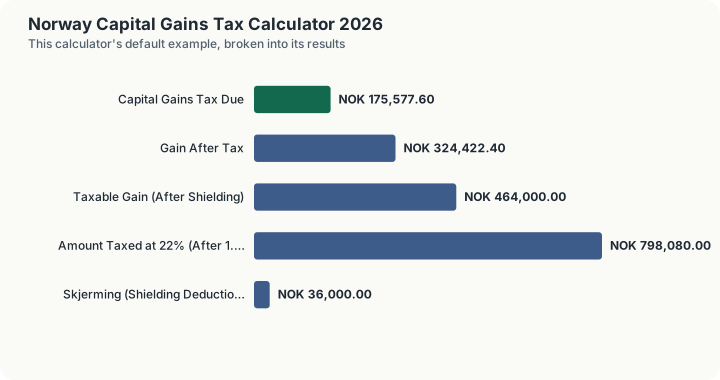
Using the calculator's default inputs -- an NOK 500,000 share gain on shares with an NOK 1,000,000 cost basis, at a 3.6% skjermingsrente:
- Shielding allowance: 1,000,000 x 3.6% = NOK 36,000
- Taxable gain after shielding: 500,000 - 36,000 = NOK 464,000
- Uplifted amount: 464,000 x 1.72 = NOK 798,080
- Tax at 22%: 798,080 x 22% = NOK 175,577.60
- Gain after tax: 500,000 - 175,577.60 = NOK 324,422.40
- Effective rate on the full gain: 175,577.60 / 500,000 = 35.12% -- below the 37.84% headline, purely because of the shielding deduction
Three contrasts make the mechanics visible:
- No shielding at all (cost basis effectively zero): 500,000 x 1.72 = 860,000; x 22% = NOK 189,200, the clean 37.84% case. The NOK 36,000 shielding allowance in the default scenario is worth NOK 13,622.40 of tax.
- A smaller gain, same basis -- NOK 250,000 gain, NOK 1,000,000 basis: shielding 36,000, taxable 214,000, uplifted 368,080, tax NOK 80,977.60. Effective rate 32.39%, because a fixed shielding allowance shelters a larger fraction of a smaller gain.
- Real estate that fails the exemption -- an NOK 300,000 gain on a property you did not live in for long enough: 300,000 x 22% = NOK 66,000. The absence of the 1.72 uplift makes this dramatically cheaper than the same gain on shares would be (NOK 113,520).
And the exit-tax case: leaving Norway with NOK 4,000,000 of net unrealized share gains has only the NOK 1,000,000 excess over the NOK 3,000,000 floor taxed: 1,000,000 x 1.72 x 22% = NOK 378,400, payable interest-free as roughly NOK 31,533.33 per year over 12 years. A latent gain at or below NOK 3,000,000 -- including a NOK 2,000,000 gain -- owes no exit tax at all.
What This Does Not Account For
- The skjermingsrente used here is provisional. 3.6% is the confirmed rate for income year 2025. The 2026 rate is calculated from the average 3-month Norwegian Treasury bill rate across the whole of the 2026 calendar year and is not published by Skatteetaten until January 2027. The 3.6% figure is a documented placeholder carried forward, not a confirmed 2026 figure -- override the shielding rate input once the official rate is announced, and treat any 2026 shielding result as an estimate until then.
- Exit-tax cancellation mechanics are modelled at medium confidence. The NOK 3,000,000 floor, the floor (excess-only) behaviour, the 37.84% rate, and the 12-year interest-free payment window are the modelled rules. The precise conditions under which returning to Norwegian tax residency cancels an outstanding exit-tax liability -- the timing, the forms, and how partial disposals during the window interact -- are not fully primary-source verified here. If you are actually emigrating, get this checked; the amounts are large and the rules have been amended repeatedly in recent years.
- Per-share shielding tracking. Real skjerming is calculated share by share, year by year, on the specific shares you hold, and unused shielding attaches to the individual share rather than to your portfolio as a whole. This calculator takes a single aggregate cost basis and a single carried-forward figure; for a portfolio built through many purchases at different prices and dates, that is directional rather than exact.
- Aksjesparekonto (ASK) and fondskonto. Gains inside a share savings account are deferred until you withdraw more than your deposited capital, which changes the timing entirely and is not modelled here.
- Fritaksmetoden (the exemption method), which largely exempts share gains realized by Norwegian companies rather than individuals. This calculator models the personal shareholder model only.
- The FIFO ordering rule for identifying which shares you sold, transaction costs, currency conversion on foreign holdings, and foreign withholding tax or credit relief on non-Norwegian shares.
- Wealth tax (formuesskatt), which is a separate annual charge on the value of your holdings and applies whether or not you sell anything.
- Real estate refinements including part-year primary-residence use, the separate rules for holiday homes (fritidsbolig) and plots of land, the treatment of a property that was rented out for part of your ownership, and the deductibility of documented capital improvements against the gain.
- Losses that arise solely from the shielding deduction, which are not deductible. This calculator applies that rule correctly by never letting shielding push a gain below zero, but it does not model the more intricate interactions between shielding, dividends received in prior years, and loss carry-forward.
Common Pitfalls
- Quoting 22% as the rate on share gains. It is the rate applied to the uplifted amount, not to the gain. The rate you actually pay on an unshielded share gain is 37.84%. Budgeting for 22% understates the bill by more than 70%.
- Assuming the 1.72 uplift applies to everything. It does not apply to real estate. A taxable property gain is taxed at a straight 22%, which is why the same nominal gain costs dramatically less on a house than on a share portfolio.
- Forgetting that shielding is forfeited on sale. Unused shielding carries forward indefinitely while you still hold the shares. The moment you sell, whatever shielding you have not used is gone -- it does not transfer to other holdings and it does not survive the disposal.
- Treating the NOK 3,000,000 exit-tax threshold as a cliff. It is a floor. At NOK 3,000,000 of latent gain you owe nothing; at NOK 3,000,001 you owe tax on just the NOK 1 excess (a few øre), not on the whole gain. Only the portion above NOK 3,000,000 is ever taxable -- getting this backwards drastically overstates the bill for anyone near the threshold.
- Miscounting the primary-residence clock. The 12-of-24-months residence test runs to the date you accept an offer, not the date of completion or handover. Selling shortly before the test is satisfied converts an entirely tax-free gain into a fully taxable one.
- Netting share losses against real estate gains without care. Both flow into alminnelig inntekt, but a share loss is uplifted by 1.72 while a property gain is not -- so a nominal krone of share loss offsets 1.72 kroner of ordinary income, and the arithmetic is not one-for-one.
- Using an old skjermingsrente. The rate changes every year and moves with short-term interest rates. Using a stale figure quietly misstates the shielding deduction, and therefore the tax, on every calculation.
Frequently Asked Questions
Why is the rate 37.84% and not 22%?
What is the skjermingsrente and how much is it worth?
Is the 3.6% skjermingsrente confirmed for 2026?
When is a Norwegian home sale tax-free?
Are share losses deductible?
Who pays Norwegian exit tax, and how much?
Do I have to pay the exit tax immediately?
Does the shielding deduction apply to real estate?
What happens to shielding I never used?
Sources
- Skatteetaten (Norwegian Tax Administration), "Factor for upward adjustment of gain/loss or dividend on shares" (skatteetaten.no/en/rates/factor-for-upward-adjustment-of-gainloss-or-dividend-on-shares) -- the 1.72 oppjusteringsfaktor, confirmed current. skatteetaten.no
Also consulted: Skatteetaten, "Risk-free interest rate for shares and sole proprietorships" (skatteetaten.no/en/rates/risk-free-interest-rate-for-shares-and-sole-proprietorships) -- the 3.6% skjermingsrente confirmed for income year 2025, used here as a provisional placeholder for 2026; Skatteetaten -- the 22% rate on alminnelig inntekt for income year 2026, the primary-residence exemption conditions (ownership over 12 months, residence for 12 of the last 24 months). Lovdata -- the NOK 3,000,000 exit-tax floor under Skatteloven section 10-70, as enacted for departures from 20 March 2024 onward.