Quick Answer: Qualified Small Business Stock held long enough can exclude gain from federal tax up to the greater of a statutory dollar cap or 10 times your basis, with the required holding period and dollar cap depending on whether the stock was acquired before or after July 4, 2025.
Overview
Section 1202 of the tax code is one of the most valuable, and most frequently misunderstood, provisions available to founders and early employees of qualifying startups. It allows an investor in Qualified Small Business Stock, universally shortened to QSBS, to exclude some or all of the gain on sale from federal income tax entirely, not merely defer it or tax it at a reduced rate, but exclude it outright. For a founder who built a company from nothing and sells for a large multiple of their tiny original investment, this can mean millions of dollars that never show up as taxable income at all.
The rules changed meaningfully in 2025. The One Big Beautiful Bill Act, enacted July 4, 2025, left the original rule intact for stock acquired on or before that date, a full 100% exclusion after a five-year holding period, capped at the greater of $10 million or 10 times the adjusted basis in the stock. But for stock acquired after July 4, 2025, it replaced the all-or-nothing five-year cliff with a tiered schedule that starts paying out exclusion benefits after just three years, and it raised the dollar cap to $15 million. This calculator models both regimes side by side so you can see which one applies to your stock and what it actually produces.
How This Is Calculated
The calculation starts with a straightforward gain figure: sale proceeds minus your adjusted basis in the stock, the price you originally paid (or the value at issuance, for many founder shares that is a very small number).
For stock acquired on or before July 4, 2025 (the legacy rule): if you have held the stock at least five years, you are eligible for a 100% exclusion, subject to a cap equal to the greater of $10 million or 10 times your adjusted basis. If your basis is small and your gain is enormous, the cap is very likely $10 million flat. If your basis is unusually large, for example because you bought a large block of stock rather than receiving founder shares for a nominal amount, the 10x-basis alternative can push your cap well above $10 million. Hold the stock fewer than five years, and none of this exclusion is available at all; the entire gain is fully taxable.
For stock acquired after July 4, 2025 (the OBBBA tiered rule): the five-year cliff is gone. Instead, holding the stock three years gets you a 50% exclusion, four years gets you 75%, and five or more years gets you the full 100%, all subject to a cap equal to the greater of $15 million or 10 times your adjusted basis. Hold the stock less than three years under this newer rule, and again, no exclusion applies at all.
Whichever regime applies, the calculator applies the relevant exclusion percentage to the smaller of your total gain or the applicable dollar cap, and whatever is left over is the taxable portion of your gain. That taxable portion is then taxed at ordinary long-term capital gains rates, 0%, 15%, or 20% depending on your total income, stacked on top of your other taxable income for the year using the 2026 federal capital gains brackets.
Worked Example
The clean case: legacy stock, six years, gain under the cap
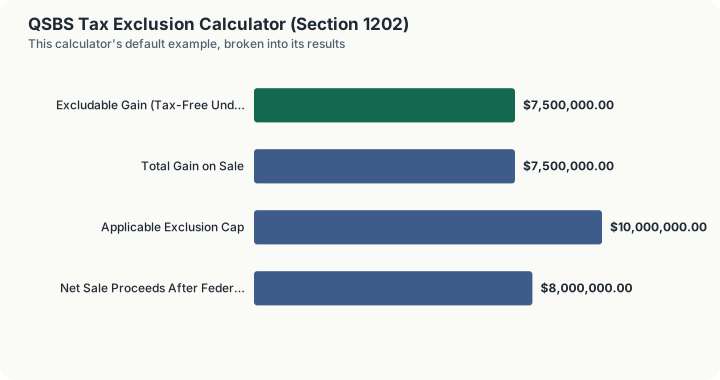
A founder holds QSBS issued well before July 4, 2025, with a $500,000 basis, and sells for $8,000,000.
Step 1 -- The gain. $8,000,000 - $500,000 = $7,500,000.00
Step 2 -- The exclusion cap. The greater of $10,000,000 or 10 x $500,000 = $5,000,000, so the cap is $10,000,000.00
Step 3 -- The exclusion percentage. Six years held under the legacy rule, which is at least five: 100%
Step 4 -- The excludable gain. min($7,500,000, $10,000,000) x 100% = $7,500,000.00
Step 5 -- The taxable gain. $7,500,000.00 - $7,500,000.00 = $0.00
Step 6 -- Federal tax on the gain. $0.00, and net proceeds stay at the full $8,000,000.00
The same founder one year early
Step 7 -- Four years held instead of six, legacy rule. Under five years, so the exclusion percentage is 0%, not a reduced rate
Step 8 -- Excludable gain. $7,500,000.00 x 0% = $0.00
Step 9 -- Tax on the whole gain. Stacked on $250,000 of other income, $1,485,225.00, leaving net proceeds of $6,514,775.00
Steps 6 and 9 differ by $1,485,225.00 and by nothing except the date on the sale agreement. There is no partial credit under the legacy rule: the fifth anniversary is a cliff, and selling a day short forfeits the entire benefit.
Where the cap binds instead of the holding period
A second founder, same legacy rule, has a $200,000 basis and sells for $15,000,000 after six years.
Step 10 -- The gain. $15,000,000 - $200,000 = $14,800,000.00
Step 11 -- The cap. The greater of $10,000,000 or 10 x $200,000 = $2,000,000, so it stays at $10,000,000.00
Step 12 -- The excludable gain. min($14,800,000, $10,000,000) x 100% = $10,000,000.00
Step 13 -- The taxable remainder. $14,800,000.00 - $10,000,000.00 = $4,800,000.00
Step 14 -- Tax on it. Stacked on $250,000 of other income under the 2026 long-term capital gains brackets: $945,225.00
Step 15 -- The effective exclusion. $10,000,000.00 / $14,800,000.00 = 67.57%, not the 100% the tier suggests
Step 11 is where the 10x-basis alternative matters. A founder holding nominally priced shares will always fall back on the flat dollar cap; only someone who actually paid for a substantial block, say $2,000,000, would see the 10x figure exceed it and lift the cap to $20,000,000.
The OBBBA tiers, where the cliff becomes a staircase
A founder with stock acquired after July 4, 2025, a $100,000 basis, sells for $6,000,000.
Step 16 -- The gain. $6,000,000 - $100,000 = $5,900,000.00
Step 17 -- The cap under the new rule. The greater of $15,000,000 or 10 x $100,000, so $15,000,000.00, five million higher than the legacy figure
Step 18 -- At exactly three years. The tier is 50%, excluding $2,950,000.00 and leaving $2,950,000.00 taxable, on which the tax is $575,225.00
Step 19 -- At four and a half years. The tier is 75%, excluding $4,425,000.00 and leaving $1,475,000.00 taxable, on which the tax is $280,225.00
Step 20 -- What the extra eighteen months bought. $575,225.00 - $280,225.00 = $295,000.00 of tax avoided
Step 21 -- The final step to five years. The tier reaches 100%, and the remaining $280,225.00 of tax goes with it
Compare step 18 with step 7. Under the legacy rule a three-year holder gets nothing at all; under OBBBA the same holder keeps half the gain tax-free. The acquisition date matters as much as the holding period, and the two rules answer the same question differently at every point before year five.
What This Does Not Account For
This calculator does not verify whether your stock actually qualifies as QSBS in the first place, which depends on a lengthy set of requirements at issuance: the issuing corporation must be a domestic C corporation, the aggregate gross assets of the company generally cannot have exceeded $50 million (raised to $75 million under OBBBA for stock issued after the aggregate-asset-test change takes effect) at any time before and immediately after the stock was issued, the stock must have been acquired directly from the corporation (not purchased from another shareholder) in exchange for money, property, or services, and the corporation must be engaged in a qualified active trade or business, excluding categories like most professional services, banking, farming, hotels, and restaurants. It does not model state tax treatment, since many states, notably California, do not conform to the federal QSBS exclusion at all and tax the full gain. It does not apply the Net Investment Income Tax, an additional 3.8% that can apply to any non-excluded portion of the gain for higher-income taxpayers. It does not model the special 28% rate under IRC Section 1(h)(4), which applies to gain from a narrower category of pre-September 27, 2010 QSBS subject to the older 50%/75% partial-exclusion regime; for the two regimes modeled here, both apply after that date, so any non-excluded gain is taxed at ordinary long-term capital gains rates instead. It also does not model stacking multiple QSBS sales, or the effect of gifting or contributing QSBS to a trust, both of which can multiply the per-taxpayer exclusion cap across multiple holders in ways well beyond a single calculator.
Common Pitfalls
- Assuming the exclusion percentage and dollar cap for the new tiered regime apply retroactively. They do not. Stock acquired on or before July 4, 2025 is governed entirely by the old five-year, $10 million (or 10x-basis) rule, regardless of when it is eventually sold.
- Confusing "issued" with "acquired." The acquisition date that matters is when you personally received the stock, not when the company was founded or when the company's very first shares were issued to anyone.
- Not confirming the underlying QSBS eligibility requirements before counting on any exclusion. A huge number of QSBS tax surprises happen because a company failed the active-business requirement, exceeded the gross-assets test at some point, or the stock was acquired in a way that does not qualify, none of which this calculator checks for you.
- Forgetting state tax exposure. A founder who owes zero federal tax on a QSBS sale can still owe a substantial state tax bill in states that do not conform to Section 1202, most notably California, Pennsylvania, and a handful of others.
- Selling one day short of a holding-period milestone. Because the required holding periods are hard cliffs (3, 4, or 5 years under the new tiers, or a single 5-year cliff under the old rule), selling even slightly early can cost a meaningfully larger exclusion percentage or lose it altogether.
Frequently Asked Questions
What is the difference between the old QSBS rule and the new OBBBA rule?
How is the $10 million or $15 million cap actually applied if I sell stock from multiple companies?
Is the 10-times-basis alternative ever actually the better number?
Does my state also exclude QSBS gain from tax?
What happens if I sell QSBS before the required holding period?
Sources
- Perkins Coie, "Significant Changes by the One Big Beautiful Bill Act to the Qualified Small Business Stock Provisions of Section 1202," perkinscoie.com/insights/update/significant-changes-one-big-beautiful-bill-act-qualified-small-business-stock
- Baker Tilly, "Changes to Section 1202, Qualified Small Business Stock, in the One Big Beautiful Bill Act," bakertilly.com/insights/changes-to-section-1202-qualified-small-business
- Greenberg Traurig, "Qualified Small Business Stock (QSBS) Regime Expanded Under One Big Beautiful Bill Act," gtlaw.com/en/insights/2025/7/qualified-small-business-stock-qsbs-regime-expanded-under-one-big-beautiful-bill-act
- Internal Revenue Service, Revenue Procedure 2025-32 (2026 federal capital gains brackets), irs.gov/pub/irs-drop/rp-25-32.pdf
- 26 U.S.C. Section 1202, Internal Revenue Code. law.cornell.edu/uscode/text/26/1202