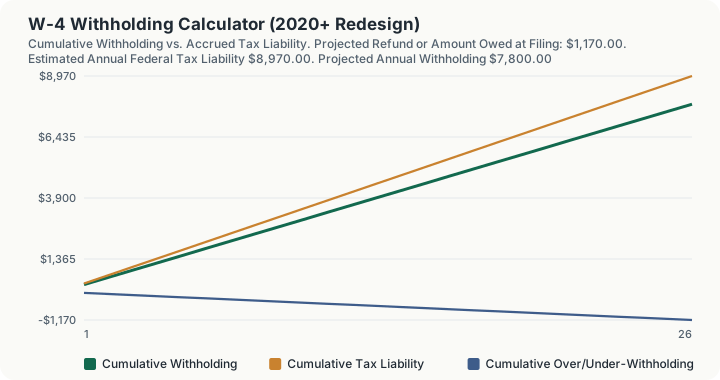
Quick Answer: A single filer earning $90,000.00 with 1 dependent and $300.00 withheld per biweekly paycheck has an estimated 2026 federal tax liability of $8,970.00 against $7,800.00 in projected withholding, leaving $1,170.00 owed at filing, an extra $45.00 per paycheck closes that gap to roughly $0.00.
Overview
The 2020 Form W-4 redesign removed the old "allowances" system entirely. Instead of picking a number of allowances that vaguely maps to a withholding amount, the current form asks directly for the facts that determine your tax liability: filing status, dependents, other income, and other deductions, then leaves the actual withholding math to your employer's payroll system and IRS Publication 15-T withholding tables.
That leaves most people unable to sanity-check their own W-4 without either trusting the IRS's own online estimator or reconstructing the math by hand. This calculator does that reconstruction directly: it estimates your full-year federal tax liability from the same inputs Form W-4 asks for, compares that against what your current per-paycheck withholding will add up to over the year, and reports the gap as a projected refund or amount owed, along with a suggested Line 4c "Extra withholding" adjustment to close it.
Getting withholding close to $0 net at filing is the goal for most people. A large refund means you gave the government an interest-free loan all year; a large balance due can trigger an IRS underpayment penalty if it exceeds the safe-harbor thresholds. This calculator is aimed at the middle: dial in withholding so filing day is a non-event.
How This Is Calculated
- Taxable income. Annual income from this job plus any other income (Form W-4 Step 4a), minus the standard deduction for your filing status and any other deductions you enter (Step 4b).
- Gross tax before credits. Computed via this platform's progressive-bracket engine against the full 2026 federal bracket schedule for your filing status.
- Dependent credit. Form W-4 Step 3 converts each dependent into a credit that directly reduces tax owed, not taxable income. This calculator applies the $2,000 Child Tax Credit rate per dependent.
- Projected withholding. Your entered per-paycheck withholding amount multiplied by the number of pay periods in the year for your selected pay frequency.
- Gap and adjustment. The difference between projected withholding and annual tax liability is your projected refund (positive) or amount owed (negative). Dividing that gap by the number of pay periods in a full year gives the suggested Line 4c extra-withholding adjustment.
That divisor matters if you are reading this partway through the year. The figure below spreads the shortfall across a whole year of paychecks, not across the ones you have left. If six months have already gone by, you would need roughly double the amount shown to close the gap before December, because you have half the paychecks left to do it in.
Worked Example
Using the calculator's default inputs:
- Annual Income: $90,000.00
- Filing Status: Single
- Dependents: 1
- Pay Frequency: Biweekly (26 pay periods)
- Current Withholding: $300.00 per paycheck
Step by step:
- 2026 single standard deduction is $16,100. Taxable income = $90,000 − $16,100 = $73,900.00, which spans the 10% ($0-$12,400), 12% ($12,400-$50,400), and 22% ($50,400-$105,700) brackets.
- Gross tax: $12,400 × 10% + $38,000 × 12% + $23,500 × 22% = $1,240.00 + $4,560.00 + $5,170.00 = $10,970.00.
- One dependent credit at $2,000 reduces that to $10,970.00 − $2,000.00 = $8,970.00 estimated annual tax liability.
- Projected withholding: $300.00 × 26 pay periods = $7,800.00.
- Gap: $7,800.00 − $8,970.00 = -$1,170.00, meaning $1,170.00 will be owed at filing under current withholding.
- Suggested Line 4c adjustment: $1,170.00 ÷ 26 = $45.00 in additional withholding per paycheck to bring the projected balance close to $0.
Carrying the Shortfall Across 26 Paychecks
Step 7 -- Paycheck one. Withheld $300.00, tax liability accrued $345.00, under-withheld $45.00
Step 8 -- Paycheck two. Withheld $600.00, liability $690.00, under-withheld $90.00
Step 9 -- Paycheck thirteen, the halfway mark. Withheld $3,900.00, liability $4,485.00, under-withheld $585.00
Step 10 -- Paycheck twenty-six. Withheld $7,800.00, liability $8,970.00, under-withheld $1,170.00
The shortfall widens by exactly $45.00 every payday, which is why the fix is $45.00 on Line 4c and not a lump sum in December. It also means the correction gets more expensive the longer it waits: catching this at paycheck thirteen leaves $585.00 already lost and thirteen paychecks to spread it over, so the required extra becomes $90.00 a period rather than $45.00. Checking withholding in January costs half what checking it in July costs.
Reading Form W-4 Steps Against This Calculator
- Step 1(c) Filing Status maps directly to the Filing Status input.
- Step 3 (Claim Dependents) maps to the Number of Dependents input, applied at the $2,000 Child Tax Credit rate.
- Step 4(a) Other Income and Step 4(b) Deductions map directly to their like-named inputs here.
- Step 4(c) Extra Withholding is exactly what this calculator's suggested adjustment is designed to fill in: a flat additional dollar amount withheld from every paycheck.
What This Does Not Account For
- Multiple jobs or a working spouse. This calculator models a single job's withholding against total household tax liability only if you enter combined income manually; it does not implement the IRS's Multiple Jobs Worksheet or the higher-withholding tables that situation requires.
- The Credit for Other Dependents. Real Form W-4 math applies $2,000 per qualifying child under 17 but only $500 per other dependent (e.g., an adult relative). This calculator simplifies by applying $2,000 uniformly across the Number of Dependents input; if most of your dependents are not qualifying children, your actual credit, and therefore actual liability, will be lower than shown here.
- Payroll withholding table quirks. Actual per-paycheck withholding computed by your employer's payroll system uses IRS Publication 15-T's percentage-method or wage-bracket tables, which do not scale perfectly linearly across the year; this calculator instead compares a full-year liability estimate against your stated flat per-paycheck withholding.
- State income tax withholding. This calculator estimates federal withholding only. State W-4-equivalent forms (where applicable) are separate and not modeled here.
- Pre-tax deductions. 401(k), HSA, and other pre-tax payroll deductions reduce your actual taxable wages; enter your annual income net of those pre-tax deductions for the most accurate estimate.
Common Pitfalls
- Confusing "dependents" with "exemptions" from the old W-4. The old allowances system is gone; Step 3 dependents are entered as a dollar credit amount, not a headcount that maps to a formula, though this calculator (and the official IRS worksheet) still starts from a headcount and multiplies by the credit rate.
- Treating a big refund as a bonus. A large refund means too much was withheld all year, an interest-free loan to the government; adjusting Line 4c downward (or claiming more dependents/deductions accurately) recovers that money in every paycheck instead of waiting until filing.
- Ignoring the underpayment penalty threshold. Owing a large balance at filing is not just an inconvenience; it can trigger an IRS estimated tax penalty if total withholding and estimated payments fall short of the safe-harbor thresholds. See the companion Quarterly Estimated Tax Calculator for that rule.
- Forgetting to update the W-4 after a raise, marriage, or new dependent. Life events that change your filing status, income, or dependents should trigger a fresh W-4 submission; withholding calculated for old circumstances drifts further from accurate with each paycheck.
- Not accounting for side income. 1099 income, investment income, or a second job's income not run through this job's W-4 is easy to under-withhold against; the Other Income (Step 4a) input exists specifically to true this up.
Frequently Asked Questions
How is this different from the IRS Tax Withholding Estimator?
What if I have more than one job?
Why does Line 4c ask for a flat dollar amount instead of a percentage?
I got a large refund last year. Should I change my W-4?
Does this calculator file my W-4 for me?
Sources
- Internal Revenue Service: Form W-4 (2026), Employee's Withholding Certificate. irs.gov
- Internal Revenue Service: Publication 505, Tax Withholding and Estimated Tax. irs.gov/publications/p505
- Internal Revenue Service: Publication 15-T, Federal Income Tax Withholding Methods. irs.gov/publications/p15t
Also consulted: Internal Revenue Service: Revenue Procedure 2025-32, 2026 federal income tax brackets and standard deduction amounts.