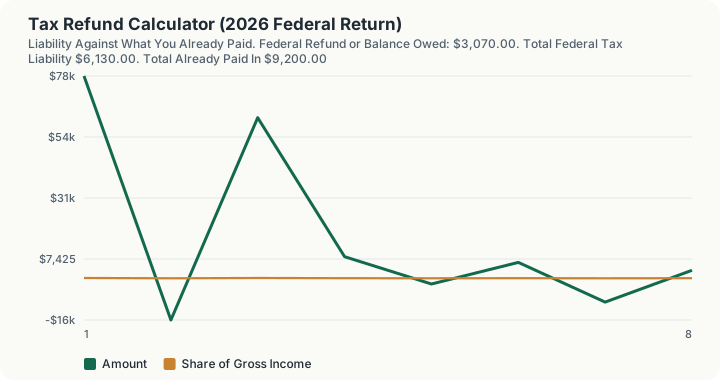
Quick Answer: A single filer with $78,000 in wages, one qualifying child, and $9,200 already withheld gets a federal refund of $3,070.00. The 2026 liability is $6,130.00 against $8,330.00 of tax before the child tax credit, so 33.4% of everything withheld comes back.
What does this calculator do?
A refund is not a windfall and it is not a reward. It is the difference between two numbers that were never required to match: what the year's tax rules said you owed, and what your employer's payroll system happened to take out of your pay along the way. Withholding is an estimate made in January by a form you filled in once. The liability is a fact settled in April.
This calculator settles that difference. It takes everything already paid toward this year's federal bill, from every source, and compares it against the liability your income and family situation actually produced under the 2026 brackets. What comes out is one number: the cheque, or the payment.
It is the retrospective companion to the W-4 withholding calculator. That page looks forward and answers a different question: how should you reset your Form W-4 so that next year lands where you want it? Its output is a per-paycheck adjustment. This page looks backward at a year that has already happened and settles the balance. The two share the same underlying liability arithmetic, on purpose, so they cannot disagree. Whether itemizing would have lowered that liability is covered in 2026 standard deduction vs itemizing.
How is this calculated?
- Add up everything already paid in. Federal income tax withheld from box 2 of every W-2, plus any quarterly Form 1040-ES estimated payments and any prior-year overpayment you applied forward. In the default case that is $9,200.00.
- Total the taxable income. Wages from box 1 plus any other taxable income with no withholding attached, such as interest or freelance profit.
- Subtract the deductions. The 2026 standard deduction for your filing status, plus any additional deductions you entered. For a single filer the standard deduction is $16,100.
- Walk the 2026 brackets. The shared bracket primitive taxes each slice of taxable income at its own rate. The sum is the tax before credits.
- Apply the child tax credit. Each qualifying child under 17 is credited at $2,200, the rate the 2026 Form W-4 Step 3 worksheet uses. The credit offsets tax but cannot take the liability below zero.
- Arrive at the liability. Tax before credits less the credit applied is what the year actually cost you.
- Subtract what you paid. Total paid in minus liability. A positive difference is a refund; a negative one is a balance owed at filing.
The settlement is simply:
R = W + E − max(0, T − C)
where $W$ is withholding, $E$ is estimated payments, $T$ is tax before credits, and $C$ is the credit claimed. When $R$ is positive it is your refund.
Worked Example
Take the defaults: $78,000 of wages, filing single, one qualifying child, $9,200 withheld, and no estimated payments or other income.
Step 1. Gross taxable income: $78,000.00.
Step 2. Standard deduction for a single filer in 2026: $16,100.00.
Step 3. Taxable income: $78,000.00 minus $16,100.00 equals $61,900.00.
Step 4. First bracket: 10% of $12,400 equals $1,240.00.
Step 5. Second bracket: 12% of ($50,400 minus $12,400), which is 12% of $38,000, equals $4,560.00.
Step 6. Third bracket: 22% of ($61,900 minus $50,400), which is 22% of $11,500, equals $2,530.00.
Step 7. Tax before credits: $1,240.00 plus $4,560.00 plus $2,530.00 equals $8,330.00.
Step 8. Child tax credit for one qualifying child: $2,200.00.
Step 9. Total liability: $8,330.00 minus $2,200.00 equals $6,130.00.
Step 10. Refund: $9,200.00 minus $6,130.00 equals $3,070.00.
Step 11. Share of withholding returned: $3,070.00 divided by $9,200.00 equals 33.4%.
Step 12. Break-even bi-weekly withholding: $6,130.00 divided by 26 equals $235.77.
That last figure is the useful one. Withholding $235.77 per paycheck instead of the $353.85 that produced this refund would have put roughly $118 back in each of 26 paychecks and produced no refund at all.
Change one input and the direction flips. Add $30,000 of freelance income with no withholding attached, and taxable income rises to $91,900, liability rises to $12,730.00, and the same $9,200 of withholding leaves $3,530.00 owed at filing.
What does this calculator not account for?
- The refundable Additional Child Tax Credit. The child tax credit is treated as wholly non-refundable here. A low-income filer whose credit exceeds their tax can receive part of the excess as a refund under the ACTC rules; this model reports the unused credit but does not pay it out. The vector at $20,000 of wages with three children leaves $5,610 of credit unused for exactly this reason.
- The Earned Income Tax Credit. The EITC is fully refundable and can be worth several thousand dollars to a working family. It is not modeled at all, so low-to-moderate income filers will see a refund materially lower than the real one.
- Credit phase-outs. The child tax credit phases out above modified adjusted gross income thresholds. No phase-out is applied, so a high earner claiming children will see a credit they may not be entitled to in full.
- State refunds. Federal only. Your state return settles separately, on its own schedule, and can go the opposite way.
- Self-employment tax. Income entered as other income is taxed at ordinary rates but carries no self-employment tax here. A freelancer owes roughly 15.3% on net profit in addition to what is shown.
- Underpayment penalties. A large balance owed can carry an estimated tax penalty under IRC Section 6654. The underpayment penalty calculator handles that; this page does not.
- Education, energy, retirement saver, and foreign tax credits. None is included. Each would reduce the liability and increase the refund.
What mistakes do people make with this?
- Treating a large refund as good news. The $3,070 in the default case was your money all year. Withheld evenly, it represented an average balance of roughly $1,535 lent to the Treasury at zero interest. That is the case for adjusting the W-4, not for celebrating.
- Entering gross salary instead of box 1 wages. Box 1 is already net of traditional 401(k) and pre-tax HSA and health premium deferrals. Entering the gross figure inflates taxable income and understates the refund.
- Forgetting the second job or the spouse's W-2. Withholding tables assume each job is the only job. Two moderate incomes are routinely under-withheld together, which is the single most common cause of an unexpected balance owed.
- Missing side income entirely. Freelance work, interest, and dividends arrive with no withholding attached. They raise the liability without raising anything on the paid-in side.
- Confusing this with the W-4 calculator. If your question is "what should I change on my form?", that is the other page. This one answers "what is the number on my return?"
- Assuming a refund means you cannot owe a penalty. You can be under-withheld early in the year, catch up late, and still face an estimated tax penalty despite a refund at filing.
Frequently Asked Questions
How big will my tax refund be?
Why did my refund get smaller than last year?
Is a big refund bad?
How is this different from the W-4 withholding calculator?
Why does the tool show unused child tax credit?
Can this tell me when my refund arrives?
Sources
- Internal Revenue Service, Revenue Procedure 2025-32 (Internal Revenue Bulletin 2025-45), for the 2026 bracket schedules and standard deduction amounts used here: irs.gov/pub/irs-drop/rp-25-32.pdf
- Internal Revenue Service, Form W-4 and its Step 3 instructions, the source of the $2,200-per-qualifying-child credit rate (2026 form: irs.gov/pub/irs-pdf/fw4.pdf) applied by the shared withholding primitive: irs.gov/forms-pubs/about-form-w-4
- Internal Revenue Service, Publication 505, "Tax Withholding and Estimated Tax," for the withholding and estimated payment rules this reconciliation follows: irs.gov/publications/p505
- Internal Revenue Service, "Where's My Refund," the only authoritative source for refund timing: irs.gov/wheres-my-refund