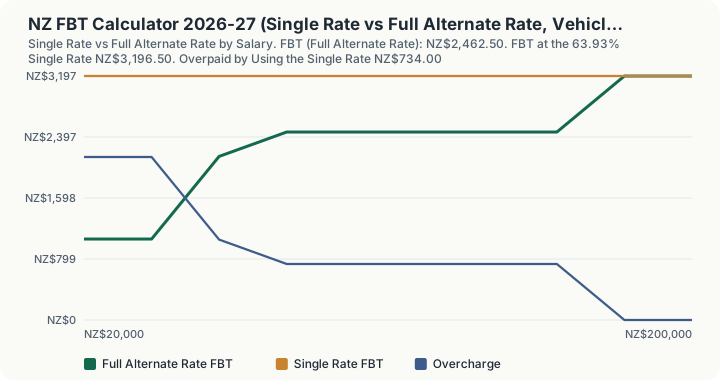
Quick Answer: On $5,000 of attributed fringe benefits given to an employee on a $90,000 cash salary, the full alternate rate calculation produces FBT of $2,462.50 for the 2026-27 year. The 63.93% single rate would charge $3,196.50 on the same benefit, so skipping the quarter-4 square-up overpays by $734.00. The effective rate here is 49.25%, because 49.25% is the gross-up of this employee's 33% marginal income tax rate.
What does this calculator do?
63.93% is not a tax rate on employers. It is 0.39 / (1 - 0.39): the gross-up of New Zealand's top personal income tax rate. A fringe benefit is given out of after-tax dollars, so FBT exists to restore the income tax the employee would have paid had the benefit been paid as cash instead. Every FBT rate in the statute is m / (1 - m) for some personal rate m:
- 0.105 / 0.895 = 11.73%
- 0.175 / 0.825 = 21.21%
- 0.30 / 0.70 = 42.86%
- 0.33 / 0.67 = 49.25%
- 0.39 / 0.61 = 63.93%
That identity is the whole point. Charge the single rate to an employee whose own marginal rate is 33% and you have grossed up at 39% for someone who was never in the 39% bracket. The statutory full alternate rate calculation, reproduced here exactly from the IR417 worksheet, is what gives the difference back. It is only for an employee already in the top bracket that the single rate is exactly right and the overcharge falls to nil.
The unfamiliar part of that worksheet is its base. The full alternate rate scale is applied to the employee's fringe-benefit-inclusive net remuneration, after income tax, which is why its thresholds ($13,962, $45,230, $62,450, $130,723) look nothing like the income tax thresholds. They are the income tax thresholds converted to an after-tax basis: $15,600 of gross income leaves $13,962 once $1,638 of tax comes off.
How is this calculated?
FBT = S(N + B) − S(N); N = C − IncomeTax (C)
$C$ is cash salary, $B$ the taxable value of attributed benefits, $N$ net cash remuneration, and $S$ the FBT alternate rate scale.
Step 1: Income tax on the cash salary, using the 2026-27 individual brackets (10.5% to $15,600, 17.5% to $53,500, 30% to $78,100, 33% to $180,000, 39% above).
Step 2: Net cash remuneration: salary less that income tax.
Step 3: Total remuneration: net cash remuneration plus the taxable value of the benefits.
Step 4: Run the FBT scale over total remuneration.
Step 5: Run the same scale over net cash remuneration alone.
Step 6: Full alternate rate FBT is the difference between those two figures, floored at zero.
Step 7: The two comparisons: the single rate is simply the taxable value x 63.93%, and the flat alternate rate available in quarters 1 to 3 is the taxable value x 49.25%. The overcharge reported is the single rate less the full alternate rate.
The motor vehicle is valued separately, and this is the one thing to be clear about: the calculator does not fold the vehicle figure into the benefit total above. It reports it on its own.
Step 8: Pick the vehicle valuation rate. Cost price is 5% per quarter or 20% a year. Tax book value is 9% per quarter or 36% a year, rising to 10.35% and 41.4% where an Investment Boost deduction has been claimed on the vehicle from 1 April 2026. Investment Boost does not change the cost price rates.
Step 9: Apply the minimum, on tax book value only. If the book value is below $8,333 ($7,317 with Investment Boost), the floor is substituted.
Step 10: Apportion by private use days: value x rate x private use days / days in period (90 for a quarter, 365 for a year).
Step 11: Test the de minimis. Quarterly returns use a $300 per-employee limit, income-year and annual returns $1,200; the all-employee limit is $22,500 either way. Exceeding either limb makes the entire unclassified value taxable, not the excess.
Worked Example
A $90,000 employee with $5,000 of attributed benefits, a $40,000 vehicle on cost price, a quarterly return, and $250 of unclassified benefits against an all-employee total of $18,000.
Step 1: Income tax on $90,000. $1,638.00 + $6,632.50 + $7,380.00 + $3,927.00 = $19,577.50
Step 2: Net cash remuneration. $90,000 - $19,577.50 = $70,422.50
Step 3: Total remuneration. $70,422.50 + $5,000 = $75,422.50
Step 4: FBT scale on total remuneration. $1,637.74 + $6,631.94 + $7,380.49 + $6,388.96 = $22,039.13
Step 5: FBT scale on net cash remuneration alone. $1,637.74 + $6,631.94 + $7,380.49 + $3,926.46 = $19,576.63
Step 6: Full alternate rate FBT. $22,039.13 - $19,576.63 = $2,462.50
Step 7: FBT at the 63.93% single rate. $5,000 x 0.6393 = $3,196.50
Step 8: The overcharge the square-up refunds. $3,196.50 - $2,462.50 = $734.00
Step 9: Effective FBT rate on the benefit. $2,462.50 / $5,000 = 49.25%, exactly the gross-up of this employee's 33% marginal rate
Step 10: Vehicle taxable value, cost price, quarterly. $40,000 x 5.00% = $2,000.00
Step 11: Apportion for 90 private use days in a 90-day quarter. $2,000.00 x 90 / 90 = $2,000.00
Step 12: De minimis test. $250 is at or below the $300 quarterly limit and $18,000 is at or below the $22,500 all-employee limit, so the taxable unclassified value is $0.00
What does this calculator not account for?
The vehicle value and the unclassified benefits are not added to the benefit total. The $2,000 vehicle figure and the $250 of unclassified benefits are computed and reported separately; the FBT of $2,462.50 is calculated on the $5,000 you entered as attributed benefits and nothing else. If you want the vehicle in the FBT figure, add it to the attributed benefits input yourself.
The FBT calculation is annual, whatever return period you pick. The return period selector drives the vehicle valuation rates and the de minimis limits only. It does not convert the full alternate rate result into a quarterly figure.
Income tax on the cash salary excludes the ACC earner's levy, KiwiSaver, student loan repayments and any tax credits. It is bracket tax alone, which is what the IR417 worksheet uses.
Vehicle figures are treated as GST-inclusive. The GST-exclusive rate set (5.75% / 23% cost price, 10.35% / 41.4% tax book value, 11.9% / 47.61% with Investment Boost) exists in the underlying module but is not selectable here.
No pooling. The non-attributed pooled rates of 63.93% for major shareholder-employees and 49.25% for other employees, and the pool 1 eligibility limits of $160,000 of remuneration and $13,400 of attributed benefits, are not applied by this calculator.
One employee at a time. The all-employee de minimis input is a number you supply; the calculator does not aggregate a workforce, and it does not track the four-quarter window that limit is measured over.
No exemptions are tested. Work-related vehicles, emergency calls, business travel days, days a vehicle is unavailable, employee contributions towards a benefit, and the treatment of benefits to associated persons are all outside this calculation. Days you enter as private use are taken at face value.
GST on fringe benefits is not computed here, and neither are the return filing thresholds that determine whether you may file annually at all.
What mistakes do people make with this?
Paying the single rate and never doing the quarter-4 calculation. On this employee it costs $734.00 on $5,000 of benefits. Scaled across a workforce of ordinary-rate employees it is the largest routine FBT overpayment in New Zealand.
Believing the single rate is a penalty rate. It is not. It is the correct rate for a 39%-bracket employee, and the exact right answer for them, which is why their overcharge is zero.
Applying the FBT scale to gross salary. The scale runs on net, after-tax remuneration. Using $90,000 rather than $70,422.50 puts the employee in the wrong FBT band entirely.
Treating the de minimis as an allowance. It is a cliff. A $301 gift in a quarter is taxable on all $301, not on the $1 of excess.
Assuming an under-limit employee is safe. Breaching the $22,500 all-employee limit makes that employee's benefits fully taxable even though their own total was under $300.
Deducting a trade-in or an Investment Boost deduction from cost price. Neither reduces the cost price base, and Investment Boost does not lower the cost price rates.
Assuming tax book value is always cheaper. In the early years it is not: 9% a quarter on book value against 5% on cost price means more FBT, and the method is locked for as long as you own the vehicle.
Frequently Asked Questions
How much FBT do I pay on $5,000 of benefits for a $90,000 employee?
Why is the FBT rate 63.93%?
Is the alternate rate calculation worth doing?
What is the FBT on a $40,000 company car for a quarter?
What is the de minimis limit for unclassified benefits?
Does the minimum tax book value ever apply to a fully depreciated car?
Sources
- Inland Revenue, Fringe benefit tax guide IR409, April 2026 edition: ird.govt.nz/-/media/project/ir/home/documents/forms-and-guides/ir400---ir499/ir409/ir409-2026.pdf (single rate 63.93% and alternate rate 49.25%, page 5 and page 37; pooled rates page 11; motor vehicle rates pages 14 to 16; unclassified benefit de minimis page 34; full alternate rate worksheet page 40)