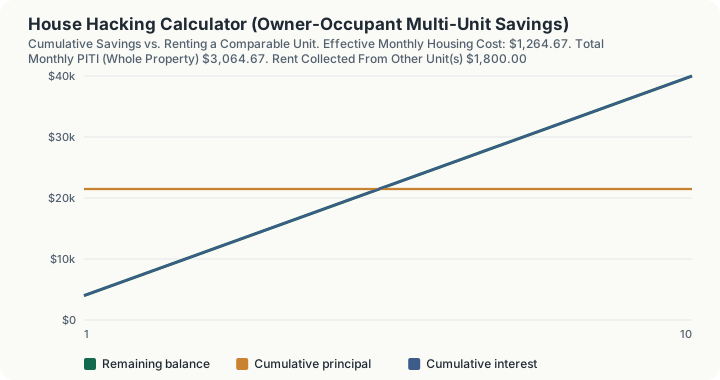
Quick Answer: House hacking means buying a small multi-unit property (a duplex, triplex, or fourplex), living in one unit, and renting out the rest so tenant rent offsets your own housing payment. On this calculator's baseline inputs ($400,000 fourplex-style purchase, 5% down, $1,800/month collected from the other unit(s)), the owner's effective monthly housing cost drops to $1,264.67, which is $335.33 less than the $1,600/month it would cost to rent a comparable single unit nearby.
Overview
House hacking is an owner-occupant strategy, not strictly an investment strategy, though the two overlap heavily. The core mechanic is financing: because the buyer intends to live in one of the units, the purchase qualifies for owner-occupant loan programs (FHA loans down to 3.5% down, or low-down-payment conventional programs around 5%) on properties with up to four units, financing terms an investor buying the identical building purely as a rental would not get. Investment-property loans on non-owner-occupied multi-unit buildings typically require 20-25% down and price at a higher rate, so the owner-occupancy requirement is not a technicality, it is the financial engine that makes the strategy accessible with a fraction of the capital a pure investment purchase would need.
This calculator answers the question a house hacker actually cares about: after collecting rent from the other unit(s), what does it really cost you, out of pocket, to live there each month, and how does that compare to what you would pay to rent a comparable standalone unit instead? It computes the full monthly PITI (principal, interest, property tax, insurance) on the whole property, plus any HOA, then nets out the rental income from the non-owner-occupied units to arrive at an effective housing cost. That figure is then compared directly against a market rent input for a comparable single unit, which is the real apples-to-apples savings number, since simply looking at "my mortgage payment" without context tells you nothing about whether house hacking beat the alternative of just renting.
In a strong house hack, the effective housing cost can approach zero or even go negative, meaning the rental income from the other units more than covers the entire PITI payment and the owner effectively lives for free while building equity. This calculator flags that scenario explicitly rather than just showing a negative dollar figure and leaving you to interpret it.
How This Is Calculated
Step 1: Loan amount and monthly principal & interest. Financed on the full purchase price using a standard amortizing mortgage:
Step 2: Property tax and insurance.
Step 3: Total monthly PITI for the whole property.
Step 4: Effective monthly housing cost. Rent collected from the unit(s) you do not occupy is subtracted from the total payment:
Step 5: Real savings vs. renting. The effective housing cost is compared against what a comparable standalone unit would cost to rent on the open market:
Worked Example
Using this calculator's baseline inputs: a $400,000 duplex/fourplex-style purchase, 5% down ($20,000 down payment, $380,000 loan), a 6.75% interest rate over 30 years, a 1.2% annual property tax rate, $2,400/year in insurance, no HOA, $1,800/month collected from the other unit(s), and a $1,600/month comparable single-unit market rent.
- Down payment: $400,000 × 5% = $20,000; loan amount = $380,000
- Monthly P&I on $380,000 at 6.75% over 360 months: $2,464.67
- Monthly property tax: $400,000 × 1.2% ÷ 12 = $400.00
- Monthly insurance: $2,400 ÷ 12 = $200.00
- Total monthly PITI: $2,464.67 + $400.00 + $200.00 + $0 = $3,064.67
- Effective monthly housing cost: $3,064.67 − $1,800.00 = $1,264.67
- Percent of PITI offset by rent: $1,800 ÷ $3,064.67 × 100 = 58.7%
- Monthly savings vs. renting a comparable unit: $1,600 − $1,264.67 = $335.33
A second reference point shows how far this can go: on a $350,000 purchase with a 3.5% FHA down payment ($12,250 down, $337,750 loan) at 6.5%, if the other unit(s) rent for $2,600/month against a total PITI of $2,622.31, the effective housing cost falls to just $22.31/month, meaning rent from the other units covers 99.1% of the entire payment on the whole property, single-family-home-sized mortgage included.
Financing Note: The Owner-Occupant Advantage
The single biggest lever in house hacking is not the rental income, it is the financing. FHA loans allow as little as 3.5% down on properties with up to four units, provided the buyer occupies one unit as a primary residence, and many conventional low-down-payment programs allow around 5% down under the same owner-occupancy condition. An investor purchasing the identical fourplex purely as a rental, with no intent to live there, would typically need 20-25% down under standard investment-property underwriting, plus usually a somewhat higher rate. On a $400,000 purchase, that is the difference between a roughly $20,000 down payment and an $80,000-$100,000 down payment for the exact same asset. This calculator's default 5% down payment reflects that owner-occupant advantage directly; the "Financing Note" output field adjusts its guidance based on whatever down payment percentage you enter.
What This Does Not Account For
- The owner-occupancy requirement duration. FHA and most conventional owner-occupant loan programs require the buyer to occupy the property as a primary residence, typically for a minimum of one year, before renting out their own unit or moving out. Moving before that period ends can violate the loan's occupancy terms.
- Vacancy and tenant turnover on the rented unit(s). The rental income figure you enter is treated as fully collected every month; real vacancy between tenants will temporarily raise your effective housing cost above what is shown here.
- Owner-unit-specific maintenance and utilities. This calculator nets rental income against the whole-property PITI; it does not separately break out utilities, in-unit maintenance, or landlord responsibilities you take on across shared systems.
- Property management time. Managing tenants who are also, effectively, your neighbors is a real and sometimes underestimated cost of house hacking; this calculator has no line item for the owner's own time.
- Tax treatment of a partially owner-occupied, partially rental property. Depreciation, expense allocation between personal and rental use, and capital gains treatment on eventual sale are governed by specific IRS rules for mixed-use property that this calculator does not model.
Common Pitfalls
- Comparing your mortgage payment directly to a market rent without netting out the other units' rent first. The whole point of house hacking is the net number; looking at the gross PITI in isolation makes the strategy look far less attractive than it is.
- Assuming FHA/low-down financing is available regardless of unit count or occupancy timeline. FHA specifically caps eligible properties at up to four units and requires genuine primary-residence occupancy; buyers who plan to house hack and then immediately relocate should confirm program requirements with their lender.
- Underestimating property tax reassessment after purchase. Many jurisdictions reassess property tax near the new purchase price at closing, which can raise the monthly tax figure well above what the previous owner was paying.
- Ignoring self-management realities. Small multi-unit properties, especially owner-occupied ones, are frequently self-managed; budget realistic time and tolerance for tenant issues on top of the pure dollar math shown here.
- Forgetting that "negative effective housing cost" is still real income, not found money. If rental income exceeds PITI, that surplus is taxable rental income and should be planned for accordingly, not treated as pure savings.
Frequently Asked Questions
What property types qualify for FHA house hacking financing?
How long do I have to live in the property to keep FHA financing valid?
What if my effective housing cost comes out negative?
How is this different from the rental property calculator on this site?
What market rent should I use for the "comparable single unit" input?
Sources
- U.S. Department of Housing and Urban Development (HUD), FHA loan program requirements for 1-4 unit owner-occupied properties, hud.gov/program_offices/housing/sfh
- Fannie Mae Selling Guide, owner-occupant financing requirements for 2-4 unit properties, selling-guide.fanniemae.com
- IRS Publication 527, Residential Rental Property (Including Rental of Vacation Homes), for mixed personal-use/rental property tax treatment, irs.gov/publications/p527