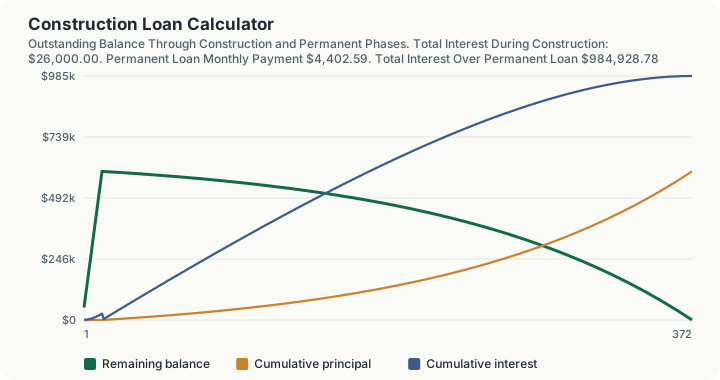
Quick Answer: A $600,000 construction loan at 8% drawn in a straight line over a 12-month build costs $26,000.00 in interest during construction, then converts into a $4,402.59 monthly payment on a 30-year permanent loan.
Overview
A construction loan funds a home build in stages rather than handing the borrower the full amount on day one. As the builder completes each phase (foundation, framing, roofing, and so on), the lender releases a draw to cover that phase's cost. Because the loan isn't fully disbursed at closing, you don't pay interest on the whole approved amount from day one; you pay interest only on however much has actually been drawn so far.
This calculator models that draw process as a straight line: the outstanding balance grows steadily from $0 at the start of construction to the full loan amount by the time the build finishes. Real draw schedules are lumpier (a big draw at foundation, another at framing, and so on), but a straight-line model gives a reasonable, easy-to-understand approximation of the total interest cost during the build.
Once construction wraps up, most construction loans convert into a standard permanent mortgage, either automatically (a "construction-to-permanent" loan) or through a separate refinance. From that point forward, the loan behaves exactly like any other fixed-rate amortizing mortgage: a level monthly payment that includes both principal and interest for the full term.
How This Is Calculated
- Draw-phase balance. For each month of the construction period, the outstanding drawn balance is assumed to be the loan amount multiplied by the fraction of the construction period that has elapsed. Month 1 of a 12-month build has roughly 1/12 of the loan drawn; month 12 has the full amount drawn.
- Draw-phase interest. Each month's interest charge is that month's drawn balance multiplied by the monthly interest rate. Because the loan is interest-only during construction, none of this payment reduces the eventual starting balance of the permanent loan.
- Total construction interest. The sum of all the monthly interest charges across the construction period.
- Permanent-loan payment. Once construction ends, the full loan amount amortizes as a standard fixed-rate mortgage over the permanent term you select (commonly 30 years), using the standard amortization formula.
Worked Example
A $600,000 construction loan at 8% APR, drawn in a straight line over 12 months, converting to a 30-year permanent loan:
- Monthly rate: 8% ÷ 12 = 0.6666667%
- Month 1 drawn balance: $600,000 × (1 ÷ 12) = $50,000; interest = $50,000 × 0.6666667% = $333.33
- Month 12 drawn balance: full $600,000; interest = $600,000 × 0.6666667% = $4,000.00
- Total interest across the 12-month construction period: $26,000.00
- Permanent loan payment on $600,000 at 8% over 30 years (360 months): $4,402.59 per month
If the build stretches to 18 months instead of 12, the draws spread out more slowly, and total construction-period interest rises to $38,000.00, even though the same $600,000 is eventually drawn, because the average outstanding balance is held for longer before the permanent loan takes over.
What the Build Timeline Costs, Month by Month
The draw schedule runs the construction months and the permanent schedule runs the 360 that follow. Moving the inputs rather than the months prices each decision separately.
The straight-line draw, read off the schedule. Month 1 draws $50,000 of the $600,000 and charges $333.33 of interest. Month 2 stands at $100,000 drawn and $666.67 of interest. Month 3 is $150,000 and $1,000.00. Month 12, fully drawn, charges $4,000.00, which is exactly twelve times the first month's figure because the balance grows linearly and the rate does not. Total construction-phase interest is $26,000.00, and the average monthly charge across the twelve months is $2,166.67, half the final month's figure.
Six months of delay, priced. Extending the build from 12 months to 18 takes construction interest from $26,000.00 to $38,000.00. Six months of delay costs $12,000.00, or $2,000.00 a month, and the permanent payment is unaffected at $4,402.59 because the loan amount has not changed. Compressing to a 6-month build takes construction interest to $14,000.00, so the first six months of the build cost $12,000 and the second six cost $14,000: the later months are dearer because more of the loan is outstanding.
A point of rate, priced across both phases. Moving from 8% to 9% takes construction interest from $26,000.00 to $29,250.00 and the permanent monthly payment from $4,402.59 to $4,827.74. Total project financing cost rises from $1,010,928.78 to $1,167,234.83, so one point of rate on a $600,000 build costs $156,303.39 across the full life of the financing.
The permanent term, which dominates everything else. Converting to a 15-year permanent loan instead of a 30-year one raises the monthly payment from $4,402.59 to $5,733.91 and cuts total permanent interest from $984,928.78 to $432,104.72. That $552,827.20 saving is larger than the loan itself, and it dwarfs every construction-phase decision on this page: the entire 12-month construction interest bill of $26,000.00 is under 5% of it.
Where the model simplifies. The draw is straight-line by construction, one twelfth of the budget each month on the default settings. Real draws follow inspection milestones and are lumpy, front-loaded by foundation and framing costs, so a real build's interest will not match the even progression above. The engine also charges no origination points, no inspection fees, no interest reserve and no rate change at conversion: the permanent phase reuses the same rate you entered for construction, where a real conversion would reprice to the then-current mortgage market.
What This Does Not Account For
- Lumpy, phase-based draw schedules. Real construction draws come in uneven chunks tied to inspection milestones, not a smooth daily ramp. A front-loaded or back-loaded draw schedule changes the actual interest cost.
- Construction loan fees. Inspection fees, draw fees, and a higher origination fee than a standard purchase mortgage are common and not included here.
- Interest reserve accounts. Some construction loans fund a reserve so the borrower doesn't have to make out-of-pocket interest payments during the build; that reserve itself accrues cost that isn't modeled here.
- Cost overruns and change orders. If the project goes over budget, additional draws beyond the original loan amount aren't reflected in this calculator.
- Rate locks and float-down provisions. Many construction-to-permanent loans lock the permanent rate at closing with a float-down option; this calculator assumes the same rate applies through both phases.
Common Pitfalls
- Budgeting only for the permanent payment. Borrowers sometimes plan cash flow around the eventual mortgage payment and forget that construction-period interest payments (however modest early on) are due throughout the build.
- Underestimating a delayed build. If construction runs longer than planned, interest-only payments continue accruing on a larger and larger balance, and this calculator's straight-line assumption will understate cost for a project that front-loads its draws.
- Assuming the construction loan and permanent loan always carry the same rate. Many construction-to-permanent products lock the permanent rate separately, sometimes with a rate premium if market rates rise during the build.
- Not confirming automatic conversion terms. Some construction loans require a separate closing and requalification to convert to permanent financing; if your credit or income changes during the build, that conversion isn't guaranteed.
Frequently Asked Questions
Do I make full mortgage payments during construction?
What happens if my construction project takes longer than planned?
Is a construction loan the same as a construction-to-permanent loan?
How is interest calculated if I haven't drawn the full loan amount yet?
Can I get a fixed rate for the entire construction and permanent period?
Sources
- Consumer Financial Protection Bureau (CFPB): disclosure requirements for construction and construction-to-permanent mortgage products under Regulation Z. ecfr.gov/current/title-12/chapter-X/part-1026
Also consulted: U.S. Department of Housing and Urban Development (HUD): construction loan and construction-to-permanent financing program guidance; Federal Home Loan Mortgage Corporation (Freddie Mac): construction conversion and single-close mortgage program mechanics referenced for standard structuring.