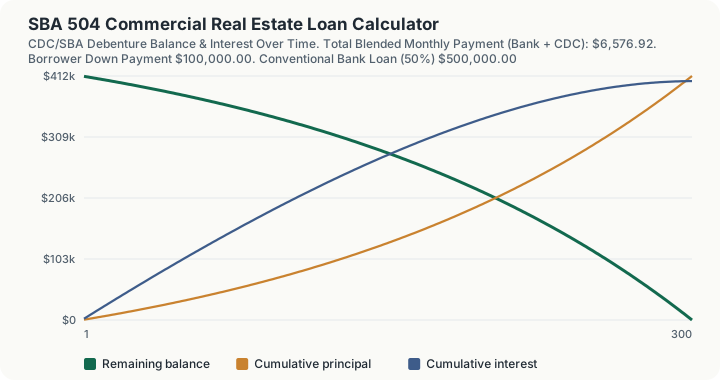
Quick Answer: A $1,000,000 commercial real estate project under a standard SBA 504 structure splits into a $500,000 conventional bank loan, a $400,000 CDC/SBA debenture, and a $100,000 borrower down payment, producing a blended monthly payment of about $6,576.92 across both loan pieces.
Overview
An SBA 504 loan is not a single loan. It's a financing structure, and understanding that structure is the entire key to understanding the program. Three separate parties contribute capital to a commercial real estate or major fixed-asset purchase: a conventional bank or credit union provides roughly 50% of the project cost as a standard first-position commercial loan at market rates; a Certified Development Company (CDC), a nonprofit partner of the SBA, provides roughly 40% through a fixed-rate, long-term debenture that carries an SBA guarantee; and the small business borrower contributes the remaining 10% (or more, for certain property types) in cash as a down payment.
This calculator models that full three-piece structure rather than pretending it is one blended loan with one rate. It calculates the bank portion and the CDC/SBA debenture portion separately, since they carry different rates, different terms, and fundamentally different risk profiles, and then sums the two monthly payments to show the borrower's actual total monthly obligation. The CDC/SBA debenture, being the defining and most distinctive piece of the 504 structure, is the one shown in full month-by-month detail in the schedule table.
How This Is Calculated
Step 1: Split the total project cost using the standard structure. The conventional bank loan is fixed at 50% of total project cost. The borrower's down payment defaults to 10%, the minimum most 504 borrowers put down. The CDC/SBA debenture absorbs whatever remains:
Startups (businesses operating less than two years) and single-purpose properties, such as hotels, gas stations, self-storage facilities, and similar special-use real estate, typically require a larger down payment, 15% to 20%, which shrinks the CDC portion proportionally while the bank's 50% share stays fixed.
Step 2: Add CDC/SBA closing fees to the debenture. The CDC processing fee, SBA guaranty fee, funding fee, and servicing fee are bundled together and typically run 2.5% to 3.5% of the CDC portion. Rather than being paid in cash, these fees are financed directly into the debenture:
Step 3: Amortize each piece separately. The financed CDC amount amortizes over its own fixed term (10, 20, or 25 years) at the CDC/SBA debenture's fixed rate, which SBA sets monthly and ties to Treasury note yields. The bank portion amortizes separately over its own term at whatever market rate the lender is offering. Both use the same standard amortization formula:
Step 4: Sum the two payments. The borrower's total monthly obligation is the CDC debenture payment plus the bank loan payment, since both loans are outstanding simultaneously against the same project.
Worked Example
Take a $1,000,000 commercial real estate purchase under the standard 50/40/10 structure, with a 6.25% fixed CDC debenture rate over 25 years, 3.0% CDC/SBA closing fees, and an 8.0% conventional bank rate over 25 years.
- Down payment: $1,000,000 × 10% = $100,000.
- Bank portion: $1,000,000 × 50% = $500,000.
- CDC portion: $1,000,000 × 40% (the remainder) = $400,000.
- CDC closing fees: $400,000 × 3.0% = $12,000.
- Financed CDC amount: $400,000 + $12,000 = $412,000.
- CDC monthly payment (300 months at 6.25%): $2,717.84.
- Bank monthly payment (300 months at 8.0% on $500,000): $3,859.08.
- Total blended monthly payment: $2,717.84 + $3,859.08 = $6,576.92.
Now consider the same project as a single-purpose property, say a hotel, requiring 20% down instead of 10%. The bank portion stays fixed at $500,000 (50%), the down payment rises to $200,000, and the CDC portion shrinks to $300,000, the remaining 30%, lowering the CDC debenture payment while the bank payment stays unchanged.
What This Does Not Account For
This calculator models the three-piece capital structure and both loans' amortization. It does not include appraisal fees, environmental reports, title insurance, or other transaction-specific closing costs on the bank portion, which are separate from the bundled CDC/SBA fees modeled here. It does not model the fact that conventional bank portions in 504 deals sometimes carry a shorter amortization with a balloon payment rather than fully amortizing over the same term as the CDC debenture; this calculator assumes full amortization over whatever bank term you enter, which you should adjust to match your actual lender's structure. It does not verify project eligibility, such as the requirement that the business occupy at least 51% of an existing building or 60% of new construction, or SBA size standard eligibility based on net worth and average net income. It treats the CDC/SBA rate as fixed for the life of the debenture, which is accurate, but the bank rate you enter should reflect whatever your specific lender is actually quoting, since that piece is not government-set.
Common Pitfalls
Borrowers frequently think of the 504 program as "a 90% loan" without registering that the 90% is split across two entirely separate creditors with separate underwriting, separate closing timelines, and separate rate structures, not one blended 90% loan from a single source. It's also easy to underestimate how much the down payment requirement changes for special-use properties. Assuming the standard 10% applies to a hotel or gas station purchase, when 15% to 20% is typically required, can throw off a project's entire capital plan. Some borrowers mistakenly assume the CDC/SBA fees are paid out of pocket at closing rather than financed into the debenture, which changes the actual cash needed to close versus what shows up in the monthly payment. And because the bank and CDC portions often close on different timelines, some borrowers are surprised that the CDC debenture funding, and therefore the CDC payment, may not begin on the exact same date as the bank loan's first payment.
Frequently Asked Questions
Why does the bank get 50% and the CDC get 40% instead of some other split?
Why would I need 20% down instead of 10%?
Is the CDC/SBA debenture rate the same for everyone?
Can I use a 504 loan to refinance existing debt instead of buying new property?
What happens if I sell the property before the CDC debenture term ends?
Sources
- U.S. Small Business Administration, 504 Loan Program.
- U.S. Small Business Administration, 504 Loan Program eligibility and structure guidance (50/40/10 standard split; 15-20% equity for startups and special-purpose properties). sba.gov