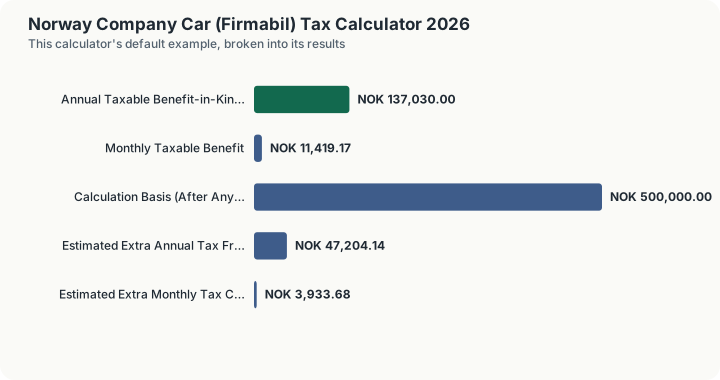
Quick Answer: A standard company car (firmabil) with an NOK 500,000 list price, under 3 years old, with normal mileage, creates a taxable benefit-in-kind of NOK 137,030 per year (NOK 11,419.17/month) added to your personinntekt for 2026. On a NOK 600,000 base salary, that benefit costs you an estimated NOK 47,204.14 in extra annual tax -- an effective 34.45% tax rate on the benefit itself.
Overview
A firmabil (company car) provided by an employer for private use is not a tax-free perk in Norway -- it is treated as taxable income, added directly to the employee's personinntekt (personal income) at a standardized, formula-driven value regardless of how much the car actually gets driven privately. Skatteetaten's method deliberately ignores the car's real depreciated value, actual running costs, or how the employee personally uses it: the benefit is calculated as a fixed percentage of the car's original list price as new, with a lower rate above a threshold, and a handful of specific, narrowly defined reductions for older cars and heavy documented business use.
This calculator applies Skatteetaten's exact 2026 method: 30% of the calculation basis up to NOK 370,300, and 20% of any amount above that -- then, if applicable, the two statutory basis reductions (for a car more than 3 years old, or with documented business driving over 40,000 km/year) that cut the calculation basis to 75%, or to 56.25% if both apply. It then goes a step further than a simple benefit figure and estimates what that benefit actually costs you in extra tax, by running your salary with and without the benefit through the full 2026 Norwegian income tax calculation.
How This Is Calculated
- Determine the calculation basis. Start from the car's list price as new. If the car is more than 3 years old as of 1 January of the income year, OR documented business use exceeds 40,000 km in the year, the basis is reduced to 75% of list price. If BOTH conditions apply, the basis is reduced further, to 56.25% (0.75 x 0.75) of list price.
- Apply the two-tier benefit rate. For 2026, the taxable annual benefit is 30% of the calculation basis up to NOK 370,300, plus 20% of any amount of the calculation basis exceeding that threshold.
where $B$ is the calculation basis after any applicable reduction.
- Add the benefit to personinntekt. This annual figure is added to the employee's gross personal income for the year, exactly as if it were additional salary -- it flows through trinnskatt, trygdeavgift, and the 22% tax on alminnelig inntekt, all calculated on the combined figure. The benefit raises alminnelig inntekt too, but not always by its full amount: minstefradrag is 46% of wage income capped at NOK 95,700, so if your base salary already reaches that cap the deduction cannot grow and the whole benefit is exposed to the 22% rate, whereas below the cap part of it is absorbed.
- Estimate the actual extra tax cost. Because Norway's system is progressive across three layers (see the companion Net Salary Calculator), the true cost of the benefit is not a single flat percentage -- it is the difference between total tax at (base salary) and total tax at (base salary + benefit). This calculator computes both directly rather than assuming a flat marginal rate.
Worked Example
Using the calculator's default inputs -- an NOK 500,000 list price, a car under 3 years old, normal business mileage, and a base annual salary of NOK 600,000:
- Calculation basis: No reduction applies -- basis = NOK 500,000
- Benefit below threshold: 30% x min(500,000, 370,300) = 30% x 370,300 = NOK 111,090
- Benefit above threshold: 20% x (500,000 - 370,300) = 20% x 129,700 = NOK 25,940
- Total annual benefit: 111,090 + 25,940 = NOK 137,030 (NOK 11,419.17/month)
- Tax at NOK 600,000 base salary (no benefit): NOK 144,182.60 (see the Net Salary Calculator's worked example)
- Tax at NOK 737,030 (base + benefit): minstefradrag = min(46% x 737,030, 95,700) = 95,700 (cap binds); alminnelig inntekt = 737,030 - 95,700 - 114,540 = 526,790; tax on general income = 22% x 526,790 = 115,893.80; trinnskatt = 1,567.40 + 16,270 + (11,980 x 13.7% = 1,641.26) = 19,478.66; trygdeavgift = 737,030 x 7.6% = 56,014.28 (below the marginal-relief cap) -> total tax = 115,893.80 + 19,478.66 + 56,014.28 = NOK 191,386.74
- Extra annual tax from the benefit: 191,386.74 - 144,182.60 = NOK 47,204.14, an effective 34.45% rate on the NOK 137,030 benefit itself -- noticeably above the flat 22% general income tax rate, because the additional income also lands in the 4.0% trinnskatt bracket and above the trygdeavgift threshold.
If the same car were more than 3 years old, the calculation basis drops to 75% of list price (NOK 375,000), reducing the annual benefit to NOK 112,030 -- a NOK 25,000 reduction in taxable benefit purely from the car's age.
What This Does Not Account For
- Electric vehicles no longer receive a special reduced valuation. The prior EV-specific discount on the company-car benefit calculation was phased out beginning with the 2023 income year; this calculator applies the same standard rules to all vehicles regardless of powertrain. (This specific point is corroborated by secondary industry sources and by the absence of any EV provision on Skatteetaten's own 2026 car-rates page, rather than by a single explicit primary-source statement -- flagged accordingly.)
- Employer's employer-side payroll tax (arbeidsgiveravgift) on the value of the benefit, which the employer pays and which does not affect the employee's personal tax bill modeled here.
- Free parking, tolls, ferries, and fuel/charging paid by the employer -- these can be separate taxable benefits (or, in some cases, tax-free) under their own distinct rules, not included in the firmabil list-price calculation.
- Company vans and pool cars (yrkesbil, varebil klasse 2) with restricted private use, which can qualify for a different, often lower or nil, benefit calculation if private use is genuinely restricted and documented -- this calculator assumes an ordinary firmabil available for private use.
- Multiple company cars in the same household or year, or a car provided for only part of the year (which prorates the benefit by the number of months available) -- this calculator computes a full-year benefit.
- The exact interaction with your specific deduction profile beyond the base-salary comparison -- the "extra tax cost" estimate assumes no other deductions or income changes besides the benefit itself.
Common Pitfalls
- Assuming the benefit is based on the car's actual current value, not its original list price. Skatteetaten always starts from the list price when new, regardless of any purchase discount negotiated, depreciation since then, or the car's real resale value -- a genuinely counterintuitive design that catches many first-time company-car recipients off guard.
- Assuming a 22% flat tax cost on the benefit. Because the added personinntekt also triggers trinnskatt and (if it pushes total income further above the threshold) trygdeavgift, the effective rate on the benefit is typically well above 22% -- 34.45% in the default example above.
- Forgetting that the age reduction is based on the calendar year, not a rolling 3-year period from delivery. The relevant test is whether the car is more than 3 years old as of 1 January of the income year in question, so the reduction can suddenly apply or stop applying at a specific fixed date each year.
- Confusing "more than 40,000 km driven" with "more than 40,000 km driven for business." The high-mileage reduction requires documented business (work-related) use specifically, not total mileage including private driving -- an important distinction that requires a mileage log (kjørebok) to substantiate.
- Not realizing both reductions can stack. An old car with high documented business mileage gets the deeper 56.25% basis reduction, not just one or the other -- missing this materially overstates the benefit for qualifying vehicles.
Frequently Asked Questions
Is the company car benefit based on what the car actually cost, or its value today?
Does an electric company car get a tax break in 2026?
How much extra tax will I actually pay for my company car?
What if my company car is more than 3 years old?
Does a company van or pool car get taxed the same way?
Is this benefit added to my salary for trygdeavgift and trinnskatt purposes, or just for the 22% tax?
Sources
- Skatteetaten (Norwegian Tax Administration), "Car rates - company cars" (skatteetaten.no/en/rates/car-rates---company-cars/) -- the 30%/20% benefit rates, the NOK 370,300 threshold, and the age/mileage basis-reduction rules for income year 2026. skatteetaten.no
Also consulted: Cross-referenced secondary source (autogear.com, "Firmabilskatt 2026") confirming the 2023 phase-out of the electric-vehicle valuation discount, since Skatteetaten's own 2026 rates page makes no separate mention of electric vehicles.