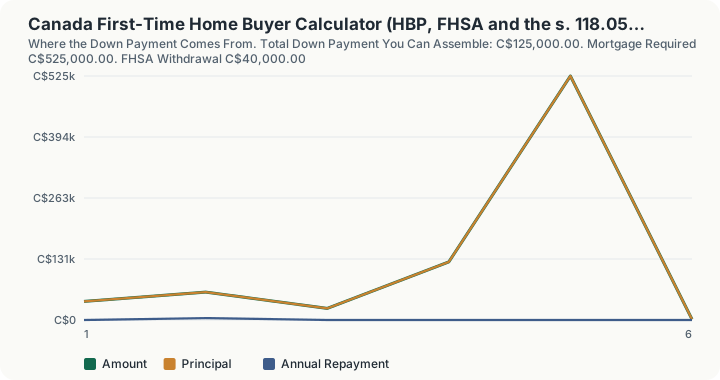
Quick Answer: A C$60,000 Home Buyers Plan withdrawal, a C$40,000 FHSA and C$25,000 of other savings assemble C$125,000 toward a C$650,000 purchase, or 19.23% down, leaving a C$525,000 mortgage. Total federal support is C$101,400, the two tax-free withdrawals plus a C$1,400.00 first-time home buyers' tax credit. The C$60,000 must go back into the RRSP at C$4,000.00 a year for fifteen years; the FHSA money never does. All figures are in Canadian dollars.
What does this calculator do?
Three federal measures help a first-time buyer in Canada, and they are frequently confused with each other because all three arrive as tax-free money at roughly the same moment. They behave very differently.
The Home Buyers Plan, in Income Tax Act s. 146.01, lets you take an eligible amount out of your RRSP without including it in income. The cap is C$60,000 per individual, and the money is a loan to yourself: s. 146.01(4) requires it to go back into the RRSP over fifteen years, beginning in the year after the completion date.
The First Home Savings Account, in s. 146.6, is not a loan. A qualifying withdrawal is entirely tax-free and is never repaid, which makes it the single most valuable of the three per dollar.
The first-time home buyers' tax credit, in s. 118.05(3), is a non-refundable credit computed by "multiplying $10,000 by the appropriate percentage for the taxation year". The appropriate percentage is the lowest s. 117(2) rate, which is 14%, so the credit is exactly C$1,400 and is fully determinable from the Act without any indexed figure. It is one credit per qualifying home, not per buyer: s. 118.05(4) says that where more than one individual is entitled in respect of the same home, the total they deduct "shall not exceed the maximum amount that would be so deductible" by any one of them alone. Two first-time buyers therefore share C$1,400, split however they agree.
All three are federal and all three are available wherever in Canada you buy. They sit alongside, and do not overlap with, provincial first-time buyer measures such as the British Columbia property transfer tax exemption, which is calculated separately on this site. A buyer in British Columbia can claim both; a buyer elsewhere gets these three plus whatever their own province offers.
How is this calculated?
Step 1: cap the Home Buyers Plan withdrawal. The s. 146.01 limit is per individual, so it doubles for two eligible buyers, and the RRSP balance is a separate real constraint:
W = min(Planned, 60,000 × n, RRSP Balance)
Step 2: spread the repayment over the statutory period.
Annual Repayment = W/15
Step 3: assemble the down payment. The FHSA withdrawal and other savings are unrestricted by these provisions:
P = W + F + S
Step 4: find the mortgage required.
M = max(0, Price − P)
Step 5: compute the s. 118.05 credit and cap it at tax payable. The credit is one amount per home whatever the number of buyers (s. 118.05(4)), and it is non-refundable, so it cannot exceed the federal tax actually owed (for two buyers, the tax of the two of you combined, since you can split it):
HBTC = min(10,000 × 0.14, Federal Tax Payable)
Worked Example
Using the page defaults: a C$650,000 home, one eligible buyer, a C$75,000 RRSP, a C$60,000 planned withdrawal, C$40,000 in an FHSA, C$25,000 of other savings, and C$9,000 of federal tax otherwise payable.
Step 1: cap the Home Buyers Plan withdrawal. The C$60,000 planned is exactly at the statutory limit and well inside the C$75,000 RRSP balance. C$60,000
Step 2: the annual repayment. C$60,000 spread over the fifteen years required by s. 146.01(4). C$4,000.00
Step 3: the FHSA qualifying withdrawal. Tax-free, and not repayable. C$40,000
Step 4: other savings. C$25,000
Step 5: total down payment. C$60,000 plus C$40,000 plus C$25,000. C$125,000
Step 6: down payment as a share of the price. C$125,000 divided by C$650,000. 19.23%
Step 7: the mortgage required. C$650,000 less C$125,000. C$525,000
Step 8: the s. 118.05 credit. C$10,000 multiplied by the 14% appropriate percentage. C$1,400.00
Step 9: check it against tax payable. C$1,400.00 fits comfortably inside C$9,000 of federal tax, so the full credit is usable. C$1,400.00
Step 10: total federal support. The two tax-free withdrawals plus the credit. C$101,400
Note what the calculator separates: C$40,000 of that never has to be repaid, while C$60,000 must go back into the RRSP. They are both tax-free coming out, and they are not the same kind of money.
What does this calculator not account for?
- Whether you actually qualify as a first-time buyer. Section 146.6 defines a qualifying individual as someone who has not lived in a home they or a spouse owned at any time in the calendar year or the four preceding calendar years. The Home Buyers Plan and the s. 118.05 credit have their own related tests. This page assumes you meet them.
- The qualifying withdrawal conditions. Both the FHSA and the Home Buyers Plan require written requests, a written agreement to acquire the home before a deadline, and residency in Canada. A withdrawal that fails these becomes fully taxable.
- The 90-day rule on RRSP contributions. Money contributed to an RRSP within 90 days of a Home Buyers Plan withdrawal may not be deductible. Contributing to an RRSP specifically in order to withdraw it under the plan can therefore backfire.
- What happens if you miss a repayment. Missing a Home Buyers Plan repayment does not create a debt. The missed amount is simply added to your income for that year and taxed. That is often worse than it sounds and is not modelled here.
- No provincial measures. Provincial land transfer tax, provincial first-time buyer exemptions and rebates, and municipal land transfer taxes are all separate and are not included in the total federal support figure.
- No GST or HST new housing rebate. A new build attracts GST or HST, with a partial rebate under the Excise Tax Act that this page does not compute.
- No minimum down payment test. Canada's tiered minimum down payment rules sit in mortgage insurance policy rather than statute, and this page does not check whether the amount you assembled clears them. It reports the percentage so you can check yourself.
- No closing costs. Legal fees, title insurance, inspection, appraisal and adjustments typically run to one or two percent of the price and are not deducted from the down payment here.
What mistakes do people make with this?
- Treating the Home Buyers Plan as free money. It is a fifteen-year interest-free loan from your own retirement savings, and every dollar you fail to repay becomes taxable income in the year it was due.
- Believing the FHSA and the Home Buyers Plan are alternatives. They are separate measures under separate sections and can both fund the same purchase. Using only one leaves room on the table.
- Expecting the s. 118.05 credit to be a payment. It is non-refundable. A buyer with little federal tax payable gets only part of the C$1,400, and a buyer with none gets nothing.
- Claiming the credit twice for one home. Two first-time buyers buying together share a single C$1,400 under s. 118.05(4), split however they like; they cannot claim C$1,400 each. Only the Home Buyers Plan limit doubles.
- Draining the FHSA and the RRSP without leaving anything for closing costs. The down payment is not the only cash you need on completion day, and lenders will ask you to demonstrate you have the rest.
Frequently Asked Questions
How much can I withdraw under the Home Buyers Plan?
How long do I have to repay the Home Buyers Plan?
How much is the first-time home buyers' tax credit?
Can I use the FHSA and the Home Buyers Plan together?
How is this different from the BC first-time buyer exemption?
Sources
- Income Tax Act, R.S.C. 1985, c. 1 (5th Supp.), s. 146.01, the Home Buyers' Plan: the C$60,000 limit on eligible amounts received in a calendar year, and the fifteen-year repayment formula in s. 146.01(4). Justice Laws Website, read 2026-08-31; Act current to 2026-06-21, last amended 2026-06-18. laws-lois.justice.gc.ca/eng/acts/I-3.3/section-146.01.html
- Income Tax Act, s. 118.05(3), the first-time home buyers' tax credit: "the amount determined by multiplying $10,000 by the appropriate percentage for the taxation year". Justice Laws Website, read 2026-08-31. laws-lois.justice.gc.ca/eng/acts/I-3.3/section-118.05.html
- Income Tax Act, s. 146.6, the First Home Savings Account, including the qualifying individual test and the qualifying withdrawal conditions. Justice Laws Website, read 2026-08-31. laws-lois.justice.gc.ca/eng/acts/I-3.3/section-146.6.html
- Income Tax Act, s. 117(2), which fixes the appropriate percentage used by s. 118.05(3) at the lowest bracket rate of 14%. Justice Laws Website, read 2026-08-31. laws-lois.justice.gc.ca/eng/acts/I-3.3/section-117.html