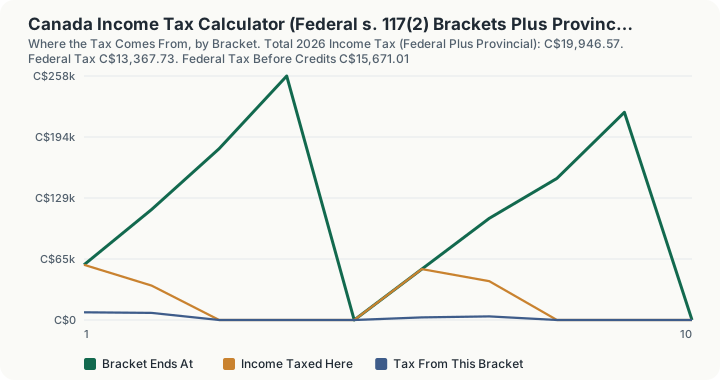
Quick Answer: C$95,000 of taxable income in Ontario attracts C$19,946.57 of income tax in 2026: C$13,367.73 federal after the C$16,452 basic personal amount credit, and C$6,578.84 to Ontario, which includes a C$750 Ontario Health Premium and C$1.81 of Ontario surtax. That leaves C$75,053.43 after tax, an average rate of 21.00%, with 31.48% falling on the next dollar. All figures are in Canadian dollars.
What does this calculator do?
Canadian personal income tax is levied twice on the same income: once federally under the Income Tax Act, and once by the province or territory you lived in on December 31. Each of the ten provinces and three territories sets its own brackets, its own rates and its own basic personal amount, and a few add something extra on top. Any calculator quoting a single "Canadian tax rate" is quietly assuming a province it has not named.
This calculator asks for your taxable income and your province or territory, and applies the 2026 schedules for both levels. The five federal rates are the Income Tax Act s. 117(2) rates of 14%, 20.5%, 26%, 29% and 33%, with the 2026 indexed thresholds of C$58,523, C$117,045, C$181,440 and C$258,482 published by the Canada Revenue Agency. Every provincial and territorial ladder comes from the CRA's 2026 rate table and its T4127 payroll formulas, and Quebec's from Revenu Quebec.
The same C$95,000 of taxable income costs C$17,557.34 in Nunavut, C$19,822.21 in Alberta, C$19,946.57 in Ontario, C$23,841.52 in Quebec and C$25,179.87 in Nova Scotia. Federal tax is identical in every case except Quebec, where the 16.5% Quebec abatement reduces it; the whole spread is the provincial layer.
The other thing worth understanding is that the basic personal amount is not a deduction. It is a non-refundable credit computed at the lowest rate of each ladder: 14% federally, and the province's own lowest rate provincially. That is what makes it worth the same number of dollars to a top-bracket earner as to someone in the first bracket.
How is this calculated?
- Federal tax before credits. Taxable income runs through the 2026 federal ladder. Each rate applies only to the slice of income inside its own bracket.
- Federal basic personal amount. C$16,452 at taxable income up to C$181,440, falling in a straight line to C$14,829 at C$258,482 and above, as s. 118(1.1) and the CRA's 2026 figures set out. It is converted to a credit at 14% and subtracted, floored at zero.
- Quebec abatement. For a Quebec resident only, federal tax is reduced by 16.5%.
- Provincial or territorial tax before credits. Taxable income runs through your jurisdiction's 2026 ladder.
- Provincial basic personal amount credit. Your jurisdiction's 2026 basic personal amount times its lowest rate. Yukon uses the federal amount and its phase-out; Manitoba's C$15,780 amount falls to zero between C$200,000 and C$400,000; Alberta adds its supplemental credit where the credits exceed C$4,896.
- Ontario and British Columbia adjustments. Ontario adds a surtax of 20% of basic Ontario tax above C$5,818 plus 36% above C$7,446, subtracts the Ontario tax reduction at low incomes, and adds the Ontario Health Premium on taxable income above C$20,000. British Columbia subtracts its tax reduction of up to C$690, which phases out at 3.56% of income above C$25,570.
- Total and rates. Federal plus provincial tax is the headline. The marginal rate is the extra tax on the next C$100 of taxable income, so it picks up the surtax and the basic personal amount phase-out where they bite.
Tax = ∑_i rᵢ × sliceᵢ − r_low × BPA (at each level)
Worked Example
Using the page defaults: C$95,000 of taxable income in Ontario.
Step 1: tax the first federal bracket. C$58,523 at 14%. C$8,193.22
Step 2: tax the second federal bracket. C$95,000 less C$58,523 is C$36,477, at 20.5%, giving C$7,477.785, which rounds to C$7,477.79
Step 3: federal tax before credits. C$15,671.01
Step 4: the federal credit. C$95,000 is below C$181,440, so the full C$16,452 basic personal amount applies, at 14%. C$2,303.28
Step 5: federal tax. C$13,367.73
Step 6: Ontario tax before credits. C$53,891 at 5.05% is C$2,721.50, and the remaining C$41,109 at 9.15% is C$3,761.47. C$6,482.97
Step 7: the Ontario credit. C$12,989 at 5.05%. C$655.94
Step 8: basic Ontario tax. C$5,827.03
Step 9: Ontario surtax. C$5,827.03 is just C$9.03 above the C$5,818 threshold, and 20% of that is C$1.81
Step 10: Ontario Health Premium. C$95,000 is in the C$72,000 to C$200,000 tier, which is capped at C$750.00
Step 11: Ontario tax. C$5,827.03 plus C$1.81 plus C$750.00. C$6,578.84
Step 12: total income tax. C$19,946.57
The average rate is 21.00%. The marginal rate is 31.48%: 20.5% federal plus Ontario's 9.15%, grossed up by the 20% surtax that now applies to every extra dollar of basic Ontario tax.
What does this calculator not account for?
- Only the basic personal amount is applied as a credit. The Canada employment amount, CPP and EI credits, the age amount, pension income, disability, tuition, medical expenses and charitable donations are all real non-refundable credits that this page does not model. The take-home pay calculator adds the employment-related ones.
- Low-income reductions outside Ontario and British Columbia are not modelled. Nova Scotia, Newfoundland and Labrador, Prince Edward Island, New Brunswick and Manitoba each grant a reduction on the return for modest incomes, so tax at low incomes in those provinces is overstated here.
- Quebec is computed from its brackets and basic personal amount only. Quebec's own deductions and credits are not modelled.
- Net income is taken to equal taxable income for the federal, Manitoba and Yukon basic personal amount phase-outs.
- No refundable credits or benefits, no alternative minimum tax, no dividend gross-up, and no special treatment of capital gains. Those have their own calculators on this site, including the capital gains calculator and the dividend tax credit calculator.
What mistakes do people make with this?
- Believing a higher bracket taxes all your income at the higher rate. It never does. Crossing a threshold changes the rate only on the dollars above it, which is why a raise can never leave you worse off through the tax system alone.
- Treating the basic personal amount as a deduction. It is a credit at 14% federally. The C$16,452 federal amount is worth C$2,303.28, not C$16,452 times your marginal rate.
- Using gross salary instead of taxable income. RRSP contributions, union dues and child care expenses all come off before the ladder runs, so entering gross pay overstates your tax.
- Forgetting the Ontario surtax and health premium. They are part of Ontario income tax. At high incomes the surtax lifts Ontario's top effective provincial rate well above the 13.16% headline rate.
- Assuming a national provincial rate. Combined marginal rates at C$95,000 run from 27.50% in Nunavut to 37.17% in Nova Scotia. A figure computed for one province is simply wrong in another.
Frequently Asked Questions
What are the 2026 federal income tax brackets in Canada?
Is the basic personal amount a deduction or a credit?
Why does the basic personal amount get smaller at high incomes?
How much income tax do I pay on C$95,000 in Ontario?
What is the difference between my marginal rate and my average rate?
Sources
- Canada Revenue Agency, Current year tax rates and income brackets (2026), page dated 2026-06-25, read 2026-10-14. canada.ca/en/revenue-agency/services/tax/individuals/tax-rates-brackets/current-year.html
- Canada Revenue Agency, T4127 Payroll Deductions Formulas, 122nd Edition, effective January 1, 2026: the 2026 federal and provincial basic personal amounts, the Ontario surtax, health premium and tax reduction, the Alberta supplemental credit, the Manitoba and Yukon basic personal amount rules and the Quebec abatement. Read 2026-10-14. canada.ca/en/revenue-agency/services/forms-publications/payroll/t4127-payroll-deductions-formulas/t4127-jan/t4127-jan-payroll-deductions-formulas-computer-programs.html
- Canada Revenue Agency, T4127 Payroll Deductions Formulas, 123rd Edition, effective July 1, 2026: the annual 2026 figures for British Columbia (5.60% lowest rate, C$690 tax reduction), Newfoundland and Labrador (C$13,094 basic personal amount) and Prince Edward Island (20% over C$200,000). Read 2026-10-14. canada.ca/en/revenue-agency/services/forms-publications/payroll/t4127-payroll-deductions-formulas/t4127-jul/t4127-jul-payroll-deductions-formulas.html
- Revenu Quebec, Income Tax Rates (2026) and Employers: Principal Changes for 2026 (C$18,952 basic personal amount). Read 2026-10-14. revenuquebec.ca/en/citizens/income-tax-return/completing-your-income-tax-return/income-tax-rates
- Manitoba Finance, Personal Income Taxes: indexation of Manitoba's bracket thresholds paused from the 2025 tax year, so the 2026 thresholds stay at C$47,000 and C$100,000. Read 2026-10-14. gov.mb.ca/finance/personal/ptaxes.html
- Income Tax Act, R.S.C. 1985, c. 1 (5th Supp.), s. 117(2) and s. 118(1) and (1.1). Justice Laws Website, read 2026-08-31. laws-lois.justice.gc.ca/eng/acts/I-3.3/section-117.html