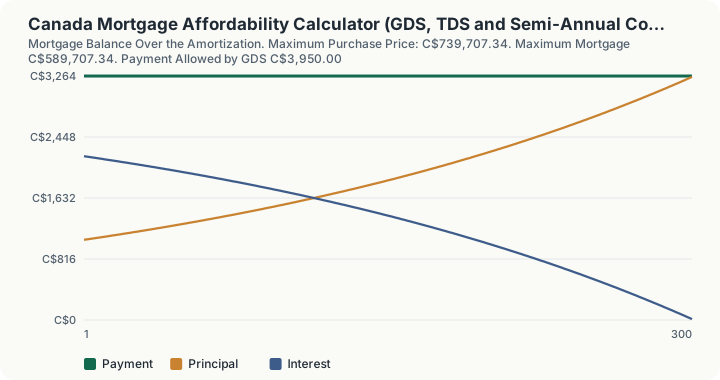
Quick Answer: C$140,000 of gross household income with C$150,000 down buys up to C$739,707.34, supported by a C$589,707.34 mortgage over 25 years at a 6.5% qualifying rate. Gross debt service is the binding ratio at C$3,950.00 of principal and interest, where total debt service would have allowed C$4,033.33. The payment actually due at the 4.5% contract rate is C$3,263.87, leaving a C$686.13 monthly cushion. All figures are in Canadian dollars.
What does this calculator do?
Canadian mortgage qualification runs on two ratios and one rate that is not the rate you will pay.
Gross debt service measures your housing costs against gross income: principal, interest, property tax, heat, and half of any condo fee. Total debt service adds every other debt payment you carry. A lender applies a ceiling to each, and whichever ceiling produces the smaller payment is the one that governs. Knowing which one bound is the most actionable thing this calculator tells you, because if total debt service is binding then paying down a car loan raises your maximum, and if gross debt service is binding then it does not.
The rate used to test those ratios is not your contract rate. Federally regulated lenders qualify borrowers at a higher rate so that the payment remains affordable if rates rise. That produces the slightly odd arithmetic on this page: the maximum mortgage is the present value of the qualifying payment discounted at the QUALIFYING rate, while the payment you will actually make is computed at the contract rate. The difference between the two is the cushion, and it is the entire point of the exercise.
One genuinely Canadian detail underlies all of it. Interest Act s. 6 provides that where mortgage money is repaid in blended payments, no interest is recoverable unless the mortgage states the rate "calculated yearly or half-yearly, not in advance". That is why a Canadian fixed-rate mortgage compounds semi-annually while payments are made monthly, and why a Canadian payment is slightly lower than an American one at the same posted rate. This calculator converts the semi-annual rate to its exact monthly equivalent before solving anything, using the sixth root of one plus half the annual rate.
How is this calculated?
Step 1: find gross monthly income and the fixed housing costs. Note that only half the condo fee enters either ratio:
H = (Property Tax)/12 + Heat + (Condo Fee)/2
Step 2: find the payment each ratio allows.
P_GDS = g⋅Iₘ − H; P_TDS = t⋅Iₘ − H − D
Step 3: take the lesser. That is the qualifying principal and interest payment:
P = min(P_GDS, P_TDS)
Step 4: convert the qualifying rate under Interest Act s. 6.
i = (1 + r/2)^(1/6) − 1
Step 5: find the mortgage that payment supports at the qualifying rate.
M = P × (1 − (1 + i)⁻ⁿ)/i
Step 6: add the down payment for the maximum price, then compute the payment actually due at the contract rate through the same semi-annual conversion.
Worked Example
Using the page defaults, and taking the ratio arithmetic first.
Step 1: gross monthly income. C$140,000 divided by 12 is C$11,666.666, which carries to C$11,666.67
Step 2: monthly property tax. C$5,400 divided by 12. C$450.00
Step 3: total fixed housing costs. C$450.00 plus C$150.00 of heat, with no condo fee. C$600.00
Step 4: the gross debt service allowance. C$11,666.67 at the 39% ceiling. C$4,550.00
Step 5: the payment gross debt service leaves for principal and interest. C$4,550.00 less C$600.00. C$3,950.00
Step 6: the total debt service allowance. C$11,666.67 at the 44% ceiling is C$5,133.33, less C$600.00 of housing costs and C$500.00 of other debt. C$4,033.33
Step 7: take the lesser. C$3,950.00 is smaller, so gross debt service binds. C$3,950.00
Step 8: convert the 6.5% qualifying rate. One plus half of 6.5% is 1.0325, and its sixth root less one gives a monthly effective rate of 0.53%
Step 9: the mortgage that C$3,950.00 supports over 300 months at that rate. C$589,707.34
Step 10: the maximum purchase price. C$589,707.34 plus the C$150,000 down payment. C$739,707.34
Step 11: the payment actually due at the 4.5% contract rate. C$3,263.87
Step 12: the monthly cushion. C$3,950.00 less C$3,263.87. C$686.13
What the Maximum Mortgage Costs Once You Are In It
The twelve steps above size the loan. The schedule shows what carrying it feels like, and the first year is the least flattering part.
Step 13: month one. Of the C$3,263.87 payment, C$2,190.95 is interest and C$1,072.92 is principal, leaving C$588,634.42
Step 14: month two. Interest C$2,186.96, principal C$1,076.91, and cumulative interest of C$4,377.91, leaving C$587,557.51
Step 15: after twelve payments. Cumulative interest C$26,025.03
Step 16: the balance after that first year. C$589,707.34 less the principal repaid. C$576,565.93
Step 17: the end of a five-year term, month 60. Cumulative interest C$123,866.65, balance C$517,741.79
Step 18: the full 300 months. Total interest C$389,454.01
A year of payments totalling C$39,166.44 has reduced the debt by C$13,141.41. At the end of the first five-year term, when the mortgage has to be renewed at whatever rate exists then, C$123,866.65 of interest has been paid and C$71,965.60 of principal retired: the borrower still owes 88% of the original loan. That renewal exposure is the reason the qualifying rate sits two points above the contract rate, and the C$686.13 cushion in step 12 is what absorbs it.
What does this calculator not account for?
- Every ratio ceiling and the qualifying rate are inputs, not law. The 39% gross and 44% total debt service defaults are CMHC's limits for its standard purchase insurance product; other CMHC products and private insurers use lower ones, and lenders apply them with discretion. The qualifying rate follows OSFI's minimum qualifying rate, the greater of the contract rate plus 2 points or 5.25%, which binds federally regulated lenders but not provincially regulated credit unions.
- The insurance threshold applies to banks. Bank Act s. 418(1) bars a bank from lending more than 80% of a home's value unless the excess is insured. Other lenders follow the same 80% line in practice, but it is not a rule for every lender.
- The insurance premium itself is not computed. Where insurance is required, the premium is added to the mortgage, which changes both the balance and the payment. This page flags that insurance would be required and stops there.
- The tiered minimum down payment is not applied. Canada's minimum down payment rises in bands with the purchase price. This calculator reports your down payment percentage so you can check it, but does not enforce a minimum.
- Lender discretion is not modelled. Real underwriting weighs credit score, employment stability and how much income is bonus or commission, so two applicants with identical inputs here can get very different answers.
- Property tax is entered, not derived from the price. A more expensive home attracts more property tax, which reduces ratio room, which reduces the price you qualify for. That circularity is not solved here.
- No closing costs, no land transfer tax, and no ongoing maintenance or property insurance.
- The full amortization is assumed at one rate. Canadian mortgages are written in terms, typically five years, and renew at whatever rate prevails, so the 25-year interest figure assumes a rate that will not hold.
What mistakes do people make with this?
- Reading the maximum as a recommendation. These ratios describe what a lender will lend, not what is comfortable. Both are computed on gross income, before tax, CPP and EI, which is why the resulting payment can feel far heavier than the percentage suggests.
- Paying down the wrong debt. If gross debt service is binding, clearing a car loan changes nothing, because that payment never entered the binding ratio. Check which ratio bound before deciding.
- Forgetting that only half the condo fee counts. A C$550 fee adds C$275 to the ratios, not C$550. That still costs roughly C$275 of monthly payment room, so a condo qualifies for a smaller mortgage than a freehold at the same price.
- Assuming a Canadian and an American payment match at the same posted rate. Semi-annual compounding under Interest Act s. 6 makes the Canadian effective monthly rate slightly lower, and the payment slightly smaller.
- Stretching the amortization to qualify for more. Going from 25 to 30 years raises the maximum price and raises total interest sharply. The calculator will show you both if you change the input.
Frequently Asked Questions
What are the GDS and TDS ratios?
What is the mortgage stress test?
Why is a Canadian mortgage compounded semi-annually?
Why does the calculator use two different rates?
Sources
- Interest Act, R.S.C. 1985, c. I-15, s. 6: where mortgage principal and interest are payable in blended payments, no interest is chargeable or recoverable unless the mortgage states the principal and the rate "calculated yearly or half-yearly, not in advance". Justice Laws Website, read 2026-08-31; last amended 2008-06-18. laws-lois.justice.gc.ca/eng/acts/I-15/section-6.html
- CMHC, "CMHC Purchase" mortgage loan insurance: maximum GDS 39% and TDS 44%, calculated at the greater of the contract rate plus 2% or 5.25%. cmhc-schl.gc.ca/professionals/project-funding-and-mortgage-financing/mortgage-loan-insurance/mortgage-loan-insurance-homeownership-programs/purchase
- Office of the Superintendent of Financial Institutions, "Minimum qualifying rate for uninsured mortgages": the greater of the mortgage contract rate plus 2% or 5.25%. osfi-bsif.gc.ca/en/supervision/financial-institutions/banks/minimum-qualifying-rate-uninsured-mortgages
- Bank Act, S.C. 1991, c. 46, s. 418(1): no residential mortgage loan above 80% of the property's value unless the excess is insured. laws-lois.justice.gc.ca/eng/acts/B-1.01/section-418.html
Also consulted: the tiered minimum down payment sits in federal mortgage insurance rules rather than in statute and is not applied by this calculator.