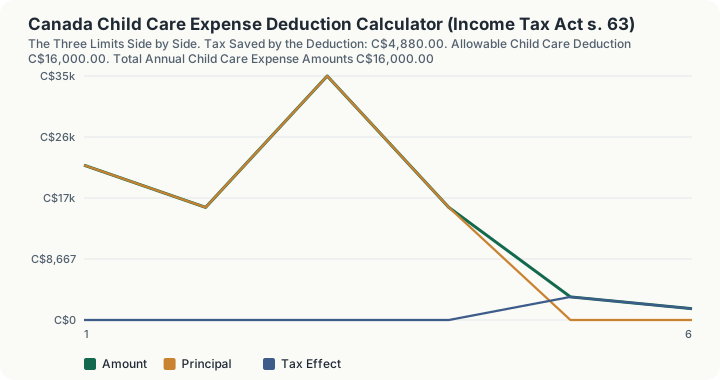
Quick Answer: Two children under 7 and C$22,000 of child care paid, against C$52,000 of earned income for the lower-earning spouse, produce a C$16,000 deduction worth C$4,880.00 at a combined 30.5% marginal rate. The binding cap is the Income Tax Act s. 63(3) per-child amount, not the C$22,000 actually spent or the C$34,666.67 two-thirds earned income limit, so C$6,000 of spending gets no tax relief at all and the net cost of child care is C$17,120.00. All figures are in Canadian dollars.
What does this calculator do?
The child care expense deduction is one of the few genuinely large deductions in the Canadian personal tax system, and it is also one of the most tightly capped. Income Tax Act s. 63(1) does not simply let you deduct what you spent. It allows the LEAST of three separate amounts, and in most real families at least one of them bites hard.
The three limits are: what you actually paid, the total of the per-child annual amounts in s. 63(3), and two thirds of earned income. The per-child amounts are C$11,000 where the disability tax credit is available for the child, C$8,000 for a child under 7 at the end of the year, and C$5,000 for any other eligible child. Every one of those figures is stated in the Act itself and none is in the annual indexation list, so unlike most Canadian tax numbers they simply do not change from year to year.
The second structural feature that surprises people is s. 63(2). The deduction generally must be claimed by the LOWER-income supporting person, and the two-thirds limit is measured against that person's earned income. A family where one parent works part time can therefore lose most of the deduction even though the household spent a great deal on care, because two thirds of a small income is a small number.
Knowing which of the three limits bound is the most useful thing this calculator tells you, because it tells you whether anything you could change would help.
How is this calculated?
Step 1: total the s. 63(3) annual amounts. One amount per eligible child, by category:
M = 11,000d + 8,000u + 5,000o
Step 2: compute two thirds of earned income, measured against the lower-earning supporting person under s. 63(2):
Y = 2/3 × Earned Income
Step 3: apply the periodic cap where overnight care is involved. The s. 63(3) periodic amount is one fortieth of the annual amount, per week, per child:
C_cap = M/n × 1/40 × w × n
Step 4: take the least of the three s. 63(1) limits.
D = min(Expenses, M, Y)
Step 5: value the deduction at your combined marginal rate. The deduction reduces income, so it is worth the deduction multiplied by the rate, not the deduction itself:
Saving = D × (r_fed + r_prov)
Worked Example
Using the page defaults: two children under 7, C$22,000 of expenses, a lower earned income of C$52,000, and combined marginal rates of 20.5% federal and 10% provincial.
Step 1: total the per-child annual amounts. Two children under 7, at C$8,000 each under s. 63(3). C$16,000
Step 2: compute two thirds of earned income. Two thirds of C$52,000 is C$34,666.666, which carries to C$34,666.67
Step 3: note what was actually spent. C$22,000
Step 4: take the least of the three. C$16,000 is smaller than both C$22,000 and C$34,666.67, so the per-child amounts govern. C$16,000
Step 5: find the spending that gets no relief. C$22,000 less C$16,000. C$6,000
Step 6: federal tax saved. C$16,000 at 20.5%. C$3,280.00
Step 7: provincial tax saved. C$16,000 at 10%. C$1,600.00
Step 8: total tax saved. C$3,280.00 plus C$1,600.00. C$4,880.00
Step 9: the real subsidy rate. C$4,880 divided by the C$22,000 actually spent. 22.18%
That subsidy rate is the number worth remembering. The combined marginal rate is 30.50%, but because the per-child cap bit, the effective relief on what the family actually spent is only 22.18%.
What does this calculator not account for?
- Marginal rates are inputs, and the deduction can lower your own rate. A large deduction can move you into a lower bracket, so the last dollars of it may be worth less than the first. This page applies one federal rate and one provincial rate throughout.
- The federal bracket thresholds are indexed and were not verified, which is why the page asks for a rate rather than deriving one from income.
- Provincial rates have no national value and vary by more than ten points across the country.
- The s. 63(2) exceptions are not modelled. The higher-income spouse may claim the deduction for weeks in which the lower earner was at school, in hospital, in prison, or living separate and apart because of a marriage breakdown. This calculator implements only the general rule and measures the two-thirds limit against the lower earner.
- Earned income is entered, not derived. Section 63(3) defines it to include employment income, net self-employment income and certain other amounts, but not investment income, pensions or most benefits. Entering total income here will overstate the two-thirds limit.
- The periodic cap is applied uniformly across children. Where several children attend overnight care for different numbers of weeks, or where only some weeks are overnight, the real calculation is per child and per week. This page applies a single number of weeks to every eligible child.
- No provincial child care programs. Several provinces run subsidized or reduced-fee child care that reduces what you spend in the first place. That changes the input, not the calculation, and none of it appears here.
- No Canada Child Benefit. That is a monthly payment, not a deduction, and it is calculated elsewhere on this site.
What mistakes do people make with this?
- Claiming on the higher earner's return. Section 63(2) generally requires the lower-income supporting person to claim, and CRA will reassess a return that gets this backwards. It also usually costs the family money, because the deduction is then worth the lower earner's marginal rate rather than the higher one.
- Using the age at the time care was provided. The C$8,000 band depends on the child being under 7 AT THE END of the year, so a child who turns 7 in December falls into the C$5,000 band for that whole year.
- Assuming the whole nursery bill is deductible. At the defaults, C$6,000 of C$22,000 spent produces no relief at all. Two children under 7 cap the deduction at C$16,000 regardless of what care costs in your city.
- Missing the caregiver's social insurance number. Receipts from an individual caregiver must show it. Without it the claim is not supportable, however real the expense was.
- Treating the deduction as a rebate. A C$16,000 deduction is not worth C$16,000. It is worth C$16,000 times your combined marginal rate, which here is C$4,880.
Frequently Asked Questions
How much child care can I deduct in Canada?
Do the C$8,000 and C$5,000 amounts go up with inflation?
Which parent should claim it?
Why is my deduction smaller than what I paid?
Does summer camp count?
Sources
- Income Tax Act, R.S.C. 1985, c. 1 (5th Supp.), s. 63: s. 63(1) for the least-of-three structure and the two-thirds earned income limit, s. 63(2) for the lower-income claimant rule and its exceptions, and s. 63(3) for the C$11,000, C$8,000 and C$5,000 annual child care expense amounts and the one-fortieth periodic amount. Justice Laws Website, read 2026-08-31; Act current to 2026-06-21, last amended 2026-06-18. laws-lois.justice.gc.ca/eng/acts/I-3.3/section-63.html
- Income Tax Act, s. 117(2), the five federal marginal rates at which the deduction is valued. Justice Laws Website, read 2026-08-31. laws-lois.justice.gc.ca/eng/acts/I-3.3/section-117.html
Also consulted: Income Tax Act, s. 118.3, the disability tax credit provision that determines which children fall into the C$11,000 band. Referenced by s. 63(3); Provincial and territorial marginal rates are set in each province's own legislation and have no national value, so they are user inputs.