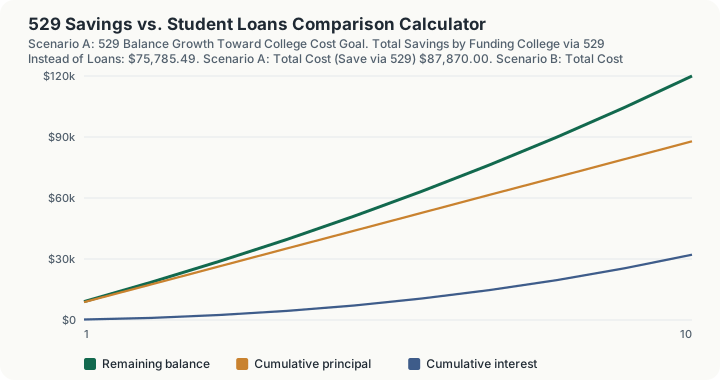
Quick Answer: For a projected $120,000 college cost, 10 years away, saving via a 529 (at a required $732.25/month, 6% assumed return) costs the family $87,870.00 in total out-of-pocket contributions. Borrowing the full amount instead via a 10-year student loan at 6.52% costs $163,655.49 in total repayment. Choosing to save now instead of borrowing later saves this family $75,785.49 over the life of both paths.
Overview
Every family paying for college is really choosing between two ways to pay the same bill: put money in before college and let it grow, or borrow money after college starts and pay it back with interest. Both paths eventually cover the same $120,000 (or whatever the real cost turns out to be). The only question that matters is how much extra it costs to go one way versus the other, and that extra cost shows up in opposite directions for each path.
Scenario A, saving via a 529, "costs" you the monthly contribution discipline of putting money in for years before you need it, but in exchange, the market pays part of the bill for you: tax-free investment growth covers a real share of the total. Scenario B, borrowing via student loans, costs you nothing extra today, but the lender charges interest for the privilege of paying later, and that interest is real money leaving the family's pocket that never buys anything except time.
This calculator is built to show both totals honestly rather than assume saving always wins. A family that genuinely cannot spare $732.25 a month for 10 years is not actually choosing between "cheap" and "expensive," they're choosing between "impossible" and "possible." Liquidity and feasibility are real constraints that a total-dollar comparison doesn't capture on its own, which is why the sections below spell out what this tool does and doesn't account for.
How This Is Calculated
Scenario A (save via 529). The calculator solves for the exact monthly contribution required, starting from your current savings, so that compounding at your assumed annual return over your savings horizon lands exactly on your target college cost. This uses the platform's shared time-value-of-money solver, the same one that solves mortgage payments elsewhere on this site, just solving for a savings payment instead of a loan payment. That monthly figure then feeds a full year-by-year growth projection, the same shared primitive behind the 529 plan calculator.
Scenario B (borrow via student loans). The calculator takes the shortfall between your target college cost and your current savings, and amortizes it as a standard fixed-rate loan over your chosen repayment term, using the platform's shared amortization engine, the same engine behind every mortgage and auto loan calculator on this site.
The comparison. Scenario A's total family cost is your current savings plus every dollar you contributed (not including the growth the market added, since that money isn't out of your pocket). Scenario B's total family cost is your current savings plus every dollar you eventually repay on the loan, principal and interest combined. The difference between those two totals is the headline number: what saving early actually saves you, in real dollars, compared to paying it off later with borrowed money.
Worked Example
A family is ten years out from a projected $120,000 college bill, has nothing saved yet, expects 6% on a 529, and faces the 2026-27 federal Direct Loan rate of 6.52% over a standard ten-year term.
Scenario A: save it
Step 1 -- Solve for the required monthly contribution. $0 today, a $120,000 target, 120 months at 0.5% a month, gives $732.25 a month
Step 2 -- Year 1. $732.25 x 12 = $8,787.00 contributed, ending balance $9,032.72, of which $245.72 is growth
Step 3 -- Year 2. Another $8,787.00 in, ending balance $18,622.55, cumulative growth $1,048.55
Step 4 -- Year 5, the halfway mark. Contributions to date $43,935.00, cumulative growth $7,154.10, balance $51,089.10
Step 5 -- Year 10. Contributions $87,870.00, cumulative growth $32,130.65, balance $120,000.65
Step 6 -- What the family actually paid. $0 starting savings + $87,870.00 of contributions = $87,870.00
Look at the shape of steps 2 through 5. At year 5 the account is 86% contributions; growth only reaches a quarter of the balance by year 10. Ten years is not long enough for compounding to dominate, which is exactly why the same exercise started at birth rather than at age 8 requires a far smaller monthly figure.
Scenario B: borrow it
Step 7 -- The amount borrowed. $120,000 target - $0 saved = $120,000.00
Step 8 -- The monthly payment. $120,000 amortised at 6.52% over 120 months = $1,363.80 a month
Step 9 -- Total repaid. $1,363.80 x 120 months = $163,655.49
Step 10 -- Interest inside that. $163,655.49 - $120,000.00 = $43,655.49
The comparison
Step 11 -- The gap. $163,655.49 - $87,870.00 = $75,785.49
Step 12 -- Where that gap comes from. $32,130.65 of growth the family earned + $43,655.49 of interest the family avoided = $75,786.31, the same figure to within a rounding cent
Step 12 is the whole page. The two paths fund an identical $120,000 of college; the difference is who collects ten years of compounding on each side of it. Note also the monthly commitment: $732.25 while saving against $1,363.80 while repaying. The loan path is not merely more expensive in total, it is nearly twice as demanding month to month, and it arrives at a point in a graduate's life when income is lowest.
Why the Gap Is So Large
The $75,785.49 difference isn't a coincidence of these particular numbers, it's the two-sided nature of compound interest working in opposite directions. In Scenario A, the family is the one earning the compounding, 10 years of it, tax-free. In Scenario B, the lender is the one earning the compounding, another 10 years of it (the loan's own repayment term), fully taxable to the lender and non-deductible to the family (federal student loan interest deduction is capped at $2,500/year and phases out at moderate income, covering only a fraction of what's paid here). Waiting to pay for college doesn't just delay the cost, it hands 20 combined years of compounding (10 saving + 10 repaying) to someone else instead of keeping it for yourself.
What This Does Not Account For
- Financial aid and scholarships. Neither scenario models need-based aid, merit scholarships, or how a 529 balance affects a FAFSA calculation (parent-owned 529s are assessed at a modest 5.64% as a parental asset). Real college costs are rarely paid entirely by one family's savings or loans alone.
- Feasibility of the required monthly contribution. This calculator tells you what monthly contribution is required to reach your goal, not whether that amount fits your budget. A family that cannot realistically save $732.25/month isn't failing at math, they may have no path to Scenario A at all, regardless of what the numbers say is theoretically cheaper.
- Loan forgiveness and income-driven repayment programs. Federal loans have income-driven repayment options and, for some borrowers, forgiveness programs that could reduce the true lifetime cost of Scenario B below what a standard amortization schedule shows.
- Mixed strategies. Most real families use a blend, some savings plus some borrowing, rather than the all-or-nothing scenarios modeled here. Use the "Current College Savings" input alongside a smaller monthly contribution target to approximate a partial-savings, partial-loan strategy.
- Investment risk and sequence-of-returns risk. The 6% return in Scenario A is an assumption, not a guarantee. A market downturn in the years right before college starts could leave the 529 balance well short of the projection, a risk a fixed-rate loan doesn't carry (though a loan carries its own risk: today's 6.52% rate assumption could also change before you actually borrow).
Common Pitfalls
- Comparing only the monthly payment, not the total cost. A monthly loan payment can look manageable next to a required monthly 529 contribution, but the loan's monthly payment happens over a shorter, later window and includes interest; comparing total dollars paid over the full timeline (as this calculator does) gives a more complete picture.
- Ignoring that both paths take the same number of total years. Ten years of saving plus ten years of loan repayment is 20 years of financial commitment either way; the "borrow now, pay later" path doesn't actually shorten the family's total financial involvement in the cost of this degree.
- Treating this as financial advice rather than a math comparison. This tool shows the dollar tradeoff clearly, but real decisions also depend on job security, other debt, retirement savings priorities, and the family's tolerance for investment risk versus fixed debt.
- Assuming the federal loan rate used here applies to every loan a family might take. Private student loans and Parent PLUS loans carry different, often higher, rates than the 6.52% federal undergraduate Direct Loan rate modeled by default here.
Frequently Asked Questions
Is saving always cheaper than borrowing?
What if I can only afford to save part of the required monthly contribution?
Why is the student loan rate higher than the 529 return rate by default?
Does this calculator account for the federal student loan interest deduction?
What's the fastest way to close the gap between the two scenarios?
Sources
- Federal Student Aid, U.S. Department of Education / Federal Register, "Annual Notice of Interest Rates for Fixed-Rate Federal Student Loans," 2026-27 academic year (6.52% undergraduate Direct Loan rate). studentaid.gov
- IRS Publication 970, "Tax Benefits for Education" (529 plan tax treatment and student loan interest deduction rules). irs.gov/publications/p970
- Internal Revenue Code Sec. 529, "Qualified Tuition Programs." sec.gov
Also consulted: College Board, "Trends in College Pricing and Student Aid 2025" (average public 4-year in-state total cost of attendance); U.S. Department of Education, Federal Student Aid, "Interest Rates and Fees" (studentaid.gov).