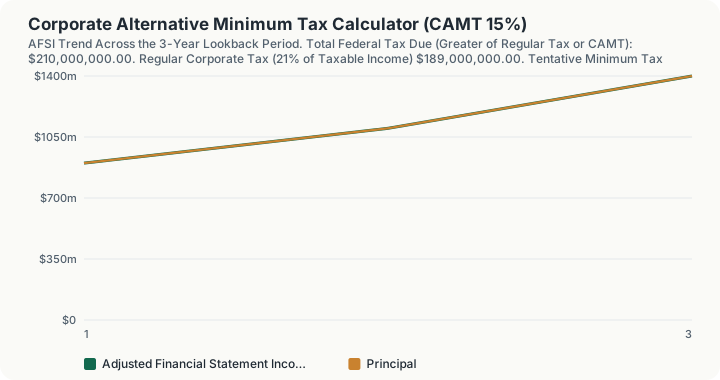
Quick Answer: A corporation averaging over $1 billion of adjusted financial statement income across three years must pay 15% of that book-based income where it exceeds regular 21% tax. On the baseline (AFSI of $900M, $1,100M and $1,400M against $900M of regular taxable income), the CAMT figure of $210,000,000 beats the regular tax of $189,000,000, so $21,000,000 of it is CAMT that would not otherwise be owed.
Overview
The corporate alternative minimum tax, commonly abbreviated CAMT, was created by the Inflation Reduction Act of 2022 and took effect for tax years beginning after December 31, 2022. It was designed to address a specific complaint about the corporate tax system: some of the largest, most profitable companies in the country reported billions of dollars in profit to their shareholders on audited financial statements while paying very little in federal income tax, because of legitimate but generous provisions in the tax code, most notably accelerated and bonus depreciation. CAMT responds by creating a second, parallel tax base built from book income rather than taxable income, and requiring large corporations to pay the higher of the two calculations.
CAMT applies only to "applicable corporations," a defined term with a specific threshold test. A corporation becomes an applicable corporation when its average annual Adjusted Financial Statement Income, or AFSI, over the three preceding tax years exceeds $1 billion (a separate, lower $100 million average threshold applies to the U.S. operations of certain foreign-parented multinational groups, which this calculator does not model). Once a corporation crosses the $1 billion average, it generally stays subject to CAMT going forward, even in years where its AFSI dips, until it falls below the threshold for five consecutive years or undergoes certain ownership changes. This means CAMT status is sticky. A company having one exceptionally profitable year does not automatically escape the regime the moment income growth slows.
AFSI itself starts from net income or loss reported on the corporation's applicable financial statement, the same audited numbers filed with the SEC or used for financial reporting purposes, and then applies a specific list of statutory adjustments under IRC § 56A. Those adjustments include add-backs for certain federal income taxes, adjustments for consolidated group members, treatment of covered foreign corporations, and, notably, a requirement to use regular tax depreciation (rather than book depreciation) for computing AFSI, which is one of the more consequential adjustments because it claws back some of the benefit of accelerated and bonus depreciation for CAMT purposes specifically.
Once AFSI is determined, the mechanics are comparatively simple: 15% of current-year AFSI, reduced by an allowable CAMT foreign tax credit, is the tentative minimum tax. The corporation separately computes its regular federal income tax, a flat 21% of regular taxable income under IRC § 11(b). It pays whichever of the two figures is larger. The amount by which the tentative minimum tax exceeds regular tax is the actual incremental CAMT liability owed on top of the regular tax bill.
How This Is Calculated
This calculator asks for AFSI figures for the current year and the two preceding years, so it can compute the three-year rolling average and test it against the $1 billion applicable-corporation threshold, exactly as the statute requires. If the average is below $1 billion, CAMT simply does not apply for the year, and the corporation owes only its regular 21% tax.
If the average is at or above $1 billion, the calculator computes both figures for the current year:
`
Regular Tax = Regular Taxable Income × 21%
Tentative Minimum Tax = max(0, Current-Year AFSI × 15% − CAMT Foreign Tax Credit)
Total Tax Due = max(Regular Tax, Tentative Minimum Tax)
Incremental CAMT Liability = max(0, Tentative Minimum Tax − Regular Tax)
`
Note the calculator uses only the current year's AFSI (not the three-year average) to compute the 15% tentative minimum tax. The three-year average is used exclusively to determine applicable-corporation status, per IRC § 59(k); the tax itself is always computed on the current year's AFSI once a corporation is within the regime.
This calculator does not attempt to model the full AFSI computation from raw GAAP financial statement line items. Building AFSI from scratch requires access to a corporation's consolidated audited financial statements and a detailed application of every IRC § 56A adjustment, well beyond what a general-purpose calculator can responsibly model. Instead, this tool assumes the user (typically a corporate tax or financial planning professional) already has an AFSI figure in hand, whether from internal modeling or a completed Form 4626, and focuses on the comparison mechanics: applicable-corporation testing and the 15%-versus-21% comparison.
Worked Example
A large domestic corporation has told shareholders it earned $1.4 billion this year, and told the IRS its taxable income was $900 million. The gap is legal, mostly timing, and precisely what the corporate alternative minimum tax was written to reach.
Step 1 -- Three years of adjusted financial statement income. $900 million, then $1,100 million, then $1,400 million
Step 2 -- The three-year average. ($900M + $1,100M + $1,400M) / 3 = $3,400M / 3 = $1,133,333,333.33
Step 3 -- The applicable corporation test. $1,133,333,333.33 exceeds the $1 billion threshold, so the corporation is an applicable corporation and CAMT applies this year
Step 4 -- Regular corporate tax. $900,000,000 taxable income x 21% = $189,000,000
Step 5 -- Tentative minimum tax. $1,400,000,000 current-year AFSI x 15% = $210,000,000
The 15% applies to the current year's book income alone. The three-year average in step 2 only decides whether the regime applies at all; it is never the base.
Step 6 -- No CAMT foreign tax credit in this example. $210,000,000 - $0 = $210,000,000
Step 7 -- Total federal tax due, the greater of the two. max($189,000,000, $210,000,000) = $210,000,000
Step 8 -- The incremental CAMT liability. $210,000,000 - $189,000,000 = $21,000,000
Step 9 -- The effective rate on book income. $210,000,000 / $1,400,000,000 = 15.00%
Step 8 is the number the finance team has to fund and the number that appears nowhere on a regular return. Note also what step 3 implies: the applicable-corporation test looks backwards over three years, so a corporation that has already fallen below $1 billion of book income this year can still be inside the regime because of the two years behind it. The test and the base measure different things, and conflating them is the most common error on this calculation.
What This Does Not Account For
- The full AFSI computation from raw financial statements. This calculator takes AFSI as a given input; it does not derive it from GAAP net income and the complete list of IRC § 56A adjustments.
- The $100 million average AFSI threshold that applies to U.S. corporations that are members of a foreign-parented multinational group, rather than the $1 billion threshold used here for domestic groups.
- The CAMT net operating loss deduction, a separate minimum-tax NOL carryforward mechanism distinct from the regular tax NOL rules.
- IRS Notice 2023-64 and subsequent proposed regulations, which contain extensive technical guidance on specific AFSI adjustments (partnership look-through rules, hedging, depreciation of CFC-held property, and more) not modeled here.
- The optional simplified method the IRS has discussed for near-threshold corporations to avoid full Form 4626 computation using a safe harbor test.
- State-level alternative minimum tax regimes, which some states impose independently of the federal CAMT.
Common Pitfalls
- Assuming CAMT applies to every large company. It applies only to applicable corporations that cross the $1 billion three-year average AFSI threshold (or the $100 million threshold for certain foreign-parented groups); the vast majority of even quite large corporations never reach this bar.
- Testing applicability using a single year's AFSI instead of the three-year average. A single unusually profitable year does not by itself trigger applicable-corporation status, and a single weak year does not by itself remove it, once the average crosses the threshold.
- Confusing AFSI with GAAP net income. AFSI starts from financial statement income but applies a specific, sometimes counterintuitive list of statutory adjustments, most importantly substituting regular tax depreciation for book depreciation.
- Forgetting that CAMT status is sticky. A corporation generally does not exit the CAMT regime just because its AFSI drops below the threshold for one year; it must fall below the threshold for five consecutive years or undergo a qualifying ownership change.
- Overlooking the CAMT foreign tax credit limitation. The CAMT foreign tax credit is a distinct, separately limited credit from the regular tax foreign tax credit, and cannot simply be substituted one for the other.
Frequently Asked Questions
Does CAMT replace the regular 21% corporate tax rate?
What happens if a corporation's average AFSI is right around the $1 billion line?
Why would a profitable company's regular tax be lower than 15% of its book income?
Is the CAMT foreign tax credit the same as the regular foreign tax credit?
Can a corporation ever get out of CAMT once it applies?
Sources
- Internal Revenue Service, "Corporate Alternative Minimum Tax," irs.gov/inflation-reduction-act-of-2022/corporate-alternative-minimum-tax
- Internal Revenue Code § 55(b)(2)(A), 15% corporate alternative minimum tax rate. law.cornell.edu/uscode/text/26/55
- Internal Revenue Code § 59(k), definition of "applicable corporation" and the $1 billion / $100 million average AFSI thresholds. law.cornell.edu/uscode/text/26/59
- Internal Revenue Code § 56A, computation of Adjusted Financial Statement Income. law.cornell.edu/uscode/text/26/56A
- Internal Revenue Code § 11(b), flat 21% regular corporate tax rate. law.cornell.edu/uscode/text/26/11