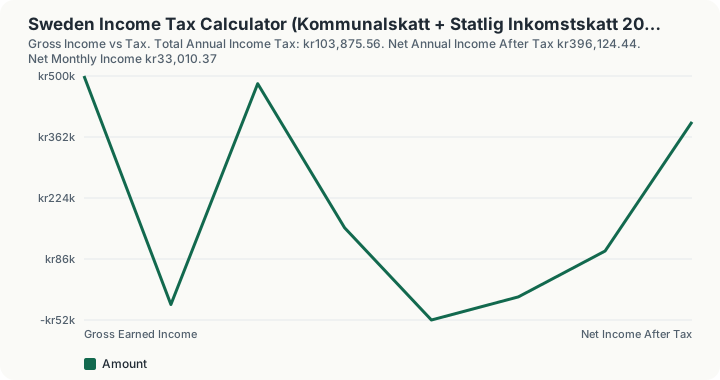
Quick Answer: On 500,000 kr of gross earned income at the 32.38% combined kommunal and region rate used as this calculator's default, total 2026 Swedish income tax is 103,875.56 kr. That leaves 396,124.44 kr net for the year, or 33,010.37 kr a month, an effective rate of 20.78%. All of it is kommunalskatt: statlig inkomstskatt is zero here, because taxable income of 482,600 kr sits below the 643,000 kr skiktgrans.
What does this calculator do?
Swedish income tax on earned income (forvarvsinkomst) has two layers, and only one of them applies to most people. The first is kommunalskatt, a flat local rate charged by your kommun with a region rate stacked on top. The second is statlig inkomstskatt, a flat 20% surcharge that applies only to the part of your taxable income above the skiktgrans, which is 643,000 kr for income year 2026.
Two adjustments sit between your salary and that bill. The grundavdrag is a basic deduction subtracted from gross income before any rate is applied. The jobbskatteavdrag is a tax credit subtracted from the kommunalskatt itself after it has been computed. They pull in opposite directions across the income range, which is why the rate people quote and the rate they actually pay on their next krona are rarely the same number.
This calculator takes the kommunal rate as an input rather than assuming one, because Sweden has 290 kommuner and no national kommunalskatt rate exists. The 32.38% default is a reported national average used as a starting point, not a rate anyone actually pays. Capital income (inkomst av kapital) is taxed separately at a flat 30% and is not part of this calculation.
How is this calculated?
The engine computes the two layers separately and adds them:
Total Tax = max(0, (G − A) × rₖ − J) + 0.20 × max(0, (G − A) − 643,000)
where $G$ is gross earned income, $A$ is the grundavdrag, rₖ is your combined kommunal and region rate, and $J$ is the jobbskatteavdrag.
Step 1: Find the grundavdrag. The engine looks up a piecewise schedule of gross income. Income of 466,000 kr or more sits on the flat floor.
Grundavdrag at 500,000 kr = 17,400 kr
Step 2: Subtract it to get beskattningsbar inkomst.
500,000 - 17,400 = 482,600 kr
Step 3: Apply the combined kommunal and region rate to that taxable base.
482,600 x 0.3238 = 156,265.88 kr
Step 4: Compute the jobbskatteavdrag. Inkomstskattelagen 67 kap. 7 § sets the credit in four bands of the 2026 prisbasbelopp of 59,200 kr. Above 8.08 prisbasbelopp (478,336 kr) it is 3.027 prisbasbelopp less the grundavdrag, times your kommunal rate.
(3.027 x 59,200 - 17,400) x 0.3238 = 52,390.32 kr
Step 5: Subtract the credit from the kommunalskatt. The result is floored at zero, so the credit can never turn into a payment.
156,265.88 - 52,390.32 = 103,875.56 kr
Step 6: Test the taxable base against the skiktgrans.
482,600 - 643,000 = -160,400 kr, so the excess is zero
Step 7: Compute statlig inkomstskatt on that excess.
0 x 0.20 = 0 kr
Step 8: Add the two layers.
103,875.56 + 0 = 103,875.56 kr
The marginal rate shown alongside the result is not read off a table. The engine runs the whole calculation a second time on 1,000 kr more gross income and divides the extra tax by 1,000. At 500,000 kr the grundavdrag is flat and the jobbskatteavdrag is capped, so the measured rate of 32.38% happens to equal the nominal rate. Lower down the range they diverge sharply.
Worked Example
Take the same 500,000 kr salary and ask what the last 1,000 kr of it was worth.
Step 1: Compute the tax at 500,000 kr.
Total tax = 103,875.56 kr
Step 2: Compute the tax again at 501,000 kr. The grundavdrag is still 17,400 kr and the credit is still 52,390.32 kr, so only the taxable base moves.
(501,000 - 17,400) x 0.3238 - 52,390.32 = 104,199.36 kr
Step 3: Take the difference.
104,199.36 - 103,875.56 = 323.80 kr
Step 4: Divide by the probe amount to get the measured marginal rate.
323.80 / 1,000 = 32.38%
Step 5: Work out what you keep.
1,000 - 323.80 = 676.20 kr
Step 6: Find the gross salary at which the national layer starts. The skiktgrans bites on income after the grundavdrag, so the engine adds the grundavdrag that applies up there to the threshold.
643,000 + 17,400 = 660,400 kr of gross income
Step 7: Measure the headroom.
660,400 - 500,000 = 160,400 kr of further gross income before the 20-point statlig layer begins.
What does this calculator not account for?
- The grundavdrag is an approximation, not the official table. Skatteverket publishes a stepped table (Bilaga 1) that rounds to the nearest 100 kr within 500 kr income bands. The engine implements a piecewise-linear model built from anchor points read off that table, accurate to roughly plus or minus 100 to 300 kr in most places but not a cell-for-cell reproduction. Reconciling this page against the official table will show a small difference.
- There is no national kommunalskatt rate. The 32.38% default is a reported 2026 national average, used only as the default rate. Real combined rates run from roughly 29% to 35.5% depending on where you were folkbokford on 1 November of the preceding year.
- Because the grundavdrag model is smooth and the real table is stepped, the measured marginal rate here is smooth where the true schedule has small steps.
- Begravningsavgift and kyrkoavgift are excluded. They appear on the same tax notice but are not income tax.
- Capital income, wealth, and social contributions are out of scope. Inkomst av kapital is taxed at a flat 30% separately. Employer social fees (arbetsgivaravgifter) are paid on top of your salary by the employer and never appear on your own bill.
- No allowance is made for age. Sweden's tax treatment of people aged 66 and over differs materially from the schedule modelled here.
What mistakes do people make with this?
- Quoting the kommunal rate as your tax rate. At 500,000 kr the nominal rate is 32.38% but the effective rate is 20.78%, because the grundavdrag shrinks the base and the jobbskatteavdrag reduces the bill by 52,390.32 kr.
- Thinking the skiktgrans is a salary threshold. It is 643,000 kr of taxable income. On this calculator's grundavdrag the equivalent gross salary is 660,400 kr.
- Assuming statlig skatt applies to everything once you cross. The 20% applies only to the excess above 643,000 kr, never to the whole income.
- Using the national average rate for a real decision. The gap between a low-rate and a high-rate kommun on the same 500,000 kr salary is thousands of kronor a year. Look up your own rate.
- Putting capital gains into the income box. They belong in inkomst av kapital at a flat 30%.
Frequently Asked Questions
How much tax do I pay on 500,000 kr in Sweden in 2026?
At what salary does statlig inkomstskatt start in 2026?
What is my real marginal tax rate?
How large is the jobbskatteavdrag in 2026?
Why is my kommunalskatt rate different from the default?
Does this include capital gains tax?
Sources
- Skatteverket, "Nar ska man betala statlig inkomstskatt och hur hog ar den?" (skatteverket.se): skiktgrans of 643,000 kr of beskattningsbar forvarvsinkomst and the 20% rate above it, income year 2026. skatteverket.se/privat/etjansterochblanketter/svarpavanligafragor/inkomstavtjanst/privattjansteinkomsterfaq/narskamanbetalastatliginkomstskattochhurhogarden
Also consulted: Skatteverket, "Tabell for grundavdrag inkomstar 2026" (Bilaga 1), the official stepped grundavdrag table that the engine's piecewise-linear model approximates; Skatteverket, "Kommunala skattesatser 2026" (published data file skattesatser-kommuner-2026.xlsx), kommunal plus landsting rates by kommun, cross-checked against SCB's "Totala kommunala skattesatser 2026, kommunvis"; Inkomstskattelagen (1999:1229) 67 kap. 7 § as amended by Lag (2025:1376), the jobbskatteavdrag for those under 66 (riksdagen.se/sv/dokument-och-lagar/dokument/svensk-forfattningssamling/inkomstskattelag-19991229_sfs-1999-1229); Regeringen, "Prisbasbelopp för 2026 fastställt", 59,200 kr (regeringen.se/artiklar/2025/09/prisbasbelopp-for-2026-faststallt).