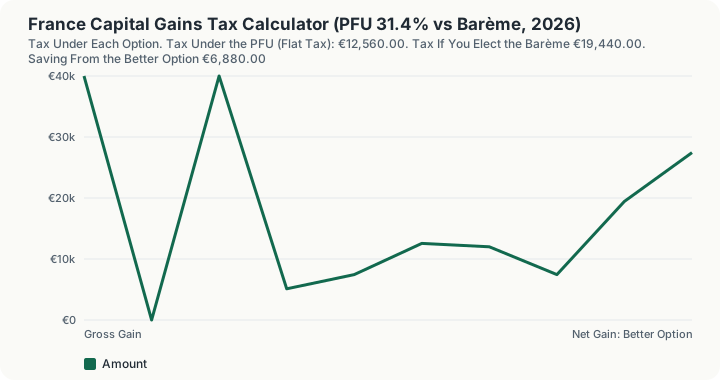
Quick Answer: A gain of €40,000 on securities acquired after 1 January 2018 bears €12,560.00 under the PFU: €5,120.00 of income tax at 12.8% plus €7,440.00 of prélèvements sociaux at 18.6%, an effective rate of 31.40%. Electing the barème instead would cost €19,440.00 for a household with €40,000 of other income, so the flat tax is cheaper by €6,880.00 and leaves a net gain of €27,440.00.
What does this calculator do?
The French flat tax on securities gains is 31.4% for 2025 income, not the 30% almost every source still quotes.
That change is recent and it is easy to miss because the headline income tax leg did not move. The prélèvement forfaitaire unique has always been two components: a 12.8% income tax leg under CGI art. 200 A, and prélèvements sociaux. It was the second leg that changed. LFSS 2026 art. 12 raised CSG on revenus du patrimoine from 9.2% to 10.6%, with a carve-out written into CSS art. L. 136-8 IV.
Securities gains are not inside that carve-out. The derogation back to 9.2% reaches only "les revenus mentionnés au a du I de l'article L. 136-6", revenus fonciers, and "les plus-values mentionnées au 2° du I de l'article L. 136-7", which are plus-values immobilières under CGI arts. 150 U to 150 UC. Gains on securities sit in L. 136-6 I e), which the derogation never touches. So prélèvements sociaux on securities are 10.6% CSG + 0.5% CRDS + 7.5% prélèvement de solidarité = 18.6%, and the PFU is 12.8 + 18.6 = 31.4%.
Rental income really does stay at 17.2%. Property gains really do stay at 17.2%. Securities do not. If you are comparing a securities disposal against a property disposal in 2026, the two now carry different social levies, and that is deliberate rather than an inconsistency.
The other decision this page prices is the barème option: taxing the gain at your progressive income tax rate instead of the flat 12.8%. Since LF 2026 art. 126 the election is no longer irrevocable, though it remains annual and global: it covers all of the year's investment income and gains or none of it.
How is this calculated?
Gain = Proceeds − Acquisition cost
PFU = Gain × 12.8% + Gain × 18.6%
Bar e me = [IR(other income + abated gain) − IR(other income)] + Gain × 18.6%
Step 1: Compute the gross gain. Proceeds less acquisition cost, floored at zero. A loss is not carried anywhere by this calculator.
Step 2: Determine the abattement rate. Zero unless the securities were acquired before 1 January 2018. For pre-2018 securities it is 50% from two full years held and 65% from eight, per CGI art. 150-0 D 1 ter.
Step 3: Apply the abattement to the income tax base only. The abated gain is the gross gain less the abattement amount. This figure is used exclusively for the barème route. It has no effect on the PFU, where the abattement is expressly unavailable, and no effect on prélèvements sociaux under either route.
Step 4: Compute prélèvements sociaux on the FULL gain. 18.6% of the gross gain, before any abattement. The same figure is charged under both routes; the choice between PFU and barème does not change it by a cent.
Step 5: Compute the PFU income tax leg. 12.8% of the gross gain. Adding this to step 4 gives the PFU total.
Step 6: Compute the household's baseline income tax. The other taxable income you entered is run through the 2026 progressive scale using the quotient familial: income is divided by the number of parts, taxed, and multiplied back. Parts are one per adult (two for a couple assessed jointly), plus half a part for each of the first two children and a full part from the third.
Step 7: Apply the plafonnement du quotient familial. The same computation is repeated using only the base parts, as if there were no children. If the benefit from the additional parts exceeds €1,807 per half-part unit, the capped benefit is used instead.
Step 8: Recompute income tax with the abated gain stacked on top. The identical calculation is run on other income plus the abated gain.
Step 9: Take the difference. Step 8 less step 6 is the incremental income tax the gain itself causes under the barème. This is a true marginal stacking, not a flat rate applied to the gain.
Step 10: Total the barème route. Step 9 plus the same prélèvements sociaux from step 4.
Step 11: Compare and report the saving. The cheaper of the two totals is identified, and the difference between them is reported.
Step 12: Compute the CSG deductible next year. 6.8% of the gross gain, per CGI art. 154 quinquies II. Because the CSG rate rose to 10.6% while the deductible share stayed at 6.8 points, the 2026 increase is entirely non-deductible: the split is now 6.8 deductible against 3.8 non-deductible, not 6.8 against 2.4. It is deductible only under the barème option and only in the year of payment.
Worked Example
Defaults: €100,000 proceeds, €60,000 acquisition cost, acquired after 1 January 2018, held 5 years, €40,000 of other household income, single, no children.
Step 1: Compute the gross gain. €100,000 − €60,000 = €40,000
Step 2: Check the abattement. Acquired after 1 January 2018, so the rate is 0% and the abattement is €0. The relief was abolished for securities acquired from that date, at any holding period, even under the barème.
Step 3: Compute the PFU income tax leg. €40,000 × 12.8% = €5,120.00
Step 4: Compute the prélèvements sociaux. €40,000 × 18.6% = €7,440.00
Step 5: Total the PFU. €5,120.00 + €7,440.00 = €12,560.00, an effective rate of 31.40%
Step 6: Compute the baseline income tax on €40,000, one part. €0 to €11,600 at 0% = €0 €11,600 to €29,579 at 11%: €17,979 × 11% = €1,977.69 €29,579 to €40,000 at 30%: €10,421 × 30% = €3,126.30 Baseline = €5,103.99
Step 7: Recompute with the gain stacked on top, on €80,000. €11,600 to €29,579 at 11% = €1,977.69 €29,579 to €80,000 at 30%: €50,421 × 30% = €15,126.30 Total = €17,103.99
Step 8: Isolate the incremental income tax the gain caused. €17,103.99 − €5,103.99 = €12,000.00
The whole gain landed inside the 30% band, which is why the increment happens to equal 30% of it exactly here.
Step 9: Total the barème route. €12,000.00 + €7,440.00 = €19,440.00, an effective rate of 48.60%
Step 10: Compare. €19,440.00 − €12,560.00 = €6,880.00 cheaper under the PFU
Step 11: Compute the net gain. €40,000 − €12,560.00 = €27,440.00
The comparison flips for pre-2018 securities. A 65% abattement on a €40,000 gain leaves only €14,000 in the income tax base, which at a 30% marginal band is €4,200 of income tax against the PFU's €5,120, and the €7,440 of social levies is unchanged either way, because the abattement never reaches them.
What does this calculator not account for?
- The CEHR (contribution exceptionnelle sur les hauts revenus, CGI art. 223 sexies). 3% then 4% above €250,000 / €500,000 for a single filer and €500,000 / €1,000,000 for a couple. It is assessed on total revenu fiscal de référence, not on one disposal, so it cannot be attributed to a single gain and is not computed here.
- The CDHR (contribution différentielle sur les hauts revenus, CGI art. 224). The 20% minimum effective rate was not a one-year measure: LF 2026 art. 2 extended it until the general budget deficit falls below 3% of GDP, so it applies for 2026 income. Like the CEHR it is assessed on total RFR and is not modelled.
- The décote. CGI art. 197 I 4, a separate relief for lower-income households, is not applied by the income tax primitive. Households near the bottom of the scale will see a barème figure slightly above the true one.
- Losses. Gains are floored at zero. Capital loss carryforwards under CGI art. 150-0 D 11 are not modelled.
- Dividends. The 40% abattement of CGI art. 158 applies to dividends under the barème and is out of scope here, which covers gains only.
- Property gains. Plus-values immobilières have their own regime, their own holding-period abattements, and prélèvements sociaux that remain at 17.2%. Use the property calculator.
- PEA, assurance-vie, PEE and other wrappers. Gains inside these have entirely different treatments and are not modelled.
- Régimes de faveur. Retirement relief for company directors, apport-cession deferrals and the abattement renforcé for young innovative companies are not applied.
- Non-residents and treaty relief. The calculation assumes a French tax resident.
- The single-disposal frame. The barème election is annual and global, covering all of the year's investment income. Comparing it against one disposal in isolation, as this page does, can favour the barème or the PFU differently once the rest of the year is included.
What mistakes do people make with this?
Using 30% for 2026 securities gains. The most consequential error on this page's subject. The flat tax is 31.4% for securities from 2025 income onward. Quoting 30% understates the tax on a €40,000 gain by €560.
Assuming the CSG rise reached everything. It did not. Rental income and property gains keep 9.2% CSG and therefore 17.2% prélèvements sociaux, by an express derogation in CSS art. L. 136-8 IV. Securities do not benefit from it.
Expecting the abattement to reduce social levies. It never has. The holding-period abattement reduces the income tax base only. Prélèvements sociaux are charged on the full gain under both routes, which is why a large abattement improves the barème's position far less than the headline rate suggests.
Assuming any long-held share qualifies for the abattement. Two cumulative conditions apply: the securities must have been acquired before 1 January 2018, and you must elect the barème. Shares bought in 2019 and held for a decade get nothing.
Treating the barème election as per-disposal. It is annual and global. It applies to all of the year's investment income and gains together, so the right comparison is across the whole year, not one line.
Assuming the election is still irrevocable. LF 2026 art. 126 abolished the irrevocability. This is a genuine change from earlier years' guidance.
Forgetting the deductible CSG. Under the barème, 6.8 of the 10.6 CSG points are deductible from the following year's taxable income. That does not appear in this year's tax bill but is real value, and it exists only on the barème route.
Frequently Asked Questions
Is the French flat tax on capital gains 30% or 31.4%?
Why is my rental income still taxed at 17.2% then?
When is the barème better than the PFU?
Can I still get the 65% abattement on shares I have held for ten years?
What is CSG déductible and does it help me?
Does this calculator cover crypto or property gains?
Sources
- CSS art. L. 136-8 (the CSG rates and the 9.2% derogation): legifrance.gouv.fr/codes/article_lc/LEGIARTI000053278668
- CSS art. L. 136-6 (the categories of revenus du patrimoine; securities gains sit in I e)): legifrance.gouv.fr/codes/article_lc/LEGIARTI000051218166
- CGI art. 200 A, version en vigueur depuis le 21/02/2026, fixing the PFU income tax leg at 12.8%: legifrance.gouv.fr/codes/article_lc/LEGIARTI000053546896
- CGI art. 154 quinquies II, CSG déductible at 6.8 points, version en vigueur depuis le 27/06/2026: legifrance.gouv.fr/codes/article_lc/LEGIARTI000047288608
Also consulted: LFSS 2026 art. 12, raising CSG on revenus du patrimoine to 10.6% with effect from the taxation of 2025 income; LF 2026 art. 126, abolishing the irrevocability of the barème option; LF 2026 art. 2, extending the CDHR; CGI art. 150-0 D 1 ter and BOFiP BOI-RPPM-PVBMI-20-20-10 for the holding-period abattement and its two cumulative conditions; CGI arts. 193, 194 and 197 I 2 for the quotient familial and its plafonnement at €1,807 per half-part for 2025 income; CGI art. 223 sexies (CEHR) and art. 224 (CDHR), disclosed above as not modelled.
All primary sources below were read on 2026-08-31. Full citations sit in engine/primitives/france-tax.ts section 8.