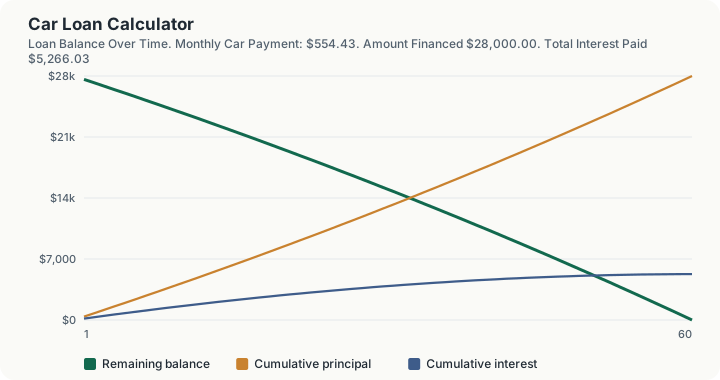
Quick Answer: A $32,000 car with $4,000 down financed at 7.0% APR over 60 months costs $554.43 a month, with $5,266.01 in total interest and $33,266.03 paid back overall on the $28,000 amount financed.
Overview
This calculator answers one question directly: given a car's price, a down payment, an interest rate, and a loan term, what is the monthly payment? It deliberately leaves out sales tax, trade-in value, and dealer fees so you can isolate the one variable that changes the payment the most and the one shoppers ask about first, the term length, and see immediately how stretching a loan from 36 to 72 months trades a lower payment for a much larger total interest bill.
For a full "out the door" estimate that folds in state sales tax, a trade-in allowance, and dealer or title fees, use this platform's auto loan calculator instead. That tool models the complete purchase transaction. This one is built for fast term comparisons and affordability checks, the kind of question you ask before you've picked a specific car or negotiated a trade-in value.
The underlying math is the same amortization engine used everywhere else on this platform: a fixed-rate loan, level monthly payments, and a full period-by-period schedule that reconciles exactly to the amount financed.
How This Is Calculated
- Amount financed. Down payment is subtracted from the car's price. This calculator does not add sales tax or fees to the financed amount, so it will understate the true amount financed for buyers who roll tax and fees into the loan.
- Monthly payment. The amount financed is amortized over the loan term using the standard fixed-payment formula:
where $P$ is the amount financed, $i$ is the monthly interest rate, and $n$ is the number of monthly payments.
- Total interest and total cost. The monthly payment is multiplied by the number of payments and compared against the amount financed to isolate total interest, then summed for the total repayment cost.
- Four-year guideline flag. The calculator flags whether the chosen term is at or under 48 months, a common rule of thumb for keeping total interest cost manageable relative to a car's depreciation curve.
Worked Example
Using the calculator's default inputs:
- Car Price: $32,000.00
- Down Payment: $4,000.00
- Interest Rate: 7.0% APR
- Term: 60 months
Step by step:
- Amount financed: $32,000 minus $4,000 equals $28,000.00
- Monthly payment at 7.0% APR over 60 months: $554.43
- Total interest paid, summed across all 60 scheduled payments: $5,266.01
- Total of all 60 payments: $33,266.03
- Term check: 60 months exceeds the 48-month guideline, so this scenario is flagged No
What This Does Not Account For
- Sales tax. Most states tax vehicle purchases, and many buyers finance the tax along with the car. This calculator's amount financed reflects the price minus down payment only, so a real loan for the same car will usually be somewhat larger.
- Trade-in value or payoff. A trade-in can reduce the amount financed (positive equity) or increase it (negative equity, if you still owe more than the trade is worth). Neither is modeled here.
- Dealer, title, and registration fees. These are commonly rolled into the loan amount and are not included in this calculator's financed balance.
- GAP insurance and extended warranties. Add-on products sold at the dealership are frequently financed as part of the loan and will increase both the payment and total interest beyond what this calculator shows.
- Depreciation. A longer loan term lowers the monthly payment but increases the risk of owing more than the car is worth for a longer stretch of the loan, since interest is front-loaded while depreciation is steepest in a car's early years.
Common Pitfalls
- Comparing only the monthly payment across term lengths. A 72-month loan can look far more affordable month to month than a 36-month loan on the same car, but usually costs meaningfully more in total interest. Compare total interest and total cost, not just the payment.
- Forgetting that tax and fees are usually financed too. If you plan to roll sales tax and fees into the loan, add them to the car price before comparing this calculator's output to a real loan quote, or the real monthly payment will come in higher than this estimate.
- Ignoring negative equity from a trade-in. Rolling an upside-down trade-in into a new loan increases the amount financed beyond the new car's price, which this calculator does not model on its own.
- Choosing a term based on payment alone without checking the interest rate risk. Longer terms often carry a rate premium at some lenders, compounding the total interest gap between a 36-month and a 72-month loan beyond what the term length alone would suggest.
- Not shopping the interest rate separately from the price. Dealer-arranged financing and independent bank or credit union financing can differ by several percentage points on an otherwise identical loan; a 2-point rate difference on a loan this size changes the total interest by well over a thousand dollars.
Frequently Asked Questions
How is this different from the auto loan calculator?
How much car can I afford based on my income?
What does the four-year guideline mean?
Why does a longer term lower my payment but cost more overall?
Does this calculator include sales tax?
What interest rate should I use?
Sources
- Consumer Financial Protection Bureau: Auto loan shopping and APR disclosure guidance. consumerfinance.gov
- Federal Trade Commission: Consumer guidance on financing and negotiating a vehicle purchase. consumer.ftc.gov
- Federal Reserve Board: Regulation Z Truth in Lending Act disclosure requirements for closed-end credit. ecfr.gov/current/title-12/chapter-X/part-1026