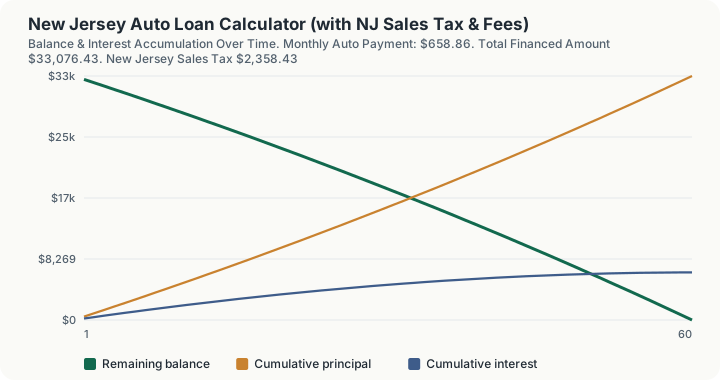
Quick Answer: A $35,000 vehicle in New Jersey with $5,000 cash down, a $599 dealer documentation fee, a 60-month term, and a 7.25% APR carries a $658.86 monthly payment. That includes $2,358.43 of New Jersey sales tax at 6.625% and $119 in title and first-year registration, financing $33,076.43. The 6.625% rate is the same in every municipality in the state, including inside Urban Enterprise Zones.
Overview
New Jersey is unusual among high-tax states in that the vehicle rate is genuinely one number. There is no county sales tax and no municipal sales tax. A car bought and registered in Newark, Cape May, or Hoboken is taxed at 6.625% under N.J.S.A. 54:32B-3, and that is the whole rate. Buyer residence versus dealer location, the question that dominates auto tax estimates in most states, does not change the rate here.
The reduced-rate programs are where New Jersey buyers get misled. Urban Enterprise Zones let qualifying retailers charge half rate, 3.3125%, on certain in-zone retail sales, and Salem County runs a similar program. Motor vehicles are excluded from both. The full 6.625% applies to a car bought inside a UEZ exactly as it does outside one. If a dealer or an online estimate quotes you 3.3125% on a vehicle, that figure is wrong.
The second thing to get right is the trade-in credit. New Jersey allows it, but on stricter conditions than most states, and buyers lose the credit by getting the sequence wrong.
Auto Loan APR by Credit Score
The APR columns below are national averages, not New Jersey figures. No primary source publishes average auto loan APR by state: Experian's report has no geographic cut, the CFPB publishes state origination volume but no rates, and the New York Fed publishes state delinquency only. The payment column is the part that is specific to New Jersey, because it runs this calculator's own New Jersey tax and fee rules at each tier's rate.
| Credit Tier | VantageScore 4.0 | Avg New APR | Avg Used APR | Est. Payment in New Jersey |
|---|---|---|---|---|
| Super prime | 781-850 | 4.55% | 6.30% | $617.40 |
| Prime | 661-780 | 6.23% | 8.77% | $643.00 |
| Nonprime | 601-660 | 9.67% | 14.03% | $697.42 |
| Subprime | 501-600 | 13.44% | 19.42% | $760.06 |
| Deep subprime | 300-500 | 16.01% | 21.77% | $804.53 |
Payment assumptions: $35,000 vehicle price, $0 trade-in, $5,000 cash down, $599 dealer documentation fee, 60-month term, new-vehicle APR applied to the New Jersey delivered price including tax and statutory fees. At the 6.39% overall new-car average the same purchase costs $645.48 a month.
The score bands are VantageScore 4.0, not FICO. The same borrower can land in a different tier under each model, so a FICO score pulled from a card issuer will not always match the band here. Source: Experian, State of the Automotive Finance Market, Q1 2026, slide 45.
What Moves Your Payment
Each row changes one input and leaves the rest at the baseline below. The dollar effects are this calculator's own output for New Jersey, not a rule of thumb.
| Factor | What Changes | Effect on Monthly Payment | Effect on Total Interest |
|---|---|---|---|
| Vehicle Price | Each extra $1,000 of price raises both the amount financed and the sales tax base, so the tax rises with it. | +$21.24 | +$208.09 |
| Trade-In Allowance | A $1,000 allowance cuts the amount financed by $1,000 and reduces the sales tax base by the same amount, so it saves tax as well as principal. | -$21.24 | -$208.09 |
| Cash Down Payment | A $1,000 larger down payment cuts the amount financed by $1,000. It never reduces the sales tax, which is assessed on the price, not on what you borrow. | -$19.92 | -$195.16 |
| Dealer Doc Fee | A $100 higher documentation fee adds $100 to the amount financed and is inside the sales tax base, so it is taxed on top of itself. | +$2.13 | +$20.81 |
| Longer Term | Stretching the same balance from 60 months to 72 months spreads the principal over twelve more payments at the same rate. | -$90.96 | +$1,357.07 |
Baseline: $35,000 vehicle price, $0 trade-in, $5,000 cash down, $599 documentation fee, 60 months at 7.25% APR, giving a $658.86 payment and $6,455.27 of total interest.
How This Is Calculated
New Jersey applies one 6.625% rate statewide, with the trade-in credit limited to property of the same kind taken in part payment for resale. Five steps.
1. Net taxable base. N.J.S.A. 54:32B-2(oo) excludes from "sales price" the credit for a trade-in of property of the same kind accepted in part payment and intended for resale, implemented at N.J.A.C. 18:24-7.4. The dealer documentary fee is part of sales price under the same subsection, so it sits inside the base.
2. Sales tax. One rate, statewide.
3. Title and registration. A fixed $119, being the $60.00 standard certificate of title and $59.00 of annual registration for a passenger vehicle under 3,500 lbs within two model years of current. A title with a single lien is $85.00 rather than $60.00.
4. Amount financed. The trade-in works twice. It lowered the tax base in step one, and it reduces the balance you borrow.
5. Amortization. The financed amount amortizes as a fixed-rate installment loan:
where $P$ is the financed amount, $i$ is the monthly rate (APR ÷ 12), and $n$ is the term in months. Each period's interest is the outstanding balance times $i$, the remainder reduces principal, and the schedule reconciles to zero at maturity.
The Trade-In Credit and the Simultaneity Rule
New Jersey imposes four conditions on the trade-in credit, and the first is the one that costs people money.
The purchase and the trade must happen simultaneously, in the same transaction. Selling your old car and then applying the proceeds to a purchase does not qualify, even if the two happen at the same dealership on the same afternoon. The New Jersey Tax Court reinforced this timing rule in Botwin v. Director, Division of Taxation. A buyer who takes a check for the old car and hands it back as a down payment has made two separate transactions and gets no tax credit for either.
The remaining three conditions are mechanical but still worth checking on the paperwork:
- The trade-in must be taken by a dealer registered with both the New Jersey Motor Vehicle Commission and the Division of Taxation.
- The dealer must obtain the certificate of title to the traded-in vehicle.
- The trade allowance must be separately stated on the invoice.
On a $35,000 car, a $10,000 trade-in taken correctly reduces the taxable base from $35,599 to $25,599 and saves $662.50 in tax. Structured as a separate sale, it saves nothing. That is the practical value of insisting the dealer write the trade onto the same buyer's order.
Worked Example
New Jersey grants the trade-in credit only when the trade and the purchase happen in the same transaction. Sell the old car separately a week earlier and the credit below disappears even if the money lands on the same buyer's order.
- Vehicle price: $35,000
- Trade-in allowance: $0
- Cash down: $5,000
- Dealer doc fee: $599
- Term: 60 months at 7.25% APR
Step 1 -- The taxable base. Sales price including the doc fee, less a simultaneous like-kind trade-in: $35,000 + $599 - $0 = $35,599.00
Step 2 -- New Jersey sales tax at 6.625%. $35,599.00 x 6.625% = $2,358.43
Step 3 -- Title and first-year registration, outside the base. $60.00 title + $59.00 registration = $119.00
Step 4 -- Total delivered price. $35,000 + $599.00 + $2,358.43 + $119.00 = $38,076.43
Step 5 -- Amount financed. $38,076.43 - $0 trade-in - $5,000 cash down = $33,076.43
Step 6 -- The monthly payment. $33,076.43 at 7.25% over 60 months = $658.86
Step 7 -- Month 1. $33,076.43 x (7.25% / 12) = $199.84 interest, $459.02 principal, balance $32,617.41
Step 8 -- Month 2. $32,617.41 x (7.25% / 12) = $197.06 interest, $461.80 principal, balance $32,155.61. Cumulative interest: $396.90
Step 9 -- The accumulation. Interest through month 12 is $2,211.27, balance $27,381.38. Over 60 months, $6,455.27
Add a $10,000 trade-in taken in the same transaction and the taxable base falls to $25,599, the tax to $1,695.93, and the payment to $446.47. The credit is worth $662.50, and it is worth exactly nothing if the paperwork treats the two sales as separate.
Negotiate the doc fee to zero instead and the payment falls to $646.14. Because the fee is taxable, killing it saves $599 of price plus $39.68 of tax, which is $638.68 off the delivered number rather than $599.
What This Does Not Account For
- The four-year registration on new vehicles. A new vehicle bought from a New Jersey dealer is registered for four years, with all four years of fees collected up front. This calculator uses one year of registration, $59.00, so a real new-car buyer's order will typically show roughly four times that on the registration line. Fees also vary by weight and age: over 3,500 lbs runs $84.00 a year within two model years of current, and older vehicles pay $71.50 or $46.50.
- The Supplemental Titling Fee. New Jersey imposes a separate one-time titling surcharge on certain new vehicles at higher price points or lower fuel efficiency, sometimes called the luxury and fuel-inefficient vehicle surcharge. Its current threshold and rate could not be verified, so this calculator does not model it and does not state a figure. If you are buying an expensive or a low-mpg new vehicle, ask the dealer whether it applies.
- Zero-emission vehicle treatment. New Jersey historically exempted ZEVs from sales tax, and that exemption has been phasing out. The current treatment was not verified, so this calculator applies the full 6.625% to every vehicle. Confirm with the Division of Taxation before relying on the number for an EV.
- A title with a lien, which is $85.00 rather than the $60.00 used here.
- Inspection and tire fees, and any municipal charges collected at registration.
- GAP insurance, extended warranties, and aftermarket add-ons, unless you fold them into the vehicle price yourself.
Common Pitfalls
- Expecting a UEZ discount on a car. Urban Enterprise Zone and Salem County reduced rates do not extend to motor vehicles. The full 6.625% applies inside a zone. This is the most common New Jersey vehicle tax misconception, and it would understate the tax on a $35,000 car by roughly $1,179 if you believed it.
- Selling the trade separately. Splitting the transaction voids the credit under N.J.S.A. 54:32B-2(oo) as read in Botwin. On a $10,000 trade that mistake costs $662.50.
- Letting the trade allowance go unstated on the invoice. The allowance has to be separately stated for the credit to hold up. Check the buyer's order before you sign it.
- Forgetting the doc fee is taxable. New Jersey caps nothing here, and reported fees run $500 to $799. A $599 fee adds $39.68 of tax on top of the fee itself.
- Budgeting one year of registration on a new car. Four years are collected at once, so the out-the-door figure is higher than a one-year estimate by roughly $177 on a standard passenger vehicle.
- Rolling negative equity forward. If you owe more than the trade is worth, the shortfall is added to the new loan. It raises the principal and the total interest, and it does not increase your tax credit, which is based on the allowance rather than your equity.
- Judging a loan by the monthly payment alone. Stretching this $33,076.43 balance from 60 to 72 months cuts the payment to $567.90 and raises total finance charges from $6,455.27 to $7,812.33.
Frequently Asked Questions
What is New Jersey's sales tax rate on cars?
Do Urban Enterprise Zone rates apply to vehicles?
Does a trade-in reduce sales tax in New Jersey?
Can I sell my old car first and still get the credit?
Is there a cap on dealer documentation fees in New Jersey?
Does New Jersey charge an annual property tax on vehicles?
Sources
- New Jersey Division of Taxation, New Jersey Tax Guide: Motor Vehicle Purchases and Leases. nj.gov/treasury/taxation
- Consumer Financial Protection Bureau, Truth in Lending Act (Regulation Z, 12 CFR § 1026.22) disclosure requirements for installment credit. ecfr.gov/current/title-12/chapter-X/part-1026
Also consulted: N.J.S.A. 54:32B-3 (imposition of sales tax; 6.625% rate effective January 1, 2018); N.J.S.A. 54:32B-2(oo) and N.J.A.C. 18:24-7.4 (sales price definition, trade-in credit conditions, taxability of dealer fees); Botwin v. Director, Division of Taxation, New Jersey Tax Court (simultaneity requirement for the trade-in credit); New Jersey Motor Vehicle Commission, registration and title fee schedule (title $60, title with single lien $85, weight and age based registration, four-year registration on new dealer sales); Experian, State of the Automotive Finance Market, Q1 2026, slide 45 (average new and used auto loan APR by VantageScore 4.0 credit tier; national, no state level cut published).