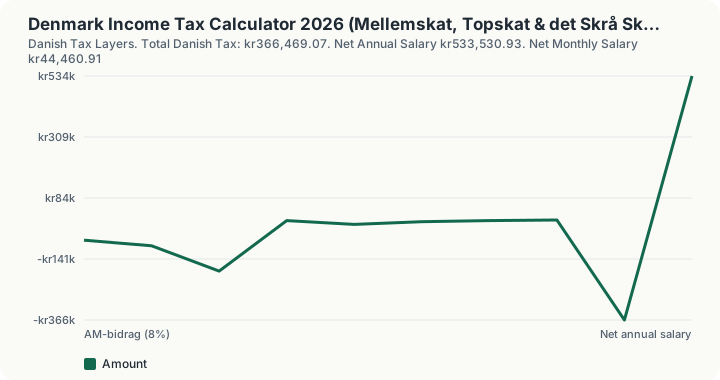
Quick Answer: A DKK 900,000 salary in a 26.30% municipality with no church tax owes DKK 366,469.07 of Danish tax in 2026, leaving DKK 533,530.93 net for the year, or DKK 44,460.91 a month. That is an average rate of 40.72% on gross, and it is already DKK 2,316.32 lower than the DKK 368,785.39 the layer-by-layer rates would produce, because the personskattelovens § 19 tax ceiling binds at this municipal rate and cuts the mellemskat rate by 1.240 percentage points.
What does this calculator do?
2026 is the first tax year under Denmark's restored three-bracket structure. The 2023-24 agreement on lower tax on work income reintroduced a mellemskat (middle-bracket tax) that did not exist in 2025, and added a top-topskat (additional top-bracket tax) on very high incomes. So a 2026 Danish salary now passes through four state layers, not two, on top of the municipal tax.
The thing that makes Denmark genuinely hard to estimate, and the thing this calculator is built around, is that the state rates and the municipal rate are not independent. Personskattelovens § 19, stk. 1, det skrå skatteloft, caps the sum of bundskat, mellemskat and the municipal rate at 44.57%. Where a municipality's rate pushes that sum over the ceiling, the state reduces the mellemskat rate by exactly the excess. Two people on identical salaries in different municipalities therefore face different state tax rates, not just different municipal ones, and the higher-tax municipality does not cost quite as much as its headline rate implies.
One point that most write-ups get wrong: topskat and top-topskat sit above the ceiling and are not covered by it. The statute names only the mellemskat provisions as the target of the reduction, and the explanatory memorandum to the reform bill says so in terms. The 52.07% and 57.07% figures that Danish commentary quotes are the highest combined rate that results once the mellemskat nedslag is in, not separate ceilings that produce relief of their own.
Because the ceiling is calibrated so that the national average municipality sits fractionally under the trigger, most Danish taxpayers get nothing from it. The default here deliberately uses a 26.30% municipality, the top of the 2026 range, so the mechanism is visible.
How is this calculated?
The four state layers and the municipal layer are computed first, then § 19 relief is subtracted from the progressive state layers:
Tax = AM + T_bund + T_kommune + T_kirke + ∑_L [B_L × (r_L − n_L)]
where $L$ runs over mellemskat, topskat and top-topskat, B_L is that layer's base and r_L its statutory rate. The § 19 nedslag n_L is non-zero for mellemskat alone; for topskat and top-topskat it is always zero, because the statute does not reach them.
Step 1: Charge AM-bidrag on gross wage income. 8% of gross, taken off the top before every other tax and outside the ceiling entirely.
Step 2: Compute personal income after AM-bidrag. Gross minus the AM-bidrag. Every bracket threshold in Denmark is measured against this figure, not against gross.
Step 3: Compute the beskæftigelsesfradrag. 12.75% of gross wage income (the AM-bidragsgrundlag, i.e. before AM-bidrag is deducted), capped at DKK 63,300.
Step 4: Compute the jobfradrag. 4.5% of the portion of gross above DKK 235,200, capped at DKK 3,100.
Step 5: Compute the bundskat base and charge 12.01%. Personal income after AM-bidrag, less the DKK 54,100 personfradrag. The two employment deductions do not reduce this base.
Step 6: Compute the municipal base and charge the municipal and church rates. Personal income after AM-bidrag, less the beskæftigelsesfradrag, less the jobfradrag, less the personfradrag. Both the municipal rate and the church rate apply to this same base.
Step 7: Charge mellemskat at 7.5% above DKK 641,200. On personal income after AM-bidrag, before any ceiling relief.
Step 8: Charge topskat at 7.5% above DKK 777,900. Same base, before ceiling relief.
Step 9: Charge top-topskat at 5% above DKK 2,592,700. Same base, before ceiling relief.
Step 10: Add up the capped rate sum. Bundskat + mellemskat + the municipal rate. Topskat, top-topskat and church tax are all excluded from this sum.
Step 11: Derive the mellemskat nedslag. The reduction is the amount by which that sum exceeds the 44.57% ceiling, floored at zero and capped at the mellemskat rate itself. The mellemskat rate can be reduced to zero but never below it.
Step 12: Convert the nedslag into kroner of relief. The mellemskat base multiplied by the nedslag in percentage points. Topskat and top-topskat receive no relief.
Step 13: Subtract the relief and total the tax. Total tax is AM-bidrag + bundskat + municipal + church + the reduced mellemskat + full topskat + full top-topskat.
Step 14: Report the trigger rate and headroom. The municipal rate at which the ceiling starts to bind is the ceiling percentage minus the bundskat rate minus the mellemskat rate. Headroom is that trigger less your municipal rate; negative means relief is due.
Worked Example
A DKK 900,000 salary, municipality at 26.30%, no church tax, using the calculator's default ceiling percentages.
Step 1: AM-bidrag. 900,000 x 8% = DKK 72,000.00
Step 2: Personal income after AM-bidrag. 900,000 - 72,000 = DKK 828,000.00
Step 3: Beskæftigelsesfradrag. min(900,000 x 12.75%, 63,300) = min(114,750, 63,300) = DKK 63,300.00
Step 4: Jobfradrag. min((900,000 - 235,200) x 4.5%, 3,100) = min(29,916, 3,100) = DKK 3,100.00
Step 5: Bundskat. (828,000 - 54,100) x 12.01% = 773,900 x 12.01% = DKK 92,945.39
Step 6: Municipal base. 828,000 - 63,300 - 3,100 - 54,100 = DKK 707,500.00
Step 7: Kommuneskat. 707,500 x 26.30% = DKK 186,072.50
Step 8: Mellemskat before the ceiling. (828,000 - 641,200) x 7.5% = 186,800 x 7.5% = DKK 14,010.00
Step 9: Topskat before the ceiling. (828,000 - 777,900) x 7.5% = 50,100 x 7.5% = DKK 3,757.50
Step 10: Top-topskat before the ceiling. 828,000 is below DKK 2,592,700, so DKK 0.00
Step 11: Mellemskat rate sum. 12.01 + 7.50 + 26.30 = 45.81%, against a 44.57% ceiling
Step 12: Mellemskat nedslag. 45.81 - 44.57 = 1.240 percentage points
Step 13: Total § 19 relief. 186,800 x 1.240% = DKK 2,316.32, all of it on the mellemskat base
Step 14: Mellemskat after the ceiling. 14,010.00 - 2,316.32 = DKK 11,693.68
Step 15: Topskat after the ceiling. Unchanged at DKK 3,757.50, because § 19 does not cover topskat
Step 16: Total tax before the ceiling. 72,000.00 + 92,945.39 + 186,072.50 + 14,010.00 + 3,757.50 = DKK 368,785.39
Step 17: Total tax after the ceiling. 368,785.39 - 2,316.32 = DKK 366,469.07
Step 18: Net annual salary. 900,000 - 366,469.07 = DKK 533,530.93
Step 19: Net monthly salary. 533,530.93 / 12 = DKK 44,460.91
Step 20: Average rate on gross. 366,469.07 / 900,000 = 40.72%
Step 21: The trigger municipal rate. 44.57 - 12.01 - 7.50 = 25.06%, which the 26.30% municipality exceeds by 1.240 points, exactly the nedslag from Step 12.
Step 22: The highest combined rate this taxpayer faces. 45.81 - 1.240 + 7.50 = 52.07% with topskat live, and 57.07% once top-topskat is reached. These are consequences of the single 44.57% ceiling, not ceilings in their own right.
The marginal rate on the next krone of gross pay works out at 55.90%: AM-bidrag takes 8 øre, and the remaining 92 øre then meets bundskat, the reduced mellemskat rate and the full topskat rate, while the municipal rate applies to the same 92 øre because both employment deductions are already at their caps and no longer grow.
What does this calculator not account for?
- The § 19, stk. 2 ceiling on positive net capital income is not modelled. This calculator handles wage income only, so the 42.0% ceiling that personskatteloven § 19, stk. 2 places on the taxation of positive net capital income never comes into play. If you have substantial capital income, this page will not reproduce your assessment.
- Pension contributions are assumed to be zero. In reality both employee and employer pension contributions reduce personal income, which would lower every layer of this calculation. There is no field for them.
- Capital income is assumed to be zero. Positive net capital income is part of the bundskat base in Danish law and is not modelled here. Negative capital income (typically mortgage interest) generates a municipal-level deduction that is likewise absent.
- Only one municipal rate is modelled, not all 98 municipalities. You supply the rate. The 2026 national average is 25.049%, the range runs from 23.39% in København to 26.30%.
- This is an annual liability, not a payroll withholding simulation. It computes the statutory annual figure that SKAT's forskudsopgørelse targets. It does not reproduce the month-by-month trækprocent-plus-fradrag mechanic employers apply, which distributes tax differently across paychecks for irregular income.
- Personal deductions beyond the standard ones are excluded. Befordringsfradrag (commuting), union fees, A-kasse contributions, charitable deductions and the like are not modelled; only the personfradrag, beskæftigelsesfradrag and jobfradrag are applied.
- Ejendomsværdiskat and grundskyld are out of scope. Property taxes are separate charges under the Ejendomsskattelov and appear nowhere in this figure.
- The result is for a single filer. Transfer of unused personfradrag between spouses and other joint-assessment mechanics are not applied.
What mistakes do people make with this?
- Reading 52.07% as a cap on your total tax burden. It is not a cap at all. The statutory ceiling is 44.57% and it covers only bundskat, mellemskat and the municipal rate, measured on the base after AM-bidrag. 52.07% is simply what the combined rate comes to once topskat is added on top of a ceiling-limited base. Add the 8% AM-bidrag charged first and the true marginal rate on gross pay is higher still, 55.90% in the worked example above.
- Forgetting that church tax sits outside the ceiling. Kirkeskat is excluded from the rate sum, so a church member's total burden legitimately exceeds the ceiling percentage. The ceiling does not give back a single krone for it.
- Assuming ceiling relief is available to most people. The trigger municipal rate is 25.06% and the national average is 25.049%, eleven thousandths of a point below it. The ceiling is calibrated so that the average taxpayer never touches it.
- Applying the beskæftigelsesfradrag to the bundskat base. It does not reduce the state layers at all. Both employment deductions reduce only the municipal and church tax base, which is why they are worth roughly a quarter of their face value rather than half.
- Comparing municipalities on the headline rate alone. Above the trigger, part of a higher municipal rate is offset by a lower state rate. The difference in total tax between a 26.30% and a 25.06% municipality is therefore smaller than 1.24 points of the municipal base would suggest for anyone with mellemskat or topskat income.
- Expecting relief when your income is below the thresholds. At a DKK 400,000 salary the rate sum still breaches the ceiling, but there is no mellemskat base for the reduction to bite on, so the relief is zero.
- Expecting the ceiling to grow with your topskat bill. It does not. The nedslag is a rate cut on the mellemskat base and nothing else, so relief stops growing once you are past the topskat threshold. A very high earner in a ceiling-bound municipality gets the same kroner of relief as someone earning DKK 100,000 less.
- Mixing up the two bases. The bracket thresholds (641,200 / 777,900 / 2,592,700) are measured on personal income after AM-bidrag. The employment deductions are computed on gross before AM-bidrag. Using one base for both is a common and material error.
Frequently Asked Questions
What is det skrå skatteloft and who actually benefits from it?
What is mellemskat and why is it new?
Why is my marginal rate higher than 52.07%?
Does church tax count towards the ceiling?
Which allowances reduce which tax?
Does topskat get its own tax ceiling?
Sources
- Danish Tax Agency (Skattestyrelsen), the official authority for the national tax authority this calculator relates to. skat.dk
Also consulted: skat.dk, "Labour market contribution (AM-bidrag)", the 8% rate, unchanged since 2008; skat.dk/en-us/help/botton-bracket-middle-bracket-top-bracket-and-additional-top-bracket-tax, bundskat 12.01%, mellemskat 7.5% from DKK 641,200, topskat 7.5% from DKK 777,900, top-topskat 5% from DKK 2,592,700, all on the post-AM-bidrag basis. Re-confirmed 2026-08-30; Skatteministeriet (svmn.dk), official table of beløbsgrænser regulated under personskattelovens § 20 for 2025-2026: personfradrag DKK 54,100, beskæftigelsesfradrag and jobfradrag rates and caps; skat.dk, "Employment and job allowances": beskæftigelsesfradrag 12.75%, jobfradrag 4.5% above the threshold; danskelove.dk mirror of Personskatteloven § 3, stk. 2: confirming that AM-bidrag, but not the employment allowances, is deducted in arriving at personal income, which is why those allowances reduce only the municipal and church base; Skatteministeriet (svmn.dk), official 2026 municipal tax statistics: average kommuneskat 25.049% excluding church tax, 25.688% including, implying an average kirkeskat of 0.639%; range 23.39% (København) to 26.30%; Personskatteloven § 19: the legal basis for det skrå skatteloft, read verbatim on 2026-08-31 from lov nr. 482 af 22/05/2024 § 1 nr. 15, retsinformation.dk (ELI /eli/lta/2024/482), which re-enacts § 19 with effect from income year 2026; Explanatory memorandum to 2023/1 LSF 138, specific remarks to § 1 nr. 15, retsinformation.dk, for the scope of the nedslag and the derivation of the 52.07% and 57.07% combined rates; Skatte- og Vaekstministeriet, "Personskatteloven: satser og beloebsgraenser", page dated 27-08-2026, confirming 44.57% for § 19, stk. 1 and 42.0% for § 19, stk. 2 in 2026 and 2027.