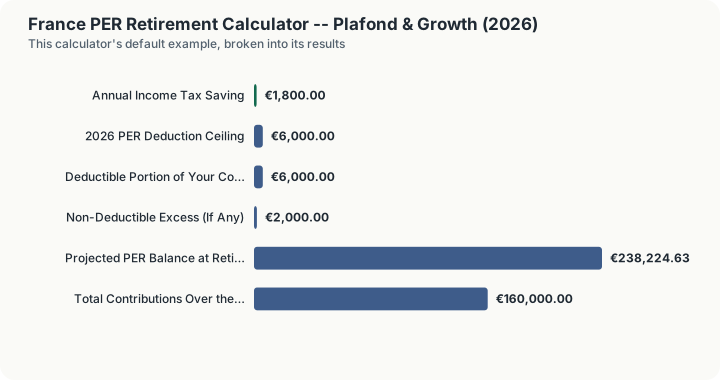
Quick Answer: A salaried employee earning €60,000 in 2025 who contributes €8,000 to a PER (Plan Épargne Retraite) in 2026 can only deduct €6,000 of it -- the "plafond fiscal" (deduction ceiling) is 10% of prior-year income -- saving €1,800 in income tax at a 30% marginal rate. Contributing €8,000 a year for 20 years at an assumed 4% annual return grows to a projected €238,224.63, of which €78,224.63 is investment growth.
Overview
The PER (Plan Épargne Retraite) is France's modern personal retirement savings vehicle, and its headline tax benefit -- contributions deducted from taxable income -- comes with a ceiling that a lot of savers overestimate. The "plafond fiscal" (fiscal deduction ceiling) for a salaried employee or civil servant is 10% of your prior year's net professional income, capped at a maximum tied to the PASS (Plafond Annuel de la Sécurité Sociale, France's social security reference ceiling), with a floor that applies even if you have little or no professional income at all.
This matters because the deduction is worth different amounts to different people, in two separate ways: first, only contributions up to your ceiling are deductible at all -- anything above it, this year, is simply not deductible (though it can potentially be carried forward for use in a later year); second, even the deductible portion is worth more to a higher earner than a lower one, because a deduction's value scales with your marginal tax bracket (TMI) -- the same €6,000 deduction saves €2,700 for someone in the 45% bracket but only €660 for someone in the 11% bracket. This calculator computes both your exact deduction ceiling and the resulting tax saving, then separately projects how your account balance could grow over your remaining working years.
This two-layer structure -- a hard annual deduction ceiling on one side, and a marginal-rate-dependent value on the other -- is why PER planning advice so often centers on "filling the ceiling in your highest-tax years." Someone whose income fluctuates significantly from year to year (a bonus-heavy role, variable self-employment income, an unusually profitable year for a small business) generally extracts more total tax value by concentrating PER contributions in the years their marginal bracket is highest, rather than contributing a flat amount every year regardless of that year's bracket.
How This Is Calculated
- Compute your 2026 PER deduction ceiling from your 2025 net professional income: 10% of that income, capped at 8 times the 2025 PASS (€47,100) × 10% = €37,680, with a floor of one PASS × 10% = €4,710 that applies regardless of how low your income is.
- Compare your planned annual contribution against that ceiling. Whichever is smaller becomes your deductible contribution; any excess above the ceiling is not deductible this year.
- Multiply the deductible contribution by your marginal tax bracket (TMI) -- 0%, 11%, 30%, 41%, or 45% -- to get your income tax saving for the year.
- Project the account's future value using your planned annual contribution, your number of years until retirement, and an assumed annual investment return, treating the PER like a standard ordinary annuity (contributions made at the end of each year, compounding annually).
Worked Example
Using the calculator's default inputs -- €60,000 of 2025 net professional income, €8,000 planned annual PER contribution, a 30% marginal bracket, 20 years until retirement, 4% assumed annual return:
- Ten percent of income: €60,000 × 10% = €6,000. This is below both the €37,680 cap and comfortably above the €4,710 floor, so the ceiling is €6,000.
- Compare to the planned contribution: €8,000 exceeds the €6,000 ceiling, so only €6,000 is deductible; the remaining €2,000 is not deductible this year (though it may be usable via the 3-year carryforward rule).
- Tax saving: €6,000 × 30% = €1,800 for the year -- over the full 20-year period, assuming the same numbers repeat, that's €36,000 in cumulative tax savings.
- Growth projection: €8,000 contributed at the end of each year for 20 years, growing at 4% annually, reaches a projected balance of €238,224.63 -- of which €160,000 is your own contributions and €78,224.63 is investment growth.
What This Does Not Account For
- The 3-year carryforward of unused ceiling. If you didn't use your full deduction ceiling in a prior year, that unused amount can typically be carried forward for 3 years and added to your current-year ceiling -- this calculator computes only the current year's ceiling from current-year income, not any accumulated carryforward.
- Spousal ceiling pooling (mutualisation). Married or PACS couples filing jointly can request that their individual ceilings be pooled, letting one spouse use the other's unused capacity -- not modeled here, since this calculator computes one individual's ceiling only.
- Self-employed (travailleur non salarié) deduction rules, which use a different, more generous formula (roughly 10% of professional profit up to 8 PASS, plus an additional 15% band on profit between 1 and 8 PASS) than the salaried-employee formula this calculator applies.
- Withdrawal-phase taxation. Contributions deducted going in are generally taxed going out (as income, plus social levies on the growth portion, for a lump-sum withdrawal) -- this calculator projects account growth only, not the eventual tax cost of accessing the funds.
- Investment fees, management charges, and sequence-of-returns risk -- the growth projection assumes a single constant annual return with no volatility or costs, which is a simplification of how real markets and real PER contracts behave.
- Early-release exceptions (first home purchase, disability, etc.) that let savers access PER funds before retirement under specific conditions.
Common Pitfalls
- Assuming the deduction ceiling scales indefinitely with contributions. Contributing more than your ceiling does not increase your deduction proportionally -- only the portion up to the ceiling is deductible in the current year.
- Forgetting the ceiling is based on PRIOR-YEAR income, not current-year income. Your 2026 contribution ceiling depends on your 2025 income, which means a big raise this year won't expand your deduction room until next year's filing.
- Confusing "deduction" with "tax credit." A PER deduction reduces your TAXABLE INCOME, not your tax bill directly -- its cash value depends entirely on your marginal tax bracket, so the same contribution is worth far more to a high earner than a low one.
- Ignoring the floor for low-income years. Even someone with modest or irregular income still gets a minimum €4,710 deduction ceiling -- worth checking if your income varies significantly year to year.
- Not distinguishing the tax saving from the investment return. The €1,800 immediate tax saving in the worked example is separate from, and in addition to, the account's own investment growth over time -- conflating the two overstates or understates the PER's total value depending on which one gets forgotten.
Frequently Asked Questions
What is the PER deduction ceiling for 2026?
What happens if I contribute more than my ceiling?
Does the PER deduction save me money directly, or just reduce my taxable income?
Is the growth projection guaranteed?
Do self-employed people use the same ceiling formula?
Are PER withdrawals tax-free in retirement?
Sources
- Service-Public.gouv.fr, "Impôt sur le revenu - Cotisations d'épargne retraite (déduction)": service-public.gouv.fr/particuliers/vosdroits/F14709.
Also consulted: Code Général des Impôts, article 163 quatervicies; PASS (Plafond Annuel de la Sécurité Sociale) 2025 value of €47,100, cross-checked against multiple current French retirement-savings advisory sources.