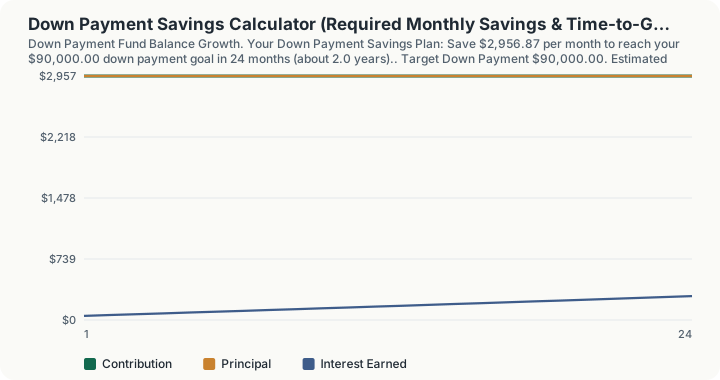
Quick Answer: On a $450,000 target home price with a 20% down payment goal ($90,000) and $15,000 already saved, closing the $75,000 gap in 24 months at a 4.0% annual return on savings requires setting aside $2,956.87 per month.
Overview
Most down payment calculators do one thing: divide a dollar target by a number of months. That answer is wrong the moment your savings sit in an interest-bearing account, because every dollar you save earlier keeps earning for longer than every dollar you save later. This calculator solves the real time-value-of-money problem: given a target down payment, what you have today, and a return rate on the account holding the money, how much do you actually need to set aside each month to hit the goal by a specific date, accounting for the growth those monthly contributions earn along the way.
It also runs the reverse question. If you already know how much you can realistically save each month, the calculator solves for how long it will take to close the gap, again accounting for compounding along the way rather than treating the goal as a flat division problem. A toggle switches between the two directions so the same underlying math serves both a "I need to buy by next spring" planner and a "I can save $1,500 a month, what's my timeline" planner.
Conventional mortgages do not require 20% down. Freddie Mac and most conventional programs allow as little as 3% to 5% down for qualified borrowers, and FHA loans go to 3.5%. Twenty percent remains the reference point mainly because it is the threshold below which lenders typically require private mortgage insurance (PMI) on a conventional loan, not because it is a minimum requirement.
How This Is Calculated
Step 1: Establish the target down payment.
Step 2: Find the funding gap. Subtract current savings from the target. If current savings already meet or exceed the target, the calculator reports the goal as met and stops there.
Step 3: Solve the time-value-of-money equation for whichever variable you asked for.
- Target-date mode solves for the required monthly Payment (PMT) using the standard annuity formula, given the present value (current savings, as a negative cash flow), the future value (the target down payment), the periodic rate (annual return divided by 12), and the number of months until your target date:
- Fixed-contribution mode solves the same equation for the Number of Periods (NPER) instead, given a fixed monthly contribution, using the natural-log identity that falls out of the same annuity formula:
At a 0% expected return the exponential forms above are undefined, so the TVM engine switches to the exact linear equivalents instead: the required monthly amount becomes the gap divided by the number of months, and the timeline becomes the gap divided by the monthly contribution.
Step 4: Project the balance. The calculator builds a month-by-month schedule showing the account balance growing from contributions plus the interest earned each month, so you can see how much of the final total came from your own contributions versus growth.
Worked Example
A buyer targeting a $450,000 home with a 20% down payment goal has $15,000 saved and expects a 4.0% annual return on a high-yield savings account, with 24 months until their target purchase date.
- Target down payment: $450,000 × 20% = $90,000.
- Funding gap: $90,000 − $15,000 = $75,000.
- Monthly rate: 4.0% ÷ 12 = 0.3333%.
- Solve for PMT over 24 months at that rate, with a starting balance of $15,000 growing toward $90,000: $2,956.87 per month.
- Check: over 24 months, $15,000 growing at 0.3333% monthly plus $2,956.87 added each month compounds to almost exactly $90,000, confirming the solved payment.
Compare that to the zero-return case: at 0% return, the same $75,000 gap over 24 months would require exactly $75,000 ÷ 24 = $3,125.00 per month, about $168 more than the interest-earning scenario, because none of the growth is doing any of the work.
Now flip the question. The same buyer knows they can realistically save $1,500 per month instead of hitting a fixed date. At the same 4.0% return, solving for time-to-goal instead of payment amount returns 45 months (about 3.75 years) to close the same $75,000 gap.
Carrying The Savings Plan Forward
Step 6 -- What month one actually adds. $2,956.87 contributed, plus $50.00 of interest on the opening $15,000, taking the balance to $18,006.87
Step 7 -- Month two. The same $2,956.87, but interest has already grown to $60.02, and the balance reaches $21,023.76
Step 8 -- Halfway, at month twelve. Balance $51,751.36, with that month alone earning $162.11
Step 9 -- The final month. Interest in month 24 is $289.18, nearly six times the month-one figure, and the balance lands at $90,000.02
Step 10 -- What the account earned rather than received. $90,000.02 - $15,000.00 - ($2,956.87 x 24 = $70,964.88) = $4,035.14 of interest
Less than a month and a half of contributions arrives free over the two years. On a 24-month horizon compounding is a rounding error next to the savings rate, which is why the honest lever on this page is the monthly amount and not the return you chase.
Down Payment Sizing and PMI
The size of your down payment interacts with two separate mortgage costs: your loan amount, and whether you pay private mortgage insurance. A 20% down payment on a conventional loan generally avoids PMI entirely. Below that threshold, PMI is charged as an ongoing monthly premium (commonly 0.5% to 1.5% of the loan amount annually, depending on credit and loan-to-value) until the loan amortizes down to 78% loan-to-value, at which point it is automatically cancelled under the Homeowners Protection Act. A smaller down payment gets you into a home sooner but adds a real monthly cost on top of principal and interest; a larger down payment delays the purchase date but eliminates that cost and reduces the loan amount itself, which lowers the principal and interest payment too.
What This Does Not Account For
This calculator solves a single time-value-of-money equation: savings growing at a fixed rate toward a fixed dollar target. It does not account for taxes on interest or investment gains in a taxable account, which would reduce the effective growth rate below the stated return. It does not model variable or step-up contribution schedules; the monthly contribution (whether solved for or fixed) is assumed constant for the entire savings period. It does not account for home price appreciation between now and your purchase date, which would raise the target down payment if home prices rise faster than your savings grow, or lower the relative gap if they don't. It does not include down payment assistance programs, gift funds, or employer matching, which many first-time buyers use to reduce or eliminate the gap this calculator solves for. It also does not factor in closing costs, which are a separate cash requirement on top of the down payment; use this platform's closing costs calculator alongside this one for a complete cash-needed-at-closing picture.
Common Pitfalls
Treating a savings account's advertised APY as guaranteed for the full savings period is a common mistake; rates on high-yield savings accounts and money market funds float and can move down as well as up, so the monthly figure this calculator produces is only as reliable as the assumed return holding steady. Another common error is solving for a monthly payment once and never revisiting it; if you fall behind or get ahead of the plan in any given month, the required payment for the remaining months changes, and re-running the calculator with updated current savings and updated months-remaining gives a more accurate current target. Buyers also sometimes anchor on 20% down as a requirement rather than a PMI-avoidance threshold, when a smaller down payment with a shorter timeline (and PMI factored into the ongoing mortgage payment) may reach homeownership sooner at a comparable total cost. Finally, it's easy to forget that the down payment gap and the closing costs gap are two separate cash needs due at the same time; budgeting only for the down payment can leave a buyer short at the closing table.
Frequently Asked Questions
Why does this calculator ask for an "expected annual return" instead of just a savings account APY?
Should I invest my down payment savings in the stock market to grow it faster?
What happens if I can't reach the required monthly savings amount?
Does a bigger down payment always mean a smaller total cost?
Why do the target-date and fixed-contribution modes give different final numbers for the same inputs?
Sources
- Consumer Financial Protection Bureau: down payment and loan-to-value guidance for conventional, FHA, VA, and USDA loan programs. consumerfinance.gov
- Consumer Financial Protection Bureau, Buying a house. consumerfinance.gov/owning-a-home
- U.S. Securities and Exchange Commission, Investor.gov compound interest reference. investor.gov/financial-tools-calculators/calculators/compound-interest-calculator
Also consulted: Freddie Mac (My Home by Freddie Mac): minimum down payment guidance for conventional conforming loans (as low as 3%-5% for qualified borrowers); U.S. Department of Housing and Urban Development: FHA minimum down payment requirement (3.5% for qualifying credit scores); Homeowners Protection Act of 1998: automatic PMI cancellation at 78% loan-to-value on the original amortization schedule.