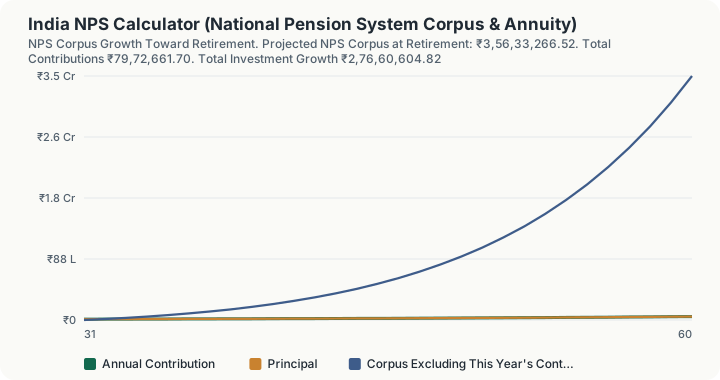
Quick Answer: Contributing ₹10,000 a month to a Tier I NPS account from age 30 to 60, stepping up 5% a year at an assumed 10% blended return, projects to a corpus of roughly ₹3.56 crore. Under the current (December 2025) PFRDA exit rules for non-Government subscribers, that requires a minimum 20% annuity purchase (about ₹71.27 lakh) and permits up to 80% as a lump sum.
Overview
This calculator is built specifically for India's National Pension System (NPS), regulated by the Pension Fund Regulatory and Development Authority (PFRDA), and every figure is shown in Indian Rupees (₹). It is not a 401(k) or IRA calculator. NPS is a market-linked, defined-contribution retirement account with two account types: Tier I, the primary retirement account, locked until retirement with tax benefits, and Tier II, a voluntary, fully liquid add-on account with the same investment menu but no lock-in and (for most subscribers) no tax benefit on contributions. This calculator models Tier I growth and exit.
The single most important thing to understand about NPS today, and the reason this calculator was rebuilt around current rules rather than the commonly-repeated "40% annuity, 60% lump sum" figure: that rule changed in December 2025. Under the PFRDA (Exits and Withdrawals under the National Pension System) (Amendment) Regulations, 2025 (gazetted 12 December 2025), non-Government subscribers (the All Citizen Model and Corporate Model -- the large majority of NPS accounts) now face a corpus-based schedule instead of a flat 40%/60% split: a corpus of ₹8,00,000 or less can be withdrawn entirely as a lump sum with no annuity requirement at all, while a larger corpus requires only a 20% minimum annuity purchase, freeing up to 80% as a lump sum. Government-sector subscribers still follow the older 40% minimum annuity / 60% lump sum rule. This calculator applies the correct rule automatically based on your projected corpus and subscriber category.
How This Is Calculated
Corpus growth. Each year, your monthly contribution (optionally stepping up annually as your income grows) compounds at your assumed blended annual return across NPS's equity (E), corporate bond (C), and government securities (G) asset classes -- a single return figure you set yourself, since actual returns depend entirely on your specific asset allocation and are never guaranteed. This calculator compounds monthly within each year using the shared time-value-of-money engine, matching how a real NPS account actually accrues.
Annuitization rule. Once the projected corpus is known, this calculator determines the applicable minimum annuity percentage: - Government-sector subscribers: minimum 40% annuitized, up to 60% lump sum -- the pre-amendment rule, still in force for this category. - Non-Government subscribers, corpus ≤ ₹8,00,000: 100% lump sum, no annuity required at all. - Non-Government subscribers, corpus above ₹8,00,000: minimum 20% annuitized, up to 80% lump sum. (Note: the actual regulation carves out an intermediate ₹8-12 lakh slab with a different mechanism -- see "What This Does Not Account For" -- which this calculator simplifies into the same 20%/80% split for corpora above ₹8 lakh.)
You can always choose to annuitize more than the mandatory minimum; this calculator lets you set a voluntary annuity percentage that overrides the floor if it's higher.
Illustrative pension estimate. The annuitized portion is assumed to purchase an annuity paying a rate you specify yourself (there is no universal, guaranteed annuity rate -- it depends entirely on the insurer and annuity option chosen at the time of purchase), divided by 12 for a monthly estimate.
Worked Example
Take a 30-year-old in the All Citizen Model paying ₹10,000 a month into Tier I, raising that by 5% each year as income rises, assuming a 10% blended return across the E, C and G asset classes, and exiting at 60.
Step 1 -- Year 1 contributions, age 30 to 31. ₹10,000 × 12 = ₹1,20,000
Step 2 -- Corpus at the end of year 1, age 31. Twelve monthly contributions compounded at 10% / 12 give a corpus of ₹1,25,655.68
Step 3 -- Year 2 contribution after the 5% step-up. ₹1,20,000 × 1.05 = ₹1,26,000
Step 4 -- Corpus at the end of year 2, age 32. ₹2,70,751.94, of which ₹1,44,751.94 was already in the account before year 2's own contributions went in
The step-up is doing something the flat-contribution version cannot: year 2 puts in ₹6,000 more than year 1, and every later year compounds that difference too.
Step 5 -- Year 3, age 33. Contribution: ₹1,26,000 × 1.05 = ₹1,32,300 Corpus: ₹4,37,638.59
Step 6 -- The mid-career milestone, age 45. Corpus: ₹54,54,476.82 That year's contribution: ₹2,37,591.79
Step 7 -- Age 50. Corpus: ₹1,07,36,231.40
Between 45 and 50 the corpus adds roughly ₹52.8 lakh of value on under ₹14 lakh of contributions, which is the point at which returns rather than deposits are running the account.
Step 8 -- The corpus at exit, age 60. ₹3,56,33,266.52 Total contributed across 30 years: ₹79,72,661.70 Total investment growth: ₹2,76,60,604.82
Step 9 -- Identify the exit rule. The corpus is far above the ₹8,00,000 threshold and the subscriber is non-Government, so the December 2025 PFRDA minimum applies: 20% annuity, up to 80% lump sum
Step 10 -- Split the corpus. Annuity purchase: ₹3,56,33,266.52 × 20% = ₹71,26,653.30 Lump sum available: ₹3,56,33,266.52 × 80% = ₹2,85,06,613.22
Step 11 -- Illustrative monthly pension. ₹71,26,653.30 × 6% = ₹4,27,599.20 a year ₹4,27,599.20 / 12 = ₹35,633.27 a month
That pension figure is the softest number on the page: the 6% is an assumption you set, not a quoted rate, and real annuity payouts vary by insurer and by which annuity option you buy. The corpus figure is arithmetic; the pension figure is an illustration built on top of it.
What This Does Not Account For
- The ₹8-12 lakh intermediate slab. The actual December 2025 PFRDA amendment specifies that a corpus between ₹8,00,000 and ₹12,00,000 can take up to ₹6,00,000 as an immediate lump sum, with the balance available via Systematic Unit Redemption (over a minimum of 6 years) or annuity purchase -- a more granular mechanism than this calculator's simplified two-tier (≤₹8L / >₹8L) model.
- Premature/voluntary exit before normal retirement eligibility. Exiting before the standard eligibility window (broadly, 60 or 15+ years of subscription) triggers a stricter 80% mandatory annuity requirement, not modeled here.
- The exact tax treatment of a larger (up to 80%) lump sum. Whether Section 10(12A)'s lump-sum tax exemption has been formally extended to cover the newly-larger lump-sum percentages permitted since December 2025 could not be confirmed against a CBDT source in this calculator's research pass -- this calculator assumes the lump sum you actually withdraw remains exempt, consistent with NPS Trust's own published guidance, but this specific extension is flagged as not independently confirmed.
- Partial withdrawals during the accumulation phase. NPS permits limited partial withdrawals for specific purposes (education, medical treatment, home purchase) after 3 years of subscription, subject to a 25%-of-own-contributions cap; not modeled here.
- Tier II contributions and withdrawals. This calculator models Tier I only; Tier II has no lock-in, no annuitization requirement, and (for most subscribers) no tax deduction on contribution.
- Sequencing/market-timing risk near retirement. A single blended return assumption smooths over the real volatility of equity/bond/gilt allocations, especially in the years just before retirement.
Common Pitfalls
- Assuming the 40%/60% rule still applies to everyone. This is now the single biggest source of outdated NPS advice: since December 2025, most non-Government subscribers face a 20% minimum annuity (or 0% below ₹8 lakh), not 40%.
- Treating the assumed return as guaranteed. NPS returns depend entirely on market performance of your chosen asset allocation; a 10% assumption is a planning input, not a promise.
- Forgetting Tier II has no tax benefit for most subscribers. Confusing Tier I's tax-advantaged, locked structure with Tier II's fully liquid, largely tax-neutral one is a common and costly mix-up.
- Ignoring the 80CCD(1B) old-regime restriction. The additional ₹50,000 NPS deduction under Section 80CCD(1B) is only available under the old tax regime; it does not apply if you've opted into the new regime.
- Missing that annuity rates are not fixed by PFRDA. The rate your annuitized corpus will actually earn depends on the specific insurer and annuity option (life annuity, annuity with return of purchase price, joint-life, etc.) you select at retirement -- this calculator's assumed rate is a placeholder for your own research, not a guarantee.
Frequently Asked Questions
Do I still have to put 40% of my NPS corpus into an annuity?
What are the NPS tax benefits?
What's the difference between NPS Tier I and Tier II?
Is the NPS lump-sum withdrawal taxable?
What return should I assume for my NPS projection?
Sources
- Income Tax Department, Government of India, the official authority for the national tax authority this calculator relates to. incometax.gov.in/iec/foportal
Also consulted: PFRDA (Exits and Withdrawals under the National Pension System) (Amendment) Regulations, 2025 -- Gazette of India, Extraordinary, Part III-Section 4, No. 808, notified 2025-12-12, fetched and read directly from the primary gazette PDF; NPS Trust, npstrust.org.in/benefits-of-nps -- Tier I/Tier II structure, Section 80CCD(1)/(1B)/(2) tax treatment, lump-sum tax exemption under Section 10(12A), fetched directly; Income Tax Act, 1961, Sections 80CCD(1), 80CCD(1B), 80CCD(2), and 10(12A).