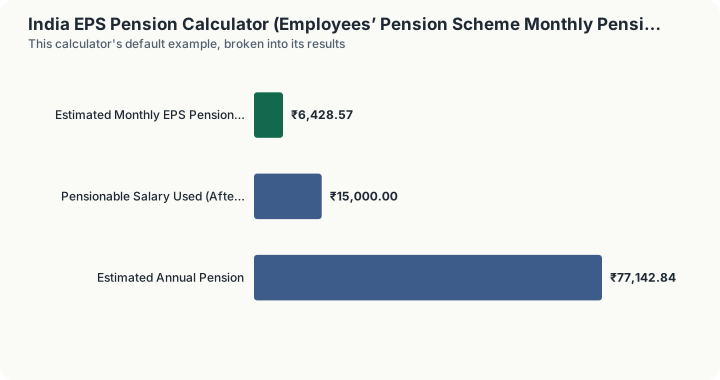
Quick Answer: For an Indian salaried employee with an average Basic Wage + DA of ₹25,000/month over the last 60 months and 28 years of pensionable service, the Employees' Pension Scheme (EPS) formula projects a monthly pension of about ₹6,428.57 at age 58 -- using the ₹15,000/month pensionable-salary cap and the automatic 2-year bonus for crossing 20 years of service.
Overview
This calculator is built for India's Employees' Pension Scheme (EPS), the defined-benefit pension arm of the EPFO system, and every figure here is shown in Indian Rupees (₹). It is not an American pension or Social Security calculator. EPS is funded not by your own contribution, but by a fixed 8.33% slice of your employer's matching EPF contribution, diverted every month and capped at a ₹15,000/month wage ceiling -- meaning at most ₹1,249.50/month per employee goes into the EPS pool regardless of how much you actually earn. On 29 June 2026, the Central Government notified the Employees' Pension Scheme, 2026 under the Code on Social Security, 2020, formally replacing EPS, 1995 and the Employees' Family Pension Scheme, 1971 -- but multiple 2026 reports confirm the underlying pension formula, the ₹15,000 wage ceiling, and the ₹1,000/month minimum pension are all explicitly unchanged by this recodification; the changes are largely administrative (for example, a new 20-day deadline for EPFO to settle claims).
Unlike EPF, which is a running balance you can eventually withdraw as a lump sum, EPS does not work that way for most members: it is a formula that converts your capped pensionable salary and years of service directly into a monthly pension for life, starting (in the standard case) at age 58. This calculator applies that formula directly so you can see, in rupees, what your EPS membership is actually projected to pay out -- a number the EPF balance alone will never show you.
How This Is Calculated
The EPS monthly pension formula is:
Monthly Pension = (Pensionable Salary × Pensionable Service) ÷ 70
Two adjustments happen before that division:
Pensionable salary is capped. "Pensionable salary" is the average of your Basic Wage + DA over the 60 months immediately preceding your date of exit, capped at the EPS wage ceiling of ₹15,000/month. Even if your actual average salary is ₹1,00,000/month, the standard EPS formula uses ₹15,000 unless you and your employer have separately exercised the post-2022 Supreme Court "higher pension" option, which lets a limited group of members contribute EPS on their actual, uncapped salary instead -- a materially different (and employer-dependent) calculation this tool does not attempt.
Pensionable service gets a bonus at 20 years. If your actual pensionable service reaches 20 years or more, EPFO adds a 2-year bonus to the service figure used in the formula -- so 28 actual years becomes 30 years for calculation purposes. Below 20 years, no bonus applies.
A ₹1,000/month minimum pension has applied to all eligible EPS pensioners since 1 September 2014, and this calculator floors the computed result at that minimum. A minimum of 10 years of pensionable service is required to draw a monthly pension at all; below that, EPFO instead pays a lump-sum "withdrawal benefit" calculated on a separate table, which this calculator does not model.
Worked Example
Consider Rahul, with an average Basic Wage + DA of ₹25,000/month over his last 60 months of service, and 28 years of total pensionable service.
Step 1 -- cap the salary. ₹25,000 exceeds the ₹15,000 wage ceiling, so the formula uses ₹15,000 as the pensionable salary.
Step 2 -- apply the service bonus. 28 years is at or above the 20-year threshold, so 2 bonus years are added: 28 + 2 = 30 years of pensionable service for the formula.
Step 3 -- compute the pension. ₹15,000 × 30 ÷ 70 = ₹450,000 ÷ 70 = ₹6,428.57 per month, or roughly ₹77,142.84 per year, for life from age 58 onward (subject to EPFO's standard pension revision and disbursement rules).
For comparison, someone with only 15 years of service at a ₹12,000/month average salary (below the ceiling, so used as-is, and below the 20-year bonus threshold) would see: ₹12,000 × 15 ÷ 70 = ₹2,571.43 per month -- noticeably lower on both a lower salary base and no bonus years.
What This Does Not Account For
- The post-2022 "higher pension" option. Members who exercised the Supreme Court-enabled option to contribute EPS on actual (uncapped) salary have a materially different, employer-specific calculation involving past contribution shortfalls and interest; this calculator only models the standard, capped-salary formula.
- Early or reduced pension (ages 50-57). EPS allows drawing a reduced pension as early as age 50, with a discount applied for each year before 58; this calculator assumes the standard age-58 exit and does not model the early-pension reduction table.
- Widow/children's pension and other EPS benefits. EPS also funds survivor pensions and other benefit categories under separate rules not covered by this monthly-pension-at-58 calculator.
- Annual pension revisions. Once in payment, EPS pensions are not automatically indexed to inflation the way some government pensions are; this calculator shows the pension amount fixed at the point of calculation.
- Below-10-years service. For pensionable service under 10 years, EPFO pays a lump-sum withdrawal benefit instead of a monthly pension, calculated from a separate EPFO table this calculator does not include (it only flags ineligibility).
Common Pitfalls
- Using actual salary instead of the capped ₹15,000. The single biggest EPS miscalculation: plugging in your real salary instead of the wage-ceiling-capped figure produces a wildly inflated pension estimate for anyone earning above ₹15,000/month.
- Forgetting the 2-year bonus below 20 years, or missing it above 20. The service bonus is a step function, not a gradual scale -- 19 years gets no bonus, 20 years gets a full 2-year bonus; there is no partial credit in between.
- Confusing EPS with EPF. EPS is not a balance you accumulate and later withdraw as a lump sum in the standard case; it is a pension-for-life formula. Your EPF balance (see the companion India EPF Calculator) is a completely separate pot of money.
- Assuming the ₹15,000 ceiling has been raised. As of this calculator's verification date, EPFO's wage ceiling for EPS purposes remains ₹15,000/month; a Supreme Court order in early 2026 gave the government a window to reconsider it, and a subsequent Labour Ministry notification (29 May 2026) appears to have reaffirmed ₹15,000 rather than raised it -- but this is a genuinely live policy area worth rechecking before relying on it for long-range planning.
- Overlooking the 10-year minimum service requirement. Anyone with less than 10 years of pensionable service does not qualify for a monthly pension at all under the standard rules and instead receives a lump-sum withdrawal benefit.
Frequently Asked Questions
How much pension will I get from EPS?
Is the ₹15,000 EPS wage ceiling ever going to increase?
What is the "higher pension" option from the 2022 Supreme Court judgment?
Do I get both an EPF lump sum and an EPS pension?
What happens if I have less than 10 years of pensionable service?
Sources
- Income Tax Department, Government of India, the official authority for the national tax authority this calculator relates to. incometax.gov.in/iec/foportal
Also consulted: EPFO/EPS scheme mechanics: Pensionable Salary × Pensionable Service ÷ 70 formula, ₹15,000/month wage ceiling, 2-year bonus for 20+ years of service, ₹1,000/month minimum pension (effective 2014-09-01) -- corroborated across multiple 2026 secondary reports; direct fetch of epfindia.gov.in was blocked in this research session; Central Government notification, Employees' Pension Scheme, 2026 (29 June 2026), under the Code on Social Security, 2020 -- recodification of EPS, 1995/Family Pension Scheme, 1971; formula, ceiling, and minimum pension confirmed unchanged; Supreme Court of India, judgment on EPS higher-pension option (November 2022), and subsequent implementation-deadline extensions and a 2026 order revisiting the general wage ceiling.