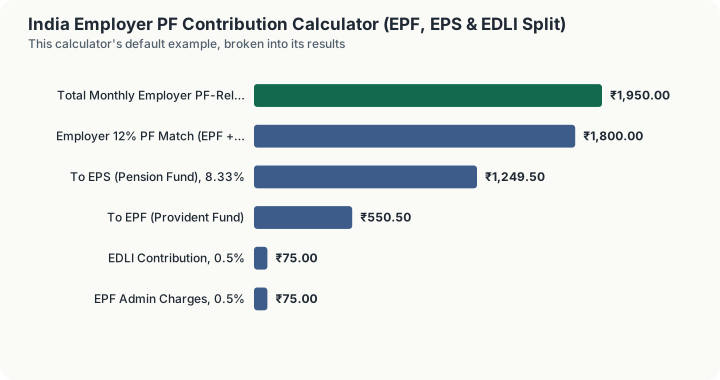
Quick Answer: On an employee earning ₹15,000/month in Basic + DA (the statutory wage ceiling), an Indian employer's total monthly PF-related cost is ₹1,950 -- ₹550.50 to the EPF account, ₹1,249.50 to the EPS pension fund, ₹75 EDLI insurance premium, and ₹75 in EPFO administrative charges. All figures are in ₹ (INR), for Indian employers running statutory payroll.
Overview
Under India's Employees' Provident Fund and Miscellaneous Provisions Act, 1952, an employer covered by the EPF scheme owes considerably more than the headline "12% employer match" figure most people quote. That 12% itself gets split between two different accounts with two different purposes -- a provident fund savings account (EPF) and a pension fund (EPS) -- and on top of that 12%, the employer separately owes a life-insurance-style contribution (EDLI) and an administrative charge to the EPFO, the government body that runs the whole scheme.
This calculator is built specifically for the employer side of that calculation -- distinct from an employee-facing EPF calculator that projects an employee's own retirement corpus growth. It answers a narrower but essential payroll question: for a given employee's monthly wages, exactly how much does the employer actually have to remit to EPFO across every account, this month, split out by purpose?
The single most important number here is the ₹15,000/month statutory wage ceiling. It caps how much of an employee's wage counts toward the EPS pension contribution and the EDLI insurance contribution, regardless of how much higher the employee's actual salary is. This calculator models a covered employee both below that ceiling (straightforward math) and above it (where EPS and EDLI stay capped while EPF and admin charges can keep growing with actual wages, depending on whether the employer applies the ceiling to EPF too).
How This Is Calculated
Employer's core 12% match, split between EPF and EPS:
Critically, EPF is not simply "3.67% of wages." It is whatever is left over after the EPS diversion is subtracted from the full 12% match. When wages are at or below the ₹15,000 ceiling, that arithmetic works out to almost exactly 3.67% (EPS takes 8.33%, EPF takes the remaining 3.67%, summing to 12%). But once wages exceed the ceiling and the employer contributes 12% on the higher, uncapped wage figure, EPS still cannot exceed its capped rupee amount -- so the entire excess above that cap flows into EPF instead, meaning EPF's effective percentage of wages rises above 3.67% for higher earners.
Employer's separate obligations, on top of the 12% match:
The EPS and EDLI wage ceilings (both ₹15,000/month) are hard statutory caps -- no employer is required to pay EPS or EDLI on wages above ₹15,000, though EPF itself can extend to full wages if the employer chooses not to apply the ceiling there. EPF administrative charges were reduced from 0.65% to 0.5% of wages effective 1 June 2018 (subject to a ₹500/month per-establishment minimum, or ₹75/month for a non-functional establishment with no contributory member that month). EDLI administrative charges, which used to add a small additional percentage, were reduced to NIL effective 1 April 2017 and have stayed at zero since.
Worked Example
Scenario 1: An employee earning exactly ₹15,000/month in Basic + DA -- precisely at the statutory wage ceiling, so no capping decision matters.
Step 1: EPS contribution.
Step 2: Total 12% employer match.
Step 3: EPF contribution (the remainder).
Step 4: EDLI contribution.
Step 5: EPF admin charges.
Step 6: Total employer cost.
Scenario 2: An employee earning ₹30,000/month, employer applies the statutory ceiling as the minimum obligation. Here, only the ₹15,000 ceiling counts for every leg of the calculation, including EPF itself.
Every downstream number is therefore identical to Scenario 1: ₹1,249.50 EPS, ₹550.50 EPF, ₹75 EDLI, ₹75 admin, ₹1,950 total -- even though the employee earns twice as much, because the employer is only meeting the statutory minimum obligation.
Scenario 3: The same ₹30,000/month employee, but the employer voluntarily matches 12% on full wages (a common private-sector practice that boosts the employee's own EPF corpus growth, even though it's not legally required above the ceiling).
EPS still cannot exceed its capped amount: $\text{EPS} = \₹1{,}249.50$ (unchanged -- the law does not allow EPS to exceed 8.33% of the ₹15,000 ceiling regardless of the employer's generosity elsewhere).
EDLI stays capped at $\₹75$ (its own ceiling is independent of what the employer chooses for EPF), but admin charges, which this calculator computes on the same wage base actually used for the PF contribution, rise to $\₹30{,}000 \times 0.5\% = \₹150$.
What This Does Not Account For
- Employee-side EPF contribution. This calculator models only the employer's contribution and cost. The employee separately contributes 12% of Basic+DA (uncapped in most cases, though some establishments cap the employee side at the ₹15,000 ceiling too), which flows entirely into the employee's own EPF account, not split with EPS.
- International workers and higher-wage exemptions. "International workers" under EPFO rules, and employees whose full salary already exceeds statutory thresholds under specific exemption categories, follow different contribution rules than modeled here.
- Exempted establishments with their own PF trusts. Large employers running an EPFO-exempted private provident fund trust follow trust-specific rules that can differ from the pooled EPFO scheme modeled in this calculator.
- VPF (Voluntary Provident Fund). Employees can voluntarily contribute above the standard 12% into VPF; this calculator only computes the statutory employer-side contribution, not any employee VPF top-up.
- New employees under wage-ceiling exemption schemes. Certain government incentive schemes have, at various points, subsidized employer EPF contributions for new employees below specific wage thresholds; this calculator does not model any such time-bound subsidy scheme.
- Establishment-level admin charge minimums. The ₹500/month (or ₹75/month) admin charge minimum applies per establishment, not per employee. This calculator shows the proportional 0.5% charge attributable to a single employee's wages for illustration; an establishment's actual total admin charge bill depends on its full payroll and is subject to that minimum floor.
Common Pitfalls
- Assuming EPF alone is "3.67% of wages." That figure is only exactly correct at or below the ₹15,000 ceiling. Above it, if the employer contributes 12% on full wages, EPF absorbs everything beyond the fixed EPS cap -- so EPF's effective rate keeps rising for higher earners, well past 3.67%.
- Forgetting EPS has a hard rupee cap, not just a percentage cap. EPS contribution cannot exceed 8.33% of ₹15,000 (₹1,249.50/month) under any circumstances, even if the employer is generously matching 12% on a much higher salary.
- Double-counting the EDLI administrative charge. EDLI contribution itself (0.5% of the capped wage) is still very much owed. It's only the separate EDLI administrative charge, historically an extra percentage on top, that was reduced to NIL in 2017 -- don't confuse the two.
- Using the pre-June-2018 admin charge rate. EPF administrative charges were 0.65% of wages before 1 June 2018. Using that stale rate instead of the current 0.5% overstates the admin charge component.
- Treating the ₹15,000 ceiling as an exemption threshold. Unlike professional tax slabs, it is not an exemption -- every employee, however highly paid, still generates an EPS/EDLI obligation up to the capped amount; the ceiling only stops those contributions from growing further, it doesn't zero them out.
Frequently Asked Questions
What percentage does an employer contribute to EPF in India?
Is the ₹15,000 wage ceiling for EPS still current?
What are EPF administrative charges right now?
Does the employer have to contribute 12% on an employee's full salary, or just up to ₹15,000?
What is EDLI and why does the employer pay for it alone?
Sources
- Income Tax Department, Government of India, the official authority for the national tax authority this calculator relates to. incometax.gov.in/iec/foportal
Also consulted: Employees' Provident Fund and Miscellaneous Provisions Act, 1952, and the Employees' Provident Fund Scheme, 1952 (EPFO, epfindia.gov.in) -- statutory 12% employer contribution and its EPF/EPS split; Employees' Pension Scheme, 1995 (EPS-95), Paragraph 3(2) -- the ₹15,000/month pensionable wage ceiling; Employees' Deposit Linked Insurance Scheme, 1976 (EDLI) -- 0.5% employer-only contribution, capped at the ₹15,000 wage ceiling; Ministry of Labour and Employment Notification reducing EPF administrative charges to 0.5% of wages, effective 1 June 2018; Ministry of Labour and Employment Notification No. S.O.828(E), dated 15 March 2017, reducing EDLI administrative charges to NIL, effective 1 April 2017.